
Everyone knows about Balta Limanı in 1838. Who knows the series of Kanlıca trade treaties of 1861?
28 April 2015 · Personal website
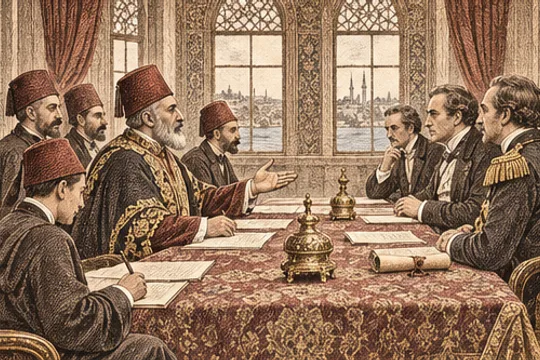
(Article 078, 28 April 2015)
Until the end of the eighteenth century, British foreign policy favoured Russian expansion at the expense of the Ottoman Empire. Britain was doing a great deal of trade with Russia in those years. With the French Revolution, however, the European balance of power to which Britain was so sensitive began to shift rapidly, and a clear Russian threat emerged. At the end of the Seven Years’ War (1756–63), Britain had taken control of France’s colony in India. The route to India, crucial to Britain’s economic future, ran through Egypt, the Mediterranean and the Strait of Gibraltar. It was known as “Britain’s imperial route.” During the Ottoman wars with Russia and Austria between 1787 and 1792, Britain became alarmed by the two powers’ desire to bring down the Ottoman Empire and, particularly, by Russia’s desire to establish itself on the Straits. Britain accordingly began to attach importance to the survival of the Ottoman Empire as a way to keep Russia from reaching the Mediterranean through the Straits. In 1790 Britain even formed an alliance with Prussia and the Netherlands to protect Ottoman territorial integrity. Its pro-Russian policy had thus changed fundamentally.
Immediately after the Congress of Vienna, Britain introduced a new foreign trade policy. British investors sought to expand their overseas trade in particular, chiefly because most European countries had begun to adopt protectionist trade policies. British merchants therefore took a special interest in the Middle East. From the 1820s to the 1840s, Britain signed numerous free-trade agreements around the world, from Latin America to China and the Ottoman Empire. Where possible it came to terms with local rulers. Where necessary it did not hesitate to use force. The opportunity Britain needed to secure the Treaty of Balta Limanı came from Mehmed Ali Pasha, the governor of Egypt, who was originally from Kavala.
Soon after succeeding Hüsrev Pasha as governor of Egypt in 1805, Mehmed Ali Pasha rose against the Ottoman Empire and weakened it for years. In 1811 he eliminated the Mamluks and established full control over Egypt. He extended his influence into Arabia and south of Egypt, modernised agriculture, established a comprehensive fiscal administration and built a modern army and fleet. He remained at odds with the Ottomans until the Convention of Kütahya was signed in 1833, after which he strove to make Egypt an independent state. The Ottoman government sought Britain’s political support to settle the Egyptian question, which had become a major threat, once and for all. Britain, in turn, sought to use it as leverage. In return for helping settle the problem posed by Mehmed Ali Pasha of Kavala, Britain demanded the Anglo-Ottoman Commercial Treaty of 16 August 1838.
The Treaty of Balta Limanı
Preparations for the Anglo-Ottoman Commercial Treaty of 16 August 1838 took about five years. The Ottoman and British delegations had begun discussions considerably earlier, with a view to revising the trade schedules agreed in 1820, which were due to expire on 1 March 1834. Their original purpose had not been to negotiate a commercial treaty. A number of developments subsequently changed the course of the talks, among them British merchants’ complaints about economic practices in Ottoman lands, Mehmed Ali Pasha’s hostility towards the Ottoman government and his application of the yedd-i vâhid monopoly system in Egypt.
The Ottoman government would periodically agree new schedules with the states to which it had granted privileges under the capitulations, on the basis of their existing agreements. The schedules listed, for each category of imports and exports, the sum payable under a customs duty of 3 percent of the goods’ value, calculated at the prevailing price for each item. The agreements called for the schedules to be revised or renewed every fourteen years. The last such schedule for British merchants had been drawn up in 1820 and was due to expire on 1 March 1834. In January 1834, the Ottoman ambassador in London, Mehmed Nuri Efendi, asked British Foreign Secretary Lord Palmerston to renew it. Palmerston and other British officials showed little interest. Prices of traded goods had risen since the 1820 schedule was drawn up, putting British merchants at an advantage. They were supposed to pay 3 percent of the value of their goods, but in practice were paying around 1 to 1.5 percent. The resulting strain on Ottoman finances led the government to look for new sources of revenue. Only in 1836 did a series of British merchants’ complaints about trade with the Ottoman Empire prompt Britain to act.
British merchants’ complaints centred on three points: the yedd-i vâhid monopoly, the system of internal customs permits (tezkire) and restrictions on trade. What European merchants in Ottoman lands objected to most was the yedd-i vâhid system, which they had been unable to remove despite the capitulations. In use from 1826, it took two forms.
In the first, a senior official was appointed as the sole purchaser of a given product or range of products in a particular region. Producers were obliged to sell to this buyer at the official price. The official then sold the goods to domestic users or foreign merchants at the monopoly price. The holder of a yedd-i vâhid became the sole purchaser of a given imported product. The monopoly prices and higher costs cut British merchants’ profit margins and reduced worldwide demand for British goods.
In the second arrangement, purchase permits (licences) were granted to a domestic merchant or another individual. A fee had to be paid to the government to obtain a permit. Since in each locality there was only one licence holder for a given product, this arrangement also created a monopoly. British merchants therefore wanted either to secure the status of the most privileged domestic merchant of the “most favoured nation” or to abolish the system altogether. Mehmed Ali Pasha’s application of the yedd-i vâhid system in Egypt left British merchants no chance of staying in business.
Mehmed Ali Pasha’s monopolies served military as well as economic and fiscal purposes. He applied the monopoly system so extensively that he effectively came to own Egypt. Using the resources he thus acquired far more rationally than the Ottomans did, he modernised Egypt. In Western circles it was said that he would not readily agree to abolish the monopolies. The Ottoman government accepted the abolition of yedd-i vâhid in the 1838 commercial treaty to break his power, for political reasons rather than economic ones.
Another grievance of British merchants concerned internal customs duties. Protracted wars had severely weakened Ottoman finances. In 1802 the government announced the withdrawal of all privileges held by foreign merchants. Foreign traders wishing to do business within the empire would therefore pay a 5 percent internal customs duty, just as domestic merchants did. The rate rose particularly under Mahmud II to meet the army’s growing needs. The duty helped domestic industry develop because it raised the price of goods subject to it.
Under its provisionist economic policy, the Ottoman government also banned the export of certain goods it considered important or imposed high duties on them when they were exported.
The talks that began in 1836 between Ottoman officials and the British continued for some time. The two delegations differed in their commercial and political experience and in how they approached the issue. Through the agreement the Ottoman government sought British support against Mehmed Ali Pasha, while Britain wanted greater freedom to operate in Ottoman lands. The first objective was political, the second economic, and Britain was more than capable of using trade and politics together. The agreement was finally signed on 16 August 1838. It consigned the Ottomans’ centuries-old provisionist economic policy to history and drew the empire into the trap of economic liberalism. From then on, nothing would be the same. And it was not.
The principal terms of the Treaty of Balta Limanı were as follows.
All rights and privileges guaranteed by the existing capitulations would remain in force indefinitely.
British merchants could sell agricultural and manufactured goods within the empire or buy them for export without exception.
The Ottoman government agreed to abolish all monopolies and end the tezkire system of permits.
All goods produced in Britain or its colonies could enter Ottoman territory on payment of a customs duty of 3 percent of their value. Goods sold within the empire would incur an additional 2 percent duty.
A British merchant buying any goods in Ottoman territory would pay 9 percent of their value in lieu of all internal customs duties. If the goods were exported, the merchant would pay a further 3 percent.
British merchants could trade on the same terms as the most privileged merchants in the Ottoman Empire.
The customs schedules, which expressed prices in kuruş, would be renewed every seven years instead of every fourteen.
Effects of the Treaty on the Ottoman Economy
The effects of the commercial treaty of 16 August 1838 on the Ottoman economy can be summarised as follows.
The treaty gave every British merchant the right to buy any goods grown or processed within the Ottoman Empire.
The yedd-i vâhid monopoly system was abolished altogether.
The permit requirement was abolished.
Under the tezkere system, which formed part of yedd-i vâhid, domestic and foreign merchants obtained a permit to buy and sell locally produced goods in return for a fee. This was one of the chief sources of revenue for the Ottoman treasury. Under the treaty, goods could be transported without a permit. Anyone demanding one would be punished, and the Ottoman government would compensate British merchants for losses they had already suffered under the system.
The treaty also gave British merchants “most favoured merchant” status and the same rights as Ottoman merchants. Previously, a British merchant, like any other European merchant, paid a 3 percent customs duty when loading goods bought in Ottoman lands onto a ship at the port. The Treaty of Balta Limanı retained that rate but revised how the duties were charged. A British merchant who bought goods at their place of production and brought them to port would pay a 9 percent âmediyye duty. If the merchant took goods on which that duty had been paid to another port without exporting them, only the 3 percent reftiyye duty would be levied. Under the previous system, the âmediyye would have been charged again. If the merchant bought the goods at the port, only the 3 percent duty would apply.
Ships passing through the Dardanelles and the Bosphorus still needed a permit known as the izn-i sefîne, but arrangements were made to issue permits more quickly. Cargo could be transferred from one ship to another in Ottoman ports, transit trade was free, and neither activity incurred a tax. Previously, all British goods imported by a British merchant had been subject to a 3 percent customs duty on their value as well as an internal customs duty. Under the treaty, after payment of the 3 percent external duty, an internal duty of 2 percent was payable to sell the goods either where they arrived or wherever they were subsequently taken. Once that duty was paid, no further tax would be levied if the goods changed hands or were sent to another country. Before the treaty, a foreign merchant had no right to bring in and sell goods that did not carry a British patent. The treaty removed this restriction and placed such goods under the import terms just described.
After the treaty was made public, the Ottoman Empire concluded agreements with numerous European states modelled on the Anglo-Ottoman Commercial Treaty. Similar treaties were signed with France on 25 November 1838; the Hanseatic cities of Lübeck, Bremen and Hamburg and with Sardinia in 1839; Sweden, Norway, Spain, the Netherlands, Belgium and the Zollverein governments in 1840; Denmark in 1841; Portugal in 1843; and finally Russia in 1846. The Zollverein parties included Prussia, Bavaria, Saxony, Württemberg, Baden, the Electorate and Grand Duchy of Hesse, Thuringia, the Nassau association and the Free City of Frankfurt. These agreements amounted to a fundamental change in the economic policy the Ottomans had followed for centuries. As the government moved away from provisionism, the decline in treasury revenues accelerated, raw materials were exported at very low prices, fledgling industry collapsed altogether, and internal and external trade passed into foreign hands.
An Ottoman chronicler who witnessed these developments summed them up as follows: “This agreement abolished the yedd-i vâhid system, only to replace it with a foreign monopoly. Foreigners took part in trade throughout the Ottoman Empire, down to the smallest transaction. Domestic industry collapsed entirely. Foreign goods found favour, and the money we had began to drain away to Europe… It is as if they said: Let Egypt suffer, and never mind if it hurts us too!”
Britain’s Lord Palmerston regarded the agreement as a masterpiece. Austria had substantial trade with the Ottoman Empire and was unwilling to adopt the agreement signed with Britain wholesale. It had privileges of its own, particularly in trade with the Danubian Principalities. Nevertheless, the most-favoured-nation clause allowed Austria to enjoy the new advantages secured by the British treaty on the same terms.
Mehmed Ali Pasha, the governor of Egypt, initially declared that he would not recognise the treaty. He soon dropped his objections and accepted it, bringing France’s opposition to an end.
The series of treaties signed in 1838 and afterward opened Ottoman markets and raw materials to foreign trade in the interests of European commercial and industrial capital. The Treaty of Balta Limanı sharply reduced the Ottoman government’s right and ability to regulate domestic affairs, set rules or take fiscal and economic measures for its own people. It also hastened the state’s economic decline. One of its chief results was the lasting removal of a substantial share of government controls over Ottoman foreign trade. European merchants thus gained access to both the Ottoman market and Ottoman raw materials. By abolishing state monopolies in foreign trade, known as yedd-i vâhid, the treaty caused agriculture and industry to decline and left merchants and artisans weakened and exposed.
From 1839, Western entrepreneurs gained a foothold in commerce and trades in Ottoman lands and moved into industry, where they competed with Ottoman subjects. They set up factories and workshops. Taking advantage of the freedoms offered by the free-trade regime, they pushed competition to the point where Ottoman artisans and shopkeepers could no longer even meet some of their obligations to the state. The complete dominance of foreign merchants over the empire’s internal and external trade made commercial relations so complicated that the government had to establish mixed commercial courts in 1846 to resolve disputes.
Another adverse effect of the treaty was that it set the Ottoman state on the path to foreign borrowing. It consolidated the state’s dependence on other countries and opened the Ottoman Empire to foreign investment. It was no coincidence that the first railway investments and the first major borrowing fell at the same time.
The treaty also began the process by which the Ottoman Empire lost its Balkan provinces. Although the process began in earnest with the 1861 series of Kanlıca commercial treaties, the commercial treaty concluded between Austria and the Ottoman Empire in 1839 sowed the first seeds. Another important result was that British merchants won the right to engage in retail trade in Ottoman territory. This undermined the Ottoman artisan and guild system, and the first signs of British protection over Egypt began to appear.
The Ottoman Empire lost its right to pursue an independent foreign trade policy and became integrated into the European economies. After Balta Limanı, European powers waited for the Ottoman government to slip into another crisis so they could have duties cut that they considered excessive. The fiscal crisis of 1860–61 and political turmoil in Lebanon forced the Ottoman Empire to conclude a fresh series of agreements with Western powers, the Kanlıca commercial treaties. The economic vulnerability that began in 1838 became more entrenched with the new round of treaties starting in 1861.
The Kanlıca Commercial Treaties
In the last months of Sultan Abdülmecid’s reign, the Ottoman state was in the grip of a major fiscal and economic crisis. Senior Ottoman statesmen considered seeking help from Western powers to prevent the crisis from turning into a political problem. Further foreign borrowing had become unavoidable. But Western powers always expected something in return for helping the Ottoman Empire. The European support given during the crisis with Mehmed Ali Pasha and the Crimean War had come at the price of significant concessions. Trade relations with European powers had thus become a means of extracting political concessions, well beyond mere technical cooperation. In the Balkan provinces, Slavs were organising against the government at Russia’s instigation. As fighting broke out again between Druze and Maronites in Lebanon and Christian subjects pressed their demands, the Ottoman government began concluding new trade agreements with European states in 1861 to head off Western demands on these questions. The agreements concluded in 1861–62 are generally known as the Kanlıca commercial treaties.
The first Kanlıca treaty was signed with France on 29 April 1861. Others followed with Italy on 10 July 1861, Britain on 1 October 1861, Belgium on 10 July 1861, Russia on 3 March 1862, the United States on 13 February 1862, Sweden on 5 March 1862, Spain and Denmark on 13 March 1862, Prussia on 20 March 1862, the Netherlands on 25 March 1862 and Austria in 1862.
The Ottoman–French commercial treaty of 29 April 1861 consisted of seventeen articles, and its provisions formed the basis for the commercial treaties with other states. Its main terms were as follows.
Full freedom of domestic trade. French merchants could buy and sell every kind of agricultural produce and manufactured article throughout the Ottoman Empire on payment of the duties paid by the most privileged Ottoman merchants. Retail trade in gunpowder, cannon and munitions was prohibited. Salt and tobacco could be freely exported, but could not be imported.
Full freedom of foreign trade. The goods mentioned above could be taken freely out of the empire. They would incur an export duty of 8 percent, which would fall by one percentage point a year until it reached 1 percent at the end of seven years, where it would remain fixed.
All merchandise imported into the Ottoman Empire on French ships would incur an 8 percent customs duty. Goods passing through the empire would be subject to a 2 percent transit duty, to be reduced to 1 percent after eight years.
No customs duty would be charged on merchandise carried through the Straits on French merchant ships.
The Kanlıca commercial treaties retained the privileges granted to foreigners by the Balta Limanı agreements signed with various states between 1838 and 1841, while preserving the restrictions on trade in certain goods imposed by the Ottoman–Russian commercial treaty of 1846. Under that treaty Russian merchants were prohibited from engaging in retail trade, including in arms, military supplies, alcoholic drinks and snuff. Trade in alum, leeches, salt and tobacco was subject to conditions. Grain could be exported only in years of abundant harvests, to prevent shortages. These conditions remained in force under the Kanlıca treaties.
The system of protection that brought profound changes to Ottoman trade and customs policy began with this treaty. Once the 1861–62 agreements abolished the exclusive right to practise a trade, European artisans and shopkeepers in Ottoman lands were free to enter any trade they wished, subject to Ottoman regulations. The treaty placed Ottoman merchants, artisans and shopkeepers, who lacked organisation, protection and resources, in an extremely difficult position. The guild system that had formed the backbone of the economy and employment began to collapse.
Effects of the Balta Limanı and Kanlıca Commercial Treaties on Ottoman Trade and Industry
As conditions around the world changed and European powers grew stronger, the capitulations that Ottoman sultans had granted to foreign merchants since the mid-sixteenth century became a serious threat to the empire’s integrity. The Industrial Revolution, which began in Europe in the late eighteenth century, soon harmed countries elsewhere in the world and naturally affected the Ottoman Empire as well. Its effects became most tangible in the Anglo-Ottoman Commercial Treaty of 1838, the Treaty of Balta Limanı. Ottoman weaknesses and Britain’s new economic policy paved the way for the agreement. The Kanlıca treaty, a further development of the same approach, disrupted the traditional Ottoman economic, social and cultural order and made the empire more dependent on foreign economies.
The process led in 1854 to persistent Ottoman budget deficits and forced the state to borrow abroad for the first time. The author dates Balta Limanı to 1839 in this passage and describes the interval as just sixteen years. In 1874, only twenty years after that first loan was signed, the Ottoman state could no longer pay its debts and had to declare a moratorium.
Provisionism had enabled the Ottoman economy to stand on its own from 1299 to 1838. The 1838 Treaty of Balta Limanı made it vulnerable, and the 1861 Kanlıca treaty struck a blow at its artisans and guilds by opening the traditional domestic market to foreigners. In 1874 it could no longer service its debts. In consequence, the Ottoman state was obliged in 1881 to approve the establishment of the Ottoman Public Debt Administration, which the author likens to today’s IMF.
Translated from the Turkish original. Türkçe