
Bring your prayer mat to Hagia Sophia on Friday, May 29…
15 April 2015 · Personal website
(Article 075 – 15 April 2015)
Hürriyet columnist Ertuğrul Özkök wrote an article objecting to a Qur’an recitation in Hagia Sophia. He said, “For God’s sake, is this befitting a modern Muslim in the twenty-first century? Your country has 80,000 mosques, where you can worship five times a day. Yet you have set your sights on one of the holiest places in the Orthodox world. Easter, the holiest day for Orthodox Christians, coincides this year with the week celebrating the Prophet’s birth. Instead of turning that coincidence into a gesture of mutual respect and tolerance, what do you do? With a disheartening display of Oriental cunning, you put on an exhibition at Hagia Sophia the day before Easter. And you have the Qur’an recited there for the first time in 85 years. You think you are sending someone a message.”
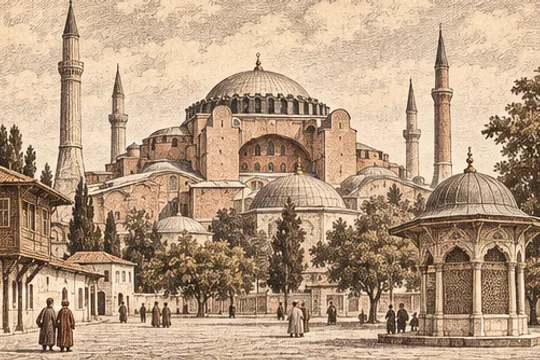
The Hagia Sophia Mosque gave the Turks standing and prestige in the Muslim world and symbolised their supremacy over the West. Built as an imperial church in this extraordinary capital of the Eastern Roman Empire, the building, a counterpart to St Peter’s in the Vatican, filled the dreams of those who sought to conquer the city for centuries. When the Prophet Muhammad said, “Constantinople shall surely be conquered. What a fine commander its conqueror will be, and what fine soldiers those who conquer it!”, the object of his words was, in fact, Hagia Sophia itself. Constantinople is a city of magnificent beauty where Europe and Asia meet. Yet there is one building that makes it what it is, and if you take that away, nothing of Istanbul is left. For centuries, in all its beauty and splendour, Hagia Sophia was where millions of Orthodox Christians bowed before God. For Muhammad and those who made it their purpose to spread Islam across the known world, Hagia Sophia was something like the “Red Apple,” a prize to be won. Once it fell, Christianity’s greatest stronghold in the East would be brought down and Islam would have a chance to spread into the heart of Europe. Isn’t that precisely what happened when Sultan Mehmed the Conqueror took Constantinople?
Hagia Sophia also mattered enormously to the Catholic world. If Catholics took the city and Hagia Sophia, the centre of a Christian denomination they considered “heretical,” the Vatican Church would become the greatest centre of faith in the world. The knights of the Vatican Church, which now presumes to judge Türkiye over the Armenian genocide, knew no bounds in their brutality and inflicted more damage on the city than anyone else during the Fourth Crusade of 1202–1204. Pope Innocent III had called on all Europe to take up arms to liberate Jerusalem, and command of the assembled army was given to the Italian Boniface. The Latin armies turned towards Istanbul instead of Jerusalem and occupied Constantinople. The city suffered the greatest devastation in its history. The Crusaders began by looting homes. The historian Geoffrey of Villehardouin, named among the early French lyric writers and a witness to the sack, wrote, “The soldiers forgot what the cross sewn onto their clothes meant and took to slaughter and arson. Homes were set alight, palaces and official buildings were stripped bare. Men were killed and women raped. Even the least valuable things were looted, down to the peasants’ shirts.”
Once the buildings had been stripped bare, it was the turn of Hagia Sophia, the greatest place of worship of its age. It was looted and made the scene of a complete disgrace. Soldiers entered the church with mules and a French prostitute. The pillaging took only a few minutes. They loaded onto the mules the wall coverings, objects believed to have belonged to the apostles of Jesus and to Mary, one of the holy nails said to have been used in the Crucifixion, the crown of thorns placed on Jesus’s head, gold and silver crosses and anything else made of precious metal. Priests who had hidden around the church were disembowelled, and nuns were raped. Catholic soldiers who came too late for the spoils began chipping pieces from Hagia Sophia’s columns, which were said to have healing powers for kidney and chest pains. The mules that collapsed under their loads were cut to pieces with swords. Once everything in the church had been carried off, the entertainment began. The French prostitute the soldiers had brought climbed into the pulpit where, only days earlier, the Orthodox patriarch had preached. She began singing bawdy songs and dancing obscenely while the soldiers drank barrels of wine. The Eastern Romans never forgot the catastrophe of 1204. It was because of this barbarity that, faced with the Turkish advance in later centuries, they said, “We would rather see a Muslim turban in Hagia Sophia than a cardinal’s hat,” instead of appealing to the Catholic world for help. The Latin Empire ruled Istanbul from 1204 to 1261, when Michael VIII Palaiologos took Constantinople back, ended Latin rule and restored the Eastern Roman Empire.
We know what came next. Mehmed the Conqueror took the city in 1453. After converting Hagia Sophia into a mosque, he personally declared that the lives, property and freedom of worship of Istanbul’s Orthodox inhabitants were under his protection. Orthodox Christians lived in peace and prosperity for centuries after the conquest.
Now consider the Tenth Crusade, which does not appear on the usual list but ended in a great Christian victory. It was waged against the Ottoman Empire from 1914 to 1918, precisely 643 years after the last Crusade. Britain, France, Italy, Russia, Greece and several other states took part. The aim was to sweep Muslim Turks completely out of Europe. And they succeeded. The Turks were driven out of all European territory except Thrace. Jerusalem fell to the British. Richard the Lionheart’s dream came true six and a half centuries later. The Turks lost all their lands in the Middle East and were confined to a tiny territory.
The West’s second objective is to clear Jerusalem of Muslim Arabs altogether. For the time being, Israel acts as its legionary. Israel’s role in the region is to deny Muslims peace and quiet and keep creating problems. When Middle Eastern oil runs out and priorities change, Israel will cease to matter. On that day the licence Western countries have recklessly given Israel to “kill as many as you can” will end, Israel will be isolated, and the Holy Kingdom of Jerusalem will be re-established.
The Vatican has stood behind every Crusade from the first in 1094 to the present day. Time is no concern to the Vatican. It waited patiently for 781 years to drive Muslims out of al-Andalus and has been waiting a thousand years to capture Jerusalem. The pope is Jesus’s shadow on earth and his plenipotentiary, his caliph, in other words. That office, then, is the planner of all these long-term projects. Think of the Islamic Caliphate, whose legal personality our republican intellectuals abolished in one fell swoop with Law No. 243 on 3 March 1924. Its Christian equivalent is the papacy.
Secularism, defined as keeping religious and state affairs apart, also originated at the Vatican. The republican leadership could not imagine what the Caliphate might bring Türkiye in the future, but the Western world, led by Britain, foresaw that the Islamic Caliphate would give Türkiye an important role.
In 1924, İsmet İnönü, Şükrü Bey and Mahmut Esat Bozkurt met at Ankara railway station to work on the constitution and went further still. They went so far as to say, “Let’s put Christianity into the constitution as the state religion so that Westerners won’t be hostile to us.” And were they the only ones? A certain Abdullah Cevdet claimed that “civilisation came to our doorstep during the Gallipoli campaign, but the Turks resisted it.” This man, who founded the Society of the Friends of England and was dubbed “Adüvvullah Cevdet,” meaning “Cevdet, enemy of God,” even said, “To improve and strengthen the Turkish race, we must bring in men for breeding from Europe and America.” Now what is the difference between what Ertuğrul Özkök says and what İsmet İnönü, Şükrü Bey, Mahmut Esat Bozkurt and Abdullah Cevdet, enemy of God, said? The mentality was the same ninety years ago as it is today.
Without the Caliphate, there is now no institution to mediate between Muslim countries or communities, voice a position, reconcile them or stand firm when necessary. The whole Arab world looks like a fire zone. Iraq, Syria, Egypt, Saudi Arabia, Yemen, Libya, Sudan and the others are busy tearing one another apart. There are no two Muslim countries bound by close friendship. All have disputes with one another, all are enemies. These are precisely the times that call for a Turkish Islamic Caliphate. The office has immense power to end hostilities, secure regional peace, lead Muslims around the world, restore Islam’s standing and open and sustain dialogue between civilisations. The Muslim caliph who takes office at Hagia Sophia, donning the robes and sword of the Caliphate, would have extraordinary authority among Muslims. Sectarian feuds and regional strife would then come to an end. The person stepping in to resolve disputes would be the shadow of our Prophet on earth. No one would make a move against such authority or act on their own. One of the fundamental conditions for Türkiye to be strong in its region is to re-establish the Caliphate. Otherwise, the region will simmer for years, millions will keep dying, people will lose their homes and homelands, and the region will go backwards step by step.
Although Türkiye signed the Treaty of Lausanne on 24 July 1923, Britain waited a year to sign. The reason was that the Grand National Assembly had yet to abolish the Caliphate. Britain signed only on 16 July 1924, four months after the assembly abolished the office on 3 March. Thus the Caliphate, which had been in Turkish hands for precisely 407 years, was dismantled by a republican leadership without vision or foresight, and Turkish influence was cut off from the Muslim world and the Middle East. The office has since remained vacant and unclaimed. Yet in Moro and Aceh, Friday sermons are still delivered in the name of the Ottoman caliph.
In an article in issue 29 of Büyük Doğu, the late Necip Fazıl Kısakürek wrote that “during the Lausanne negotiations the Western and Turkish delegations held talks and reached agreements kept secret from the public. They agreed that Türkiye’s Islamic identity would be erased, its people turned away from Islam and its government given a secular form outside Islamic rules. In return for these concessions, the European powers recognised Türkiye’s independence.”
The Turkish Empire, founded at Söğüt in 1299, spread rapidly across three continents and disintegrated in very little time. Until 1908 it covered millions of square kilometres. After Abdülhamid II was deposed in a coup in 1908 and the Unionists took power, the great state was brought to ruin in just six years. The Unionists took the Ottoman state into the First World War in 1914 and four years later had confined us to the territory in which we live today. The founders and rulers of today’s Republic came out of the Committee of Union and Progress. What happened next? First, Lausanne was signed in 1923 and the Ottoman lands were given away like a squandered inheritance. In 1924 the Caliphate was abolished, striking a blow at Islam’s most important institution. In 1935 a fraudulent decree turned the Hagia Sophia Mosque into a museum. Signs of Turkish identity began to be erased from Istanbul one by one, and just about everything was taken back to how it had been before 1453. In the single-party era, newspaper advertisements were used to sell many of the city’s mosques and prayer rooms. Buildings were pulled down and replaced. Some became taverns, some entertainment halls, and some even stables. How can we explain what happened to Islam’s sacred buildings in the capital of the Ottoman sultans who styled themselves guardians of Mecca and Medina? Who brought about this disgrace? The traitors within our ranks and the devotees of the West. We have a dark past in which opening clubs, bars and casinos, and appearing in them, was seen as a mark of being modern.
The best answer to the Vatican, which is trying to corner Türkiye with a contrived claim of Armenian genocide, is to correct an eighty-year-old mistake. A crucial election lies ahead, and shortly before it comes 29 May, the 562nd anniversary of the conquest of Constantinople. People have talked for decades about turning Hagia Sophia back into a mosque, only for it to be put off for domestic and international political reasons. We may not find a better opportunity in the next fifty years. Whether politicians want it or not, the Turkish people must make this dream come true by taking the matter into their own hands. Let us launch a campaign for Friday, 29 May, “GRAB YOUR PRAYER RUG AND COME TO HAGIA SOPHIA,” and settle the matter.
The Vatican is Christianity’s equivalent of the Caliphate, and no one today questions its existence. Yet abolishing the Islamic Caliphate removed Islam’s most important institution and left it without a head or oversight. Abolition directly serves the interests of the Vatican and many Western countries. Considering its possible influence in India and its other Muslim colonies, Britain made the abolition of the Ottoman Islamic Caliphate a matter of state policy. Today it is plain what an impasse this has created across the Muslim world, especially in the Middle East.
How do those who accuse Iran of “exporting Islamic revolution” explain the Vatican’s missionary work to spread Christianity? Do you know what would happen if anyone sought to end the Vatican’s spiritual standing today? Even Protestant Britain would be among the first to object. It knows full well that if the Catholic Church collapsed, hundreds of new denominations would spring up like mushrooms, creating new balances of power in Europe and the world over the medium and long term. It acts accordingly. The republican leadership had no understanding at all of the importance of the Caliphate or the difficulties its absence would create in later years.
Abolition left the Muslim world without a head. The Arab states founded in the Middle East with the backing of Britain and Mustafa Kemal were cut off from one another. This lack of leadership deepened sectarian divisions and made enemies of different religious groups.
The Caliphate is the foremost institution of the Muslim world. It would strengthen the New Republic of Türkiye and raise its standing throughout the world. The new Turkish Muslim caliph would be as symbolic as the British queen in Britain or the pope in the Vatican. Yet we should never underestimate the political and regional power the office would give Türkiye. Through the Caliphate, Türkiye would become the symbolic leader of the entire Muslim world, which thirsts for rights and justice. Türkiye’s influence and strength would increase at the United Nations and other international institutions. Bodies with no real standing globally, such as the Islamic Development Organisation or the Islamic Cooperation Conference, would be reshaped under Türkiye’s leadership.
Can you imagine a New Türkiye that holds the Caliphate and brings Mosul, Kirkuk, Damascus and Aleppo back under its sway?
Do you know what would happen if the Hagia Sophia Mosque opened for worship on Friday, 29 May 2015, the 562nd anniversary of the conquest of Istanbul?
That day the sky would weep. Our Prophet and 116 Muslim caliphs would stand in the first row. Sultan Mehmed the Conqueror, who gave this sacred city to Islam and the Turks, and all the other Ottoman sultans would prostrate themselves a thousand times, in tears and ecstasy.
That day the earth would shake. Every last soldier who fell for Islam in Aleppo, Egypt, Damascus, Jerusalem, Diyarbakır, Crimea, Tbilisi, Sarajevo, Athens, al-Andalus and every other land where Islam set foot would stand in prayer at Hagia Sophia in a spotless white shroud.
That day Muslims around the world would give thanks to God. From Sultanahmet to Topkapı, there would be no room in Istanbul’s streets for one more prayer rug.
That day the abject provisions of Lausanne that wounded Turkish honour would be swept away one by one, and a fully independent “New Turkish Empire” would be founded.
Come on, people of Türkiye!
On Friday, 29 May 2015, “GRAB YOUR PRAYER RUG AND COME TO HAGIA SOPHIA.”
Translated from the Turkish original. Türkçe