
Three thousand years of civilisation, economics and politics…
1 November 2014 · Tarafsız Haber
What are the Renaissance, the Age of Renewal and the Reformation?
What do these terms mean to you?
In European political history, the Renaissance, or the age of “renewal” or “reform”, marks the stage at which Western society began to leave behind the barbarity, ignorance and disregard for science of its past.
In the Middle Ages millions died of diseases such as plague, dysentery, smallpox and syphilis. People were burned alive for their beliefs. Under the feudal order, peasants were treated as captives and scarcely even counted as human beings. A king could not make his own feudal lords obey him.
At that time, barely two thousand kilometres from Europe, there was another world.
There were states with strong, thriving economies, far ahead of Europe in physics, chemistry, biology, mathematics, astronomy, law, philosophy and other fields of learning. England, Holland and France, which European historians call centralised states and which all date from the seventeenth century, had yet to become states at all. In the East, meanwhile, states two or three thousand years old stood firm, with virtually all their institutions in place. European chroniclers who dismiss the Chinese, Iranians, Arabs, Hittites, Assyrians and Turks as barbarians fail even to recognise theirs as the earliest and longest-lived centralised states in history.
Europeans devised their own definitions of state and civilisation without understanding how those states, with histories stretching back two or three millennia, held dozens or hundreds of peoples together. How did they establish their authority over millions of square kilometres from one end of Asia to the other? How did they survive for thousands of years, organise law, religion, public finance and investment, and select and train their rulers and officials? These are the things that make a state.
As everyone knows, the history of the modern world does not reach very far back. Almost everything that made Europe what it is happened in the last three hundred years. Nearly all the mercantilist colonial powers, among them Holland, Spain, Portugal and Belgium, followed much the same course. England and France joined the colonial enterprise later, and Italy and Germany last of all. If the world economy has undergone a profound transformation in those three centuries, the chief reason is advances in shipping. With their fleets, all these countries crossed oceans, reached distant continents and established trading posts and colonies. The supremacy of powers such as Spain, Portugal and Holland, which used their colonies solely for exploitation and plunder, did not last. One by one their colonies fell to the English and the French. England and France occupy a special place in this story. They took cheap raw materials from their colonies, manufactured finished goods at home and sold them back to the colonies and to other countries around the world. It was the Industrial Revolution itself that made this possible.
The Industrial Revolution began in England and then took hold in France. By developing new production techniques, these countries pioneered the use of machinery in industry and for a long time were the undisputed leaders of the world economy.
What was happening in the East in the meantime?
How were the Ottomans faring, for instance?
Did they lag so far behind in seafaring, the very thing that had enabled European countries to acquire colonies and strengthen their position?
Certainly not. With their naval strength the Ottomans had quickly gained control in North Africa and the Red Sea, taken the Aegean islands, Egypt and Rhodes, and incorporated these lands into their dominions. In European parlance they had become a colonial power. The fleet that conquered those lands could also engage major European powers at sea and inflict crushing defeats on them. The Ottomans were highly accomplished seafarers. Their real limitation was that their fleet had been designed for relatively calm waters such as the Mediterranean and the Red Sea. That is why even a captain of Piri Reis’s stature failed against the Portuguese in the Indian Ocean and lost his head for it. Had the Ottomans begun building oceangoing ships in time, their economic and political position might have been very different indeed.
Mercantilist doctrine made itself felt differently in almost every country, and its application varied from society to society.
Those who call the privileges Suleiman the Magnificent granted the king of France “capitulations” miss a subtle distinction between the Ottoman economic order and conception of government on the one hand and the European economic order on the other. The initiative came from the mercantilist businessmen who stood behind the French king and urged him to petition the sultan. To make money, those French merchants simply had to sell goods: mercantilist doctrine demanded it. The Ottomans knew nothing of mercantilism. In 1488 the Cape of Good Hope was discovered, and the Mediterranean basin lost its former importance. So did the Silk Road, the economic lifeblood of Eastern societies across a vast area stretching from China to India, Afghanistan to Iran and Turkey to Venice. The world’s greatest economic upheaval was neither the Great Depression of 1929 nor the oil crisis of 1979. The discovery of the Cape was one of the pivotal events in history. It left Eastern societies to their fate and suddenly deserted once-busy trade routes: as the saying goes, neither bird nor caravan passed that way. Cities from China to Venice and Genoa lost their commercial importance, millions lost their livelihoods, cities emptied and states fell. To borrow a fashionable expression, the first worldwide or, more strikingly, the first “global” crisis was the Cape of Good Hope crisis of 1488.
The seafaring peoples who traded on the calm waters of the Mediterranean never regained their former standing after the discovery of the Cape. Few found the courage to venture out onto the oceans. The Dutch, Spanish and Portuguese, with merchant ships fit for the open sea and little else to do, began arriving one by one on the Indian coast. They took the place of Arab merchants who for thousands of years had carried goods from those lands to the far corners of the world. The Ottomans had then been in Istanbul for just thirty-five years. Mehmed the Conqueror had granted the Venetians and Genoese their first privileges, and Bayezid II had extended them. Suleiman granted trading privileges to the French in 1535. In 1540 the privileges earlier sultans had granted the Venetians came to an end. Similar privileges went to the English in 1579 and to the Dutch in 1612.
Let us look again, from a different angle, at the trading privileges the Ottoman sultans granted foreign countries.
The year is 1488. The route around the Cape is discovered, and merchant ships that once carried goods through the Mediterranean begin sailing straight to the Indian Ocean. Trade along the Silk Road stagnates, then declines, slowly at first and soon much faster. Every caravanserai, village, town, province and even country along the route feels the crisis. Countries and peoples that once drew substantial tax revenues from the caravan trade begin to run balance-of-payments deficits. The Ottoman economy feels the effects directly. The state needs to act quickly to raise revenue. Under Mehmed the Conqueror it had been natural to support and encourage the Venetians with privileges: they carried the goods of the East to Western markets and paid substantial sums to the treasury in import duties. Yet their privileges were abolished in 1540. When Mediterranean trade dried up, the Venetians lost their former importance. Dealings with bankrupt merchants had to end somehow. The Ottomans needed money, but no state in the region had money left. They knew who did have it: the rising European powers trading directly across the open seas. Hence the trading privileges granted to the French in 1535, the English in 1579 and the Dutch in 1612. The Ottomans themselves had little cash with which to buy goods. Theirs was an economy based on payments in kind. Its guiding principle was provisionism: put the welfare of the people first, following the maxim “Keep the people alive so that the state may live.” To prevent domestic shortages, no goods or raw materials could be exported until the needs of the very last buyer at home had been met. Imports were confined to necessities, for the same reason. The aim was to ensure an adequate supply of both domestic and foreign goods. When foreign merchants brought goods into Ottoman ports, duties were levied at once and collected in gold and silver coin. A substantial share of those goods then travelled eastward in a reversal of the old trade. To soften the effects of the Cape crisis the Ottomans adopted a new economic policy, using import duties collected in their ports to close the trade deficit.
Seen in this light, were the privileges the sultans granted foreign countries really capitulations, or were they a way of earning foreign currency?
Europe’s mercantilist states saw foreign trade as a means of increasing national wealth and reducing unemployment. They therefore sought to boost exports and restrict imports, and required foreign trade to be carried in their own fleets. The Ottoman state, for its part, had from early on encouraged trade by granting privileges to European ships and merchants. In the fourteenth and fifteenth centuries these went to the Venetians, who controlled trade in the eastern Mediterranean, and to citizens of rival city-states such as Ragusa (Dubrovnik), Genoa and Florence. Customs revenue from transit trade was particularly important to the central government. The Ottomans also used trade privileges to cultivate political friendships with powerful European states. That was one reason for granting them to France and England in the sixteenth century and later to Holland, Austria, Prussia and others.
Under the capitulations, European merchants living in Ottoman ports, known as müstemin, could travel and trade throughout the empire, move goods from one region to another and use ships flying their own country’s flag. As the privileges expanded in the seventeenth and eighteenth centuries, merchants acquired new rights that conflicted with Ottoman sovereignty, including the right to establish their own courts on Ottoman soil and bring commercial disputes before them.
What economic policy did the Ottomans pursue, then, and how were they able for centuries to hold their own against all the powers of the mercantilist world?
The roughly four centuries from the founding of the Ottoman state to the end of the seventeenth century were a period of expansion. Apart from a few minor or temporary setbacks, the state suffered no major defeat. Having gained a foothold in Europe in 1354, it advanced steadily there for more than three hundred years. The timing of the Turks’ arrival deserves closer attention. Between 1347 and 1357 a great plague swept across Europe. Originating in southwestern Asia and reaching Europe in the late 1340s, it reduced the population of some European regions by 30 to 60 per cent. During the roughly hundred-year period in which mortality was so high and Europe preoccupied with its own troubles, Ottoman frontier raiders were able to push rapidly into its interior with little resistance. The Ottoman state, having made considerable headway towards world dominion, showed an extraordinary resilience and survived until the First World War.
Mercantilism made money the measure of everything. Eastern societies that only yesterday had sold goods to Europeans suddenly became consumers buying goods from them. The Ottoman state was centralised in every respect. Yet the kind of centralisation that had united Europe and fostered its development eventually became a source of difficulty for the Ottomans. The trouble lay in their failure to accumulate capital on a capitalist basis, rather than in the power or authority of the state. Until the Tanzimat Edict of 1839, Ottoman subjects could scarcely accumulate money or capital at all. There was no right to property: all land and wealth belonged to the state. After a lifetime of steady work, an Ottoman of modest means had little more than a paltry sum known as “shroud money”, set aside for burial. Under the timar system, farmers and villagers had for centuries paid taxes in kind. What remained barely sufficed for seed and food. And what of the wealthy? Rich Ottoman subjects, most of them non-Muslim, engaged in import and export, while those with more money became money changers and bankers. None was secure. A complaint, or simply attracting unwelcome attention, could bring state confiscation of everything they owned.
Among Turks, only senior military officers and civil officials came to know wealth. For them, too, confiscation was the greatest danger. When an Ottoman official was dismissed, fell from favour or died, all his possessions could be seized outright. A fortune built up over years of work could vanish in an instant. Without secure property and inheritance rights, a class of capital owners could not emerge. What point was there in working if everything ultimately went to the state? For the same reason the Ottoman economy failed to develop medium-sized and large industrial establishments. Where visible wealth drew unwelcome attention, it was wiser to live quietly from day to day and possess little.
How did the Ottoman state tax crops and livestock across its vast territories? Most land in the empire belonged to the state. Yet throughout its extensive holdings on three continents, other forms of ownership and their corresponding relations of production existed alongside the timar system.
In Rumelia, on land newly conquered from Christians, and in Muslim territories where private ownership had yet to take root, the state could readily assert its overriding rights and establish the timar system. Such land belonged directly to the state. On the former lands of the Seljuks of Anatolia, however, private ownership had emerged in the age of the Anatolian principalities. Islamic law obliged the Ottoman administration to recognise it. The contest between the central government and local interests resulted in recognition of two distinct rights over the same land. The private owner’s entitlement was called malikâne, the state’s divani and land held under this dual arrangement malikâne-divani.
Private landownership was most common in provinces where the central government had never fully imposed its administrative system. In some districts of eastern Anatolia with large Kurdish tribal populations, in the provinces of Baghdad and Basra, in Egypt and on islands conquered later, such as Rhodes, Cyprus and Crete, the state largely left existing arrangements intact. It collected annual taxes assessed province by province, while private owners continued to take the surplus produced on their land. To encourage cultivation on vacant land known as mevat, the government followed a similar policy. Those who brought it into production, or “brought it to life” as people then said, received a deed called a temlikname under Islamic law, recognising their private ownership. They owed the state no ground rent.
Private owners in Ottoman society always faced the danger of state intervention and confiscation. Those wishing to safeguard their property therefore looked for alternatives. They found a solution in Islamic law: by dedicating their assets to foundations they themselves established, they could pass them on to future generations.
At the opposite end of the spectrum were the miri has estates, owned and operated directly by the state. They were established on land retained by the central government after timars had been allocated in conquered territories. Their revenue went straight to the central treasury. They therefore differed both from the timars administered by sipahi cavalrymen and from the has and zeamet holdings within the timar system whose revenues went to senior officials. The miri has estates were managed by officials known as emins, appointed and paid by the central government.
In the second half of the fourteenth century and the first half of the fifteenth, both the Eastern Roman Empire and the small Balkan principalities were weak. Political fragmentation and diseases such as the plague mentioned earlier made Ottoman expansion easier. In its early stages, minor Balkan lords often called on the Ottomans for help in their quarrels with one another. Later, the armies these lords could muster were little match for either the sipahi cavalry or the Janissaries, Europe’s first standing army. Initially the Ottomans left existing forms of ownership and production untouched in conquered territories, merely requiring local lords to pay an annual tribute. Over time, however, state ownership gained ground there too. Conquered lands were divided into units called timars and assigned to sipahis in return for military service.
The sixteenth century was the Ottoman Empire’s heyday. Its frontiers continued to expand as it became one of the largest and most powerful states in the entire Old World. By the third quarter of the century its territories reached the Crimean Khanate in the north, Hungary and Serbia in the west, and the North African coast, Egypt and the Nile Valley in the south. Its neighbours now included Russia to the north, the Habsburg Empire to the west and the Safavid state to the east. These frontiers, and the powerful neighbours beyond them, signalled that the age of easy, rapid expansion was coming to an end.
In settled agricultural societies, East and West alike, ruling groups faced the same question: how to tax farming and livestock, the chief sources of production at the time. Collecting the agricultural surplus in kind, transporting it to market, converting it to cash and then distributing soldiers’ pay was no easy undertaking. The historical roots of the timar system are to be sought in the land regimes of western Asia, particularly Iran, in the Seljuk iqta and in the Eastern Roman pronoia.
The Eastern Roman pronoia resembled the Western fief: a grant of land to a lord in return for military service. Unlike the Western fief, however, it did not pass from father to son and could be granted only by the emperor. This distinction helped keep central authority strong. On conquering Eastern Roman territories, the Ottomans adopted the Roman military and land systems and their techniques of production and warfare, with minor changes. Eastern Roman institutions were thus one source of both Ottoman local lordship and the sipahi system.
Western arrangements for appropriating the agricultural surplus differed little from the Ottoman timar. European kings and rulers likewise assigned some of their lands to feudal lords to secure troops for wartime. The most conspicuous difference was the status of the peasant: free under the timar system, but a serf, in other words a slave, under the feudal order.
Where the timar system applied, the state surveyed all property and people capable of yielding tax revenue and entered them in its survey registers, the tahrir defterleri. The registers included urban workshops, marketplaces, ports, mills and customs posts as well as farmland. Sources of tax revenue were then grouped by annual yield into assignments of different sizes called dirliks. Those yielding the most were called has, the middle tier zeamet and the small holdings, by far the most numerous, timars. Revenues from has and zeamet holdings were reserved for the sultan himself or assigned to senior officials in lieu of salaries. Timars were granted to sipahis by a patent known as a berat. Sipahis and holders of larger assignments were expected to keep production and commerce running in an orderly fashion and collect the taxes entered in the registers. After retaining part of the revenue for their own upkeep, holders were obliged in wartime both to join the army as cavalrymen and to furnish a prescribed number of armed and armoured retainers, called cebelü, according to the size of the assignment.
From the mid-sixteenth century, precious metals, particularly gold and silver, flowing from the Americas to Europe drove up prices across Europe and especially around the Mediterranean. The Price Revolution eroded the value of taxes that sipahis collected in cash from farmers, such as the çift resmi, a levy on a farm holding. The state began to demand more frequently two levies, avarız-ı divaniyye and tekâlif-i örfiyye, previously reserved for emergencies such as war. As it sought to take an increasing share of the agricultural surplus directly, the timar system declined and tax farming, or iltizam, spread. In and before the sixteenth century the central government auctioned off the right to collect part of its taxes on trade, urban production and other activities to intermediaries called mültezims. Their aim was to make a profit by collecting taxes on the state’s behalf.
Sixteenth-century increases in Mediterranean farm prices had made trade in produce profitable, giving tax farmers and other investors another reason to acquire farms. Tax farmers could sell at rising prices the produce they collected as tithes for the state or obtained through moneylending at high interest. Merchants sent some of the goods they bought in local markets to the cities. They sold the rest to Western merchants who gathered produce in the eastern Mediterranean and carried it to other parts of Europe where it fetched higher prices.
Under the iltizam system, in use since early Ottoman times, the state auctioned the right to a given tax revenue to individuals called mültezims for terms of one to three years. Revenue sources outside the timar system were called mukataas. A mukataa comprised one or more revenue sources within specified geographical boundaries, with the amount assessed by the treasury. It might consist of levies on a town’s craft guilds or its customs duties on foreign trade. Alternatively, several kinds of tax in a single district or a single tax in several districts could form one mukataa. Because of the administration’s limited capacity, most mukataa revenues were farmed out. Tax farming was also used in provinces such as Baghdad and Basra where no timar system had taken root. A small proportion of mukataas, however, were managed directly on the state’s behalf by officials called emins.
As the state’s need for cash increased in the second half of the sixteenth century, revenue sources within the timar system, mainly agricultural, began to be converted into mukataas and auctioned to tax farmers. This opened an attractive and expanding field of investment to holders of capital in Istanbul and the provinces: military men, senior officials, religious scholars, large-scale moneylenders known as sarrafs and, to some extent, major merchants. It was the first serious initiative to allow Ottoman subjects to accumulate money and capital. Yet an important opportunity was lost when successful bidders transferred their holdings at a profit to subcontractors. Senior officials who had been assigned revenues from large dirliks in lieu of salaries also began handing collection over to tax farmers. Tax farming expanded in the seventeenth century. Major contractors in Istanbul bought up mukataas covering extensive territories, divided them into smaller lots and transferred them to provincial partners or subcontractors. In the eighteenth century the increasingly powerful provincial notables, the ayan, formed partnerships with senior officials in Istanbul and began taking over the mukataas themselves.
One important weakness of Ottoman public finance should not be overlooked. The first act after a conquest was a tahrir, or survey. All movable and immovable property in the region was registered, including farmland, vineyards, gardens, mulberry groves, olive trees and beehives. There was also a detailed census by sex, age, religion and language. In appropriating the agricultural surplus, the state adopted the timar system to achieve two things at once: to collect taxes as cheaply and easily as possible and to finance the troops it needed without burdening the treasury. Apart from port and customs dues, almost all state revenue came from agriculture and was collected indirectly through the timars. This prevented the establishment of a permanent fiscal administration. In effect the state took the easy way out: “I’ll leave everyone alone if they leave me alone.” For centuries it thereby forwent revenues it could have collected on better terms. It took three centuries, the creation of the Administration of the Six Revenues (Rüsûm-ı Sitte) in 1879, and the publication of collection figures to reveal how dependable and productive those tax sources really were. With some 5,800 employees, the administration began collecting the revenues assigned to it by the Ottoman state. In 1881 it joined the Ottoman Public Debt Administration with its entire staff, laying the foundations of the Ottoman fiscal administration. When the struggle for independence began in Anatolia, some provincial offices of the Public Debt Administration even became the first fiscal offices of the Republic of Turkey.
Towards the middle of the sixteenth century the state’s sources of tax revenue were divided almost equally between timars and tax farms. As the cash economy grew in importance, the balance shifted towards tax farming.
Meanwhile a new period was beginning that would bring disaster to the Ottoman state. Its defeat at the second siege of Vienna in 1683 was followed by the loss of some of its western territories and, ultimately, the Treaty of Karlowitz in 1699.
After so many setbacks in succession, morale was at rock bottom. The state wanted both to improve the condition of its revenue sources and to ease the cash shortage caused by the wars. It decided to offer lifetime rights to the mukataas that provided the treasury with income, in return for an upfront payment called a muaccele. A decree issued in January 1695 introduced this system of lifetime tax farms, known as malikâne.
Tax collection rights were still sold at auction, as under ordinary tax farming. The difference lay in what the bidders competed over. Under an ordinary contract they bid on the annual amount payable to the treasury. Under the new system the treasury fixed that amount, and the auction could neither raise nor lower it.
Bidders instead competed over the muaccele they would pay for the right to receive the mukataa’s annual profit for life. The treasury set a floor, generally between two and eight times the annual net profit, depending on the period. Bids were entered in a ledger kept open to the public for an extended period at an office of the treasury, and the highest bidder won. Once the buyer had paid the muaccele, he received a patent detailing his rights and obligations under the lifetime grant. Provided he observed the statutory rules, he could manage the mukataa as he saw fit and could sell it to someone else. For a tax farmer the upfront payment thus offered greater security and made the arrangement more attractive. Under ordinary tax farming a man could not in principle hold the same mukataa for long: if anyone offered more at any time, it was taken from the incumbent and awarded to the higher bidder.
The second siege of Vienna against Austria in 1683 and the wars that followed until the Treaty of Karlowitz in 1699 had given rise to lifetime tax farming. The Ottoman–Russian War of 1768–1774 brought financial difficulties that called for yet another system. Under the Treaty of Küçük Kaynarca that ended the war, the Ottomans lost territory and for the first time had to pay a war indemnity to another state, Russia. After twelve long years of struggle, Ottoman financial circles, grappling with economic difficulties, proposed taking the malikâne a step further as a way out of the crisis. The new system, called esham, operated from 1775 to 1860. Specified portions of the annual revenue from certain mukataas, known as faiz (interest), were divided into shares of 2,500 kuruş each. These shares, called sehims, were sold to individuals for the duration of their lives in exchange for an upfront muaccele.
Any Ottoman subject could buy a share: woman or man, Muslim or non-Muslim, member of the military class or ordinary taxpaying subject. On paying the treasury brokerage and registration fees amounting to 5 to 10 per cent of the muaccele, buyers received a patent in their own name and held the share for life. They could sell it on payment of a transfer duty, the kasr-ı yed, equal to 10 per cent of the muaccele. On the holder’s death the share was deemed vacant (mahlûl) and reverted to the treasury. Nothing was payable to the heirs: under the logic of the system, the annual interest paid by the treasury had already amortised the initial payment, so there was no separate repayment of principal.
Lifetime tax farms, by contrast, carried responsibility for administering taxpayers and were granted only to members of the military class. Women other than the sultan’s daughters were excluded, as were non-Muslims apart from very rare exceptions.
At the beginning of the nineteenth century the Ottoman state entered another troubled period. The Serbian war began in 1804, war with Russia lasted from 1806 to 1812 and the Greek uprising from 1821 to 1829. The Kingdom of Greece was established in 1821. Another Ottoman–Russian war followed in 1828–1829. Under the Treaty of Adrianople that concluded it, the establishment of the Greek state was recognised, Wallachia, Moldavia and Serbia received privileges, Russian merchant ships gained passage through the Straits and Russia received a war indemnity.
Abdülmecid came to the throne on the death of Mahmud II on 1 July 1839. The state was facing a grave internal crisis. Mehmed Ali Pasha of Kavala, governor of Egypt, had defeated the Ottoman armies in several places and advanced as far as the outskirts of Kütahya. Britain and France offered help in return for reforms. In fact, they themselves had helped saddle the Ottomans with the Mehmed Ali problem. Mustafa Reşid Pasha, then foreign minister, explained the state’s predicament to the sultan and persuaded him to introduce reforms. On 3 November 1839 the minister himself read the Tanzimat Edict at a grand ceremony. Henceforth no one was to be executed in secret or in public without a court ruling. Everyone’s honour and personal inviolability were to be respected. All subjects were to enjoy the same rights, dispose freely of their property and be protected from confiscation. The sovereign formally pledged that he would order no one killed or poisoned without a judicial verdict, would seize no one’s property and would abolish tax farming, which harmed the people.
The esham system had been devised to meet the state’s growing need for cash in just such a period of successive crises. In time, pressures like those that had driven the transition from lifetime tax farms to esham began to strain esham itself. Attempts to borrow abroad, where interest rates were much lower, proved unsuccessful. The financial authorities of the Tanzimat era sought a cheaper form of medium-term borrowing by detaching esham from the holder’s lifetime. On the holder’s death a share would then pass to the heirs rather than revert to the treasury, so the principal would remain private property. The Tanzimat Edict already allowed this. The new shares, called evrak-ı nakdiye, went on sale successfully in August 1840. With this first experiment, variously known as esham kavâimi, kaime-i mutebere and evrak-ı nakdiye, the nature of esham began to change. As explained earlier, however, the volume of notes grew rapidly and their market value fell just as quickly. One Ottoman gold coin rose to as much as 500 kuruş in paper. Guarantees of ownership and inheritance enabled the treasury to borrow at progressively lower rates. The original yield of 12 per cent was reduced first to 10 and then to 8 per cent. But the rapid expansion of the issue and the resulting depreciation made the kaime a major source of market instability.
Finally, in 1849 a form of esham described as evlâdiyet şurûtu, or shares with provision for the holder’s children, was issued. It extended the lifetime entitlement to the purchaser’s daughters and sons. When the original buyer, or anyone who subsequently bought the share, died, it would pass in equal portions to their children instead of returning to the treasury. Only on the death of this second generation would the share be deemed vacant and revert to the treasury.
The series of Balta Limanı trade agreements signed in 1838 with Britain and numerous other countries ended the traditional Ottoman economic system, with its emphasis on domestic provisioning and treasury revenue, and brought the empire into the liberal age. Yet this arrangement turned the Ottoman economy into an open market overnight and soon brought it to its knees.
Trade agreements with countries large and small reduced import duties from 12 to 3 per cent and largely abolished export taxes and formalities. Foreign merchants in particular could travel freely within the country and buy and sell whatever goods they wished. The value of Ottoman exports, chiefly raw materials, tripled, while that of imports, chiefly finished goods, doubled. Gold and silver drained out of the country, and by 1845 payments were becoming difficult, especially in Istanbul and other ports. The remedy devised for the shortage of coin created a problem that would plague the economy for years: paper notes called kaime, bearing 8 per cent annual interest, were put into circulation.
Once it became clear that treasury revenue and domestic debt securities could no longer meet the state’s mounting financing needs, Ottoman financial officials began seeking loans abroad. France and Britain, which had initially refused, agreed in principle to lend against guarantees after the Ottomans sided with them in the Crimean War. The real aim was to dismantle Ottoman provisionism and open the economy to the outside world. The West needed raw materials, and the Ottoman lands had them. By putting the welfare of Ottoman society first, provisionism stood in the way of exports. Allowing raw materials to be exported would ease Western countries’ difficulties but disrupt an economic order centuries old. That is exactly what happened. Exports brought in gold and silver in the short term, but domestic shortages of raw materials were felt immediately. Prices rose, the guild system weakened and unemployment grew. The Western powers had got their way. Four hundred years of Ottoman economic policy fell victim to capitalism, and in a remarkably short time the entire order was shaken. Until 1838 the Ottoman treasury had had no need to borrow abroad. Almost immediately after the Balta Limanı agreement of that year, it began to experience balance-of-payments deficits.
The first loan, contracted in 1854 because of the Crimean War, was followed by one loan after another. Between 1854 and 1874 the empire signed fifteen foreign loan agreements. Against nominal borrowing of 238,773,272 Ottoman gold liras, the treasury received net proceeds of 127,120,220 liras, about 53 per cent of the debt, a figure that included the commissions paid to banks. Despite the unfavourable terms, the money went chiefly to current expenditure, covering budget deficits and withdrawing paper money from circulation rather than to productive investment. This soon brought the state to the brink of bankruptcy. Nineteen finance ministers came and went in fifteen years. The belief that the state could not survive without foreign loans prevented genuine fiscal reform. The country’s wealth and resources were poorly used, and no lasting reforms were made to the tax system or its administration.
Annual principal and interest payments on the 238,773,272 liras borrowed in 1854–1874 amounted to 13,200,000 liras, while total budget revenue for 1874–75 was only 25,104,928 liras.
In the sixteen years between the Balta Limanı agreement of 1838 and 1854, when the Ottomans were pushed into the Crimean War, the empire drained almost all its resources to the last drop. It took out its first foreign loan in 1854 and declared itself bankrupt just twenty years later, in 1874. The crisis that broke out on European stock exchanges in 1873 bought it a little time. But the Treaty of San Stefano after the Ottoman–Russian War of 1877–78 and the Congress of Berlin that followed laid bare the Western powers’ colonial ambitions and tore Ottoman territory to pieces. Sultan Abdülhamid II saw that the Berlin treaty’s provision on foreign debt would eventually reduce the state to a colony. In 1879 he assigned part of the state’s revenues for ten years to the Administration of the Six Revenues, formed by the Galata bankers. In doing so he laid the foundations of the Ottoman Public Debt Administration established in 1881.
Had Abdülhamid II not acted in the turmoil of the last quarter of the nineteenth century, the Ottoman state might well have disappeared from history forty years sooner. The Public Debt Administration made it possible to repay loans whose proceeds had previously been squandered, giving the Ottomans breathing space and time.
During the Ottoman–Russian War of 1877–78 the government borrowed from local bankers and banks in Istanbul, pledging some of its most important revenues as security. As the Ottoman Bank and domestic creditors had lent when European banks turned their backs on Turkey, the government felt a debt of loyalty and gave repayment of those loans priority. The first proposal for the Six Revenues arrangement came to the government late in 1879 at the initiative of the Galata bankers and the Ottoman Bank. They proposed leasing certain state revenues for a limited period, using the annual yield for 1879–80 as the basis. The government accepted, and on 22 November 1879 signed a contract with the capital’s financiers. The lessees were H. Forster, Emile Deveaux and Von Haas, directors of the Imperial Ottoman Bank, and the Galata bankers Georges Zarifi, Salomon Fernandez, Bernard Tubini, Eustache Eugenidi, Theodore Mavrokordato, A. Vlasto, A. Barker, Paul Stefanovich Schilizzi, Leonidas Zarifi, Georges Coronio, Ulysse Negroponti and Z. Stefanoviç. The state temporarily assigned to these creditors the revenues from salt, silk, alcoholic drinks, fishing, tobacco and stamp duties. They would collect the taxes, set the contracted amount against their claims and remit the surplus to the government. This professionally drafted contract provided the substance of the later agreement with European bondholders, the Decree of Muharrem.
The Ottoman Bank took the lead in establishing the Six Revenues Administration, or Vâridât-ı Sitte, the forerunner of the Ottoman Public Debt Administration. Because the government had farmed out six revenues, the parties called the body they set up to manage them the Rüsûm-ı Sitte Administration. It demonstrated how remarkably state revenues could grow when well managed. Markets for the products it administered revived, and producers began cultivating new land. Importing silkworm eggs from Europe prevented the use of diseased eggs, and silk production around Bursa soon began to flourish.
The Six Revenues Administration began work under R. Hamilton on 13 January 1880. With over five thousand experienced officials, most of whom had worked in agencies collecting assigned revenues, it soon operated throughout the empire. Its creation initially alarmed European creditors. Under the settlement of 10 November 1879 the government had farmed out the stamp and spirits duties, fishing and silk taxes in certain districts, and the tobacco monopolies. The price was set at 10 per cent above the yield of those revenues between 1 March 1879 and 1 March 1880. The estimated annual revenue was 1,620,000 liras. Collections exceeded expectations in the first six months alone, surprising Europe and giving Ottoman bondholders fresh hope.
European creditors, uneasy about the Six Revenues Administration, protested to their governments. Abdülhamid II invited them to negotiate repayment of the Ottoman debts. Meetings held in Istanbul late in 1881 with representatives of the European creditors resulted in the transfer of the Six Revenues Administration, with all its assets, liabilities and staff, to the newly established Public Debt Administration.
As it began organising its operations in early 1882, the Public Debt Administration drew on the experience and skills of the Six Revenues Administration and worked closely with the Galata bankers through the Ottoman Bank. Long before the six revenues were assigned to them in 1879, the Galata bankers who founded the earlier administration had won contracts to collect those same revenues as tax farmers. They had built an efficient organisation that kept close track of taxpayers’ circumstances. M. Lang, who headed it, was a technical expert. Years of farming those six revenues had given the bankers exceptional knowledge of whom to tax and how to collect. Bringing the Six Revenues Administration under the Public Debt Administration did them no harm. In fact they welcomed the change. As Ottoman subjects, the Galata bankers who were parties to the agreement would have had little recourse had the state cancelled it for any reason. A single sentence from the sultan, the grand vizier or the finance minister could overturn everything. A more formal, substantial institution would make their claims more secure. They also knew that Abdülhamid II, wary of foreign intervention, would not allow anything to jeopardise the Public Debt Administration.
With the Public Debt Administration the Ottoman state adopted a practice hitherto without precedent in the West. It agreed to assign a share of its revenues to foreign creditors and empowered an organisation established by those creditors to collect the taxes and apply the proceeds to settling the debts.
The agreement known as the Decree of Muharrem, signed on 20 December 1881, consolidated the debts and altered their terms. It combined different debt issues and reduced both principal and interest. Of £190 million in principal, £94 million was written off, and of £62 million in interest, £52 million. Total debt thus fell from £252 million to £106 million. In return for consolidation, however, foreign creditors gained close control over Ottoman financial administration.
The agreement divided the Unified Ottoman Debt into four series, A, B, C and D. The Public Debt Administration was essentially a more fully institutionalised version of the Six Revenues Administration. The existence of such a body was difficult to reconcile with normal state sovereignty. In 1909–10 it employed five thousand officials in Istanbul and the provinces. Only some fifty were foreigners. The remainder were Ottoman subjects, 8 per cent of them non-Muslims. Of the five thousand, 3,927 served in the provinces, including 1,491 foot and mounted guards. By 1912 the administration had 8,931 employees, while the Ottoman finance ministry employed 5,472. Around the same time, the taxes collected by the administration accounted for a third of state revenue.
The council of the Public Debt Administration had seven members: five representatives of creditor countries including Britain, France, Germany, Italy and Austria-Hungary, and two representing the Ottoman Bank and the Galata bankers. The Sublime Porte would approve the budget prepared annually by the council, and a balance sheet would be drawn up at year end. A commissioner within the administration liaised with the senior Ottoman authorities. Broadly speaking, the administration managed and collected eight categories of revenue: proceeds from monopolies such as salt, tobacco and spirits, together with fishing and stamp duties; surplus customs receipts; increases in the profits tax; the Bulgarian tribute; the Cyprus tribute; the Eastern Rumelian tribute; part of the revenue from water-pipe tobacco; and the shares of the public debt apportioned to Serbia, Montenegro, Bulgaria and Greece.
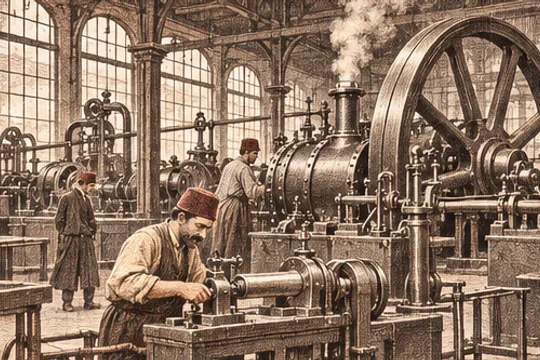
From the fifteenth century to the early twentieth, immense effort went into appropriating the agricultural surplus, yet in this system sectors outside agriculture received scarcely any attention. Until the Industrial Revolution in the West, Ottoman industry had been ahead of Europe at least in silk and cotton weaving and textiles. Faced with the severity of mercantilist competition, it rapidly began losing that advantage. Production centres across Anatolia closed one after another and lost their importance.
The last remnants of this production disappeared altogether with the signing of the Balta Limanı commercial agreement in 1838. The Ottoman state thus entered the twentieth century without a single industrial establishment of any consequence to its name.
Translated from the Turkish original. Türkçe