
The conqueror of Africa and FETÖ’s financial agents…
13 September 2016 · Personal website
(Article 106 – 13 September 2016)
On 15 July we learnt that military force is not the only means of occupying a country, seizing it and breaking it apart. The first signs had appeared during the Gezi events of 2013 and the subsequent judicial coup of 17 and 25 December. But back then many people had no idea how much influence that fanatic Fethullah Gülen wielded inside the armed forces.
Nobody even questioned the influence of the Gülenist organisation, FETÖ, in the police, let alone in the justice system and the courts. What 15 July showed was that this insidious organisation had left no nook unexplored, no institution untouched, no sector too small to target.
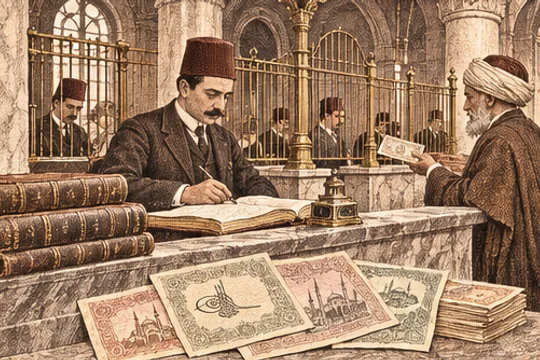
Please pay close attention to what I am about to describe. It is something that virtually any Turkish company, institution or organisation in need of financing has encountered or could encounter. In the 1980s a term came into common use in Turkish financial circles: the “moustachioed foreigner”. In 1988 the government of the day taxed stock market gains but exempted foreign investors. Foreigners could pocket every last penny of their profits tax-free, while Turkish citizens and domestic companies had to pay. Turkish nationals naturally began looking for a way round the tax and soon found one. Domestic investors made arrangements with foreign brokers and began trading from abroad. Suddenly the market had a new investor in disguise: the “moustachioed foreigner”.
The bloody coup the Fethullahist Terrorist Organisation (FETÖ) planned for the night of 15 July foundered against the will of the people. It also emerged that the network had influence in international financial institutions. It had long been known that FETÖ damaged the economy by producing unfavourable reports on Turkey and speculated on the markets alongside the so-called moustachioed foreigners. Rating agencies such as S&P, Moody’s and Fitch have now lost their credibility worldwide. Everyone knows how they work, whose orders they take and how a handful of rating announcements, well timed or otherwise, can plunge a country they have singled out into crisis and ruin. Isn’t that precisely why Greece, Bulgaria, Portugal and dozens of others, countries that cannot hold a candle to Turkey in economic development, have higher ratings than Turkey?
The 1990s were a time of chaos for Turkey. The economy was in distress, the financial sector had lost its standing, the state struggled even to pay civil servants, interest rates hit the ceiling and terrorism held the big cities hostage. The state had to borrow domestically at rates approaching 400 per cent. To pay salaries on the fifteenth of each month, the treasury had to borrow from the public on the fourteenth. Nearly 70 per cent of state revenues went to service interest on domestic and foreign debt. The state-owned Emlak Bankası, Ziraat Bankası and Halk Bankası were used to finance the public sector more than to conduct commercial banking.
In those years and afterwards, individuals and groups regularly turned up in Turkey calling themselves “financial institutions”. They purported to represent various Christian foundations in America, Germany, Switzerland, the Vatican and elsewhere, and institutions and firms in need of financing readily fell into their trap. The promise of very low interest rates, sometimes even outright grants, put highly sensitive information about Turkish companies into their hands: technological secrets, patents and know-how, sources of raw materials and the identities of customers who bought their finished products. These people and groups were actually FINANCIAL SPIES.
I have never seen any such individual or group provide a single kuruş of financing to any company in Turkey. Through these financial spies, commercial secrets of the utmost sensitivity have been and are still being passed to foreign intelligence agencies.
Think back to the WikiLeaks documents that swept the world in November 2010. When the hacker and activist Julian Assange published US State Department correspondence between embassies online, the effect was seismic. Only then did even Ankara learn that the documents named three Bursa firms on an American list of “companies to be seized or destroyed first in an emergency”. It emerged that these companies, Durmazlar, Ermaksan and Baykal, made strategically important products for aviation and aerospace, supplying Boeing, NASA and Airbus among others.
These firms have more than enough capability to produce tanks, artillery, missiles or satellites if necessary. How does America recognise their strength when they scarcely recognise it themselves?
All three manufacture the giant presses and laser systems used in defence, vehicle production, construction, domestic appliances and transport. Baykal stands out on the list. Durmazlar Makine, listed by the US State Department as “Durma”, is among the world’s largest machinery manufacturers by number of machines produced. The third, Ermaksan, is smaller than the other two but holds an important place in machinery exports.
How does such information reach the US State Department, and where does the American embassy get such detailed knowledge about these firms?
The firms that do this work are none other than the FINANCIAL SPIES I described at the outset. These “agent” institutions transfer Turkish companies’ most private commercial information abroad without a permit or licence from the Treasury Undersecretariat or from regulators such as the Banking Regulation and Supervision Agency, the Savings Deposit Insurance Fund or the Financial Crimes Investigation Board. This must never be allowed.
There is a holding company which, though it has not so much as a tree planted in Turkey, presents itself as the Turkish firm with the highest international turnover. This is its entire business. It approaches a firm, proposes a partnership, obtains all its information, then strings it along for months and either drives it under or sells it to another foreign company. The owner calls himself the “Conqueror of Africa”. His links to FETÖ and Mossad are plain as day. Be very wary of a company that buys $5,000 advertisements in financial magazines to proclaim itself the conqueror of Asia and Africa. It claims to have won contracts worth 25 to 30 billion dollars in Africa. Isn’t it curious that not a single Turkish embassy official there recognises it?
Everyone and his brother knows that before 15 July the company’s executives instructed FETÖ’s “imams” in the Council of Higher Education to prevent a strategically important foundation university from receiving a student intake quota. How painful that the state and our intelligence services should be unaware of it. Then again, when 6,500 of the 7,000 intelligence personnel at the General Directorate of Security turn out to be FETÖ members, what more is there to say? Their defining trait is strict adherence to the maxim “Hear but don’t hear, see but don’t see, know but don’t know.”
Perhaps it is clearer now why foreign firms have been able to buy so many valuable Turkish companies for next to nothing over the past fifteen or twenty years. Turkish firms with the technology to produce almost anything are slipping out of our hands through acquisitions, one after another. In many cases foreign buyers paid substantial sums, only to end production a few months later on flimsy pretexts and close the companies down.
The Finance Ministry, the Competition Authority, the Energy Market Regulatory Authority, the Capital Markets Board and all the other economic regulators need to be on their guard against such companies. Dismantling FETÖ altogether requires a thorough investigation of these “sham” holding and finance companies linked to Gülen. And not just them: the statements about Turkey’s economy made by charlatans who style themselves economists ought to be investigated too.
Last week I met Mehmet Demir, deputy chief public prosecutor in Bakırköy. I mean the prosecutor who issued the first warning to demonstrators in the streets during Gezi; who took on FETÖ members during the judicial and police coup of 17 and 25 December 2013; who, live on A Haber, accused İbrahim Okur, then head of the High Council of Judges and Prosecutors (HSYK), of lying and tore him to shreds. (That traitor Okur has since been dismissed by cabinet decision and arrested.) And I mean the prosecutor who, the moment he heard of the coup attempt on 15 July 2016, strapped on his sidearm, went to Bakırköy Courthouse, had detention orders drawn up, and seized the three tanks and arrested the nine officers who had occupied Atatürk Airport.
For years Demir has been among the foremost voices warning virtually every branch of the state about FETÖ. In 2014 he was even banished for a time to Edirne for criticising the HSYK’s İbrahim Okur. If the influence of FETÖ members in the HSYK has now been broken, I would be quite justified in saying that much of the credit belongs to Prosecutor Demir. He personally coordinated judges and prosecutors in Istanbul’s courthouses against the organisation and helped the Unity in the Judiciary group win the most recent HSYK election.
Demir argues that action against FETÖ must extend beyond military officers, police, judges and prosecutors to companies, their executives and members of the media who belong to the movement. “There is no line of defence, there is an entire area to defend,” he says. “Otherwise we will lose this war.”
If there is one thing for which pity and forgiveness can have no place, it is treason. There is no room for a moment’s hesitation in removing from state institutions members of the movement who sold their country for ONE American dollar. But if we cannot distinguish the guilty from the innocent, those involved from those who had nothing to do with it, right from wrong, this will become persecution and torment.
I heard that my friend Gökhan Gül, a chief tax inspector, had been suspended on the grounds that he belonged to FETÖ. He devoted his life to this state and made life extremely difficult for FETÖ members eight or ten years ago, before anyone was even talking about the organisation.
I maintain that those who use FETÖ as a pretext to dismiss people like him, people ready to give their lives for their country without a second thought, are themselves the ARCH-GÜLENISTS. Anyone who calls this man a FETÖ member is a traitor of the first order, dishonourable, immoral, vile, base and without decency.
Public prosecutors, consider this my formal report: whoever put Gökhan Gül’s name on the list of Gülenists, drop what you are doing, detain that scoundrel and immediately begin proceedings on suspicion of covert membership in FETÖ.
You cannot entrust FETÖ members with drawing up a list of Gülenists.
LET THOSE WHO WILL LISTEN, LISTEN. AS FOR THOSE WHO WILL NOT, MAY GOD VISIT A THOUSAND CALAMITIES UPON THEM…
(Incidentally, in yesterday’s column, entitled roughly “You Don’t Have to Pay to Be a Son of a Dog”, I raised the question of Defne Joy Foster’s suspicious death. I have learnt that the Istanbul Chief Public Prosecutor’s Office has reopened the case and will again investigate whether Ahmet Altan and his son Kerem Altan had a hand in her death. I welcome the news.)
Translated from the Turkish original. Türkçe