
Weep, my Jerusalem, weep!
14 February 2018 · Personal website
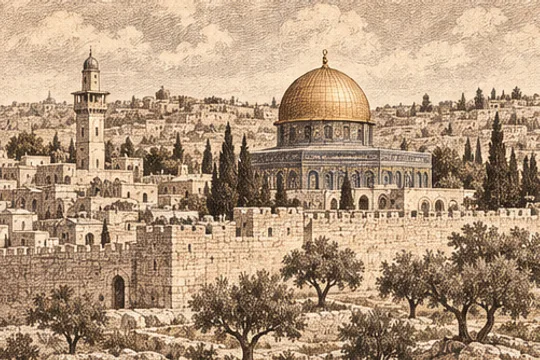
(Article 207 — 14 February 2018)
Jerusalem is the Muslim’s Red Apple, the great prize.
Jerusalem is a blessed city made in heaven and brought down to earth.
Jerusalem is the homeland of Abraham, Isaac and Jesus.
Jerusalem is the holy ground where revelation first sprang forth.
Jerusalem is where Jesus was taken up to heaven and where Mary found refuge.
Jerusalem is where the master of masters ascended to heaven and led the prophets in prayer, the place of which God said, “We have blessed its surroundings.”
Jerusalem is a city destroyed three times, occupied twenty-three times and besieged more than forty times.
Life in Jerusalem swings back and forth on the pendulum between justice and oppression.
Jerusalem is our city, your city and the city of all humanity.
Jerusalem, its people and Al-Aqsa Mosque are very much alone and sorrowful, just as the late Akif İnan wrote in his poem “Al-Aqsa Mosque”…
I saw Al-Aqsa Mosque in my dream.
It was like a child, and it was weeping.
I went and laid my forehead against its threshold.
It was as though a river were roaring underground.
…
I saw Al-Aqsa Mosque in my dream.
Carry my greetings to the Muslims, it said.
I cannot bear this separation.
Let Islam take me in its arms, it said.
The fortunes of Jerusalem, whose history is written in blood, changed with the rule of Caliph Umar (637), Sultan Saladin (2 October 1187) and Sultan Selim I (31 December 1516).
As the Muslim siege of Jerusalem intensified in 636, Patriarch Sophronius called out from the city walls: “We wish to surrender the city, but the Commander of the Faithful must come.”
When Umar arrived, the patriarch and the Christian inhabitants met him at the Damascus Gate. The patriarch withdrew to one side and began to weep. Moved, Umar tried to comfort him. “Do not grieve. Be at ease. The world is fickle. One day it is with you, another day against you.” Patriarch Sophronius replied, “I did not weep because I have lost my dominion. I wept because I understood that your rule would last forever. Oppression reigns for a moment, while justice reigns until the Day of Judgment. I thought you were rulers who would conquer and move on, only to disappear over the years.”
Despite the repeated urging of Jerusalem’s priests, Umar did not pray inside the Church of the Holy Sepulchre, built where Jesus was crucified. He prayed in the courtyard, reasoning, “The caliphs who come after me might use my having prayed here as a pretext to take away the church you hold so holy.”
“How can Saladin sleep in his own house while God’s house is in captivity?” said Saladin, who camped in a tent and succeeded in taking Jerusalem back from the Crusaders following the Battle of Hattin in 1187. He treated Jerusalem’s people with great generosity, had the cross removed from the Dome of the Rock and made the restoration, architecture and renewal of the city a priority. He gave Al-Aqsa Mosque the pulpit that Nur al-Din Zengi had commissioned. “The East’s most beloved sultan, Saladin,” in Mehmet Akif’s words, showed the same care. He made it easy for priests and others who wanted to leave Palestine to do so and granted those who wished to stay all freedoms, above all freedom of worship.
When Maymuna, one of the Prophet’s wives and a Mother of the Believers, asked, “Messenger of God, could you tell us what you enjoin concerning Al-Aqsa Mosque?” the Prophet replied, “Go there and pray in it. If you cannot go there and pray, send olive oil to be burned in its lamps.” (Abu Dawud, Book of Prayer, 14)
Led by Sinan Pasha, the Ottomans took Jerusalem on 28 December 1516 during Sultan Selim I’s campaign in Egypt. After the conquest, the sultan visited the holy city on 31 December 1516 and renamed it Kudüs-i Şerif, or Noble Jerusalem. The Ottoman state ruled Jerusalem for 401 years. Suleiman the Magnificent, Sultan Murad IV, Sultan Abdülmecid, Sultan Abdülaziz and Abdülhamid II all rendered many services to the city. Suleiman endowed forty million akçes to improve it.
Sultan Selim I, who conquered Jerusalem on 31 December 1516, carried on the tradition of serving the holy places and took the same approach as his predecessors. By the light of twelve thousand candlesticks, he performed his first night prayer in the courtyard just outside Al-Aqsa Mosque with the soldiers who had taken part in the conquest.
Selim I does not stay in Jerusalem long. He strikes while the iron is hot and moves on. He takes Cairo on 24 January 1517, enters the city in a grand ceremony on 4 February and ends the Abbasid caliphate under the Egyptian Mamluks.
On 6 July 1517 the Sacred Relics, including the Prophet Muhammad’s mantle, tooth, standard and sword, are sent from the Hejaz to Istanbul.
At a grand ceremony in Hagia Sophia Mosque on 29 August 1517, Selim receives from the last Abbasid caliph, al-Mutawakkil III, the title Khadim al-Haramayn al-Sharifayn, meaning “servant of Mecca and Medina.” From that moment he becomes the religious and political leader of Muslims throughout the world.
As the story goes, al-Mutawakkil III takes the pulpit and declares that he has transferred the caliphate to the Ottoman sovereign Sultan Selim. With his own hands he puts his robe on Selim and girds the sovereign with the sword that is one of the emblems of the caliphate.
Every Ottoman ruler after Selim uses the title of caliph in addition to those of sultan and sovereign. The caliphate remains in Ottoman hands for 407 years, until 1 November 1922.
The British knew very well that the caliphate exercised a certain influence over India’s Muslims. The office was a serious threat to British imperialism and, whatever it took, had to be removed from the hands of the Turks and the Muslims.
On 1 November 1922 the sultanate and the caliphate were separated. The sultanate was abolished and the caliph’s powers were confined to religious affairs. After Vahdettin left the country, the Grand National Assembly elected Abdülmecid Efendi of the Ottoman dynasty as the 116th caliph of Islam.
Although Turkey ratified the Treaty of Lausanne on 24 July 1923, Britain did not sign it for a year, because the Grand National Assembly had not abolished the caliphate. Britain signed only on 16 July 1924, four months after the caliphate was abolished on 3 March 1924. The Republican leadership thus ended an office that had been in Turkish hands for 407 years, entirely severing the Turks’ ties to the Muslim world and the Middle East.
Contrary to what is usually thought, the first Western crusades against Muslims did not begin in the twelfth century, but much earlier, in the ninth. Their purpose was to drive Muslims out of Spain and Portugal.
In 711 Muslims set foot in Spain under Tariq ibn Ziyad and founded the Islamic civilization of al-Andalus there. The first attempts to expel them began in the ninth century and, as is well known, were completed in 1492. Islamic rule in those lands came to an end. Tradition has it that Abu Abdallah, or Muhammad XII, the last sultan of the Emirate of Granada, surrendered the keys of the city to the Spanish king and queen without a battle. Realizing he could no longer stay, he left the city. Sunset is drawing near. For the last time the sun strikes the Alhambra, which took nearly 250 years to complete, every inch worked with exquisite care and the words “There is no victor but God” inscribed on all sides. It is the last farewell of a civilization that ruled these lands for centuries. Sultan Abdallah stops on the hilltop and looks back one last time. As the first tears fall, his mother beside him speaks the harshest words she could: “Weep, my son, weep. You did not fight like a man. Now weep like a woman.”
History books record nine military campaigns as the Crusades, intended to bring Jerusalem under Christian rule. Taking lands held sacred by Christians, recovering Jerusalem and increasing papal revenues were all important aims. The First Crusade took place from 1095 to 1099 in pursuit of these ideals. On 15 July 1099 Jerusalem fell to the Crusaders and all the Muslims and Jews living in the city were killed. The city remained the capital of the Holy Kingdom of Jerusalem for eighty-eight years, until Saladin took it back in 1187.
The Second Crusade took place in 1147–49 after the atabeg of Mosul took Edessa in 1144 and ended the County of Edessa. Emperor Conrad III of Germany and King Louis VII of France led their armies into Anatolia. They met the resistance of the Seljuk armies and returned to Europe.
The Third Crusade took place in 1189–92 after Saladin took Jerusalem in 1187. The German emperor Frederick Barbarossa entered Anatolia with a hundred thousand men. King Philip II of France and King Richard the Lionheart of England reached Acre by the Mediterranean and took the city. Richard made several attempts to capture Jerusalem but could not take it from the Muslims.
The Fourth Crusade took place from 1202 to 1204. Pope Innocent III called all Europe to join a campaign to recover Jerusalem, and command of the assembled army went to Boniface of Italy. The Latin armies turned toward Istanbul instead of Jerusalem and occupied Constantinople. The city suffered the greatest devastation in its history. The Crusaders began by looting homes. The chronicler Geoffrey of Villehardouin, one of the early French lyric poets, witnessed the plunder and writes, “The soldiers forgot the meaning of the cross stitched onto their clothes and set about butchery and arson. Houses were set ablaze, palaces and public buildings were stripped bare. Men were killed, women raped, and even the least valuable things were looted, down to the peasants’ shirts.”
Once the buildings are stripped bare, it is the turn of Hagia Sophia, the greatest place of worship of the age. It is plundered and made the scene of utter disgrace. The soldiers enter the church with mules and a French prostitute. They load the mules with wall coverings, objects believed to have belonged to Jesus’s apostles or to Mary, one of the holy nails said to have been used to crucify Jesus, the crown of thorns, gold and silver crosses and whatever is made of precious metal. Priests who have hidden in the church are disembowelled and nuns are raped. Catholic soldiers too late for the plunder begin breaking pieces off the columns, said to have healing properties and to relieve kidney and chest pain. When the mules collapse under their loads and cannot move, they are cut to pieces with swords. Once everything has been carried away, it is time to make merry. The French prostitute brought by the soldiers climbs into the pulpit from which the Orthodox patriarch preached only days earlier and begins singing bawdy songs and dancing lewdly. The soldiers meanwhile are busy drinking barrels of wine.
The Eastern Romans never forgot the disaster of 1204. That brutality was the reason that as the Turks advanced in later centuries, instead of seeking help from the Catholic world they said, “We would prefer a Muslim turban to a cardinal’s hat in Hagia Sophia.” The Latin Empire that had been founded ruled from 1204 to 1261. In 1261 Michael VIII Palaiologos retook Constantinople, brought the Latin state to an end and restored the Eastern Roman Empire.
The Fifth Crusade followed a call in 1213 by Pope Innocent III, who believed the keys to Jerusalem lay in Egypt. The Crusader army advanced toward Cairo. Near Mansoura, however, the rising Nile stranded them on higher ground and they surrendered.
The Sixth Crusade took place in 1228–29. On 18 February 1229, the Ayyubids and Crusaders signed a ten-year peace treaty. Under it, Jerusalem, Bethlehem, Nazareth, Jaffa and Sidon were left under the rule of the Holy Kingdom of Jerusalem. In 1244, Khwarazmian Tatars sacked Jerusalem. They massacred the Christian population and expelled the Jews. The city passed back into Ayyubid hands in 1247.
The Seventh Crusade, in 1248–54, was led by King Louis IX of France. After taking Damietta in Egypt, Louis marched on Cairo but was defeated and taken prisoner. The French king paid a ransom and was released.
Jerusalem then fell to the Mamluks in 1250. The Eighth Crusade, in 1268–70, was again organized by Louis IX of France. The king and half his army died in an outbreak of plague. The Ninth Crusade, the last, took place in 1271–72. Prince Edward, the future king of England, led an expedition to Acre, the seat of the Holy Kingdom of Jerusalem, against the Mamluk sultan Baybars. The expedition failed and was the last the Crusaders mounted in the Middle East. Jerusalem, under Mamluk rule since 1250, was incorporated into Ottoman territory by Sultan Selim I in 1517.
The unnamed Tenth Crusade…
Now to the Tenth Crusade, which does not appear on the list but ended in a Christian victory. It was waged against the Ottoman Empire between 1914 and 1918, exactly 643 years after the last crusade. Britain, France, Italy, Russia, Greece and a number of other states took part. Their aim was to drive the Muslim Turks off European soil altogether. And they succeeded. The Turks were driven from all European territory except Thrace. Jerusalem fell to the British. The dream of Richard the Lionheart came true six and a half centuries later. The Turks lost all their lands in the Middle East and were confined to a tiny territory.
Jerusalem falls first, 11 December 1917…
As the Ottoman state collapsed, we left Jerusalem on Sunday, 9 December 1917, after 401 years, three months and six days of rule. There was no way to hold the city anyway. The army had been routed and was withdrawing. General Edmund Allenby, who entered Jerusalem on 11 December 1917 after defeating the Ottoman army, kicked Saladin’s tomb and said, “Get up, Saladin. We are back.” By “we are back,” he meant the first arrival of the English king Richard the Lionheart, who took part in the Third Crusade in 1189 and failed.
After Jerusalem falls, it is Istanbul’s turn, 8 February 1919…
On 13 November 1918, immediately after the Armistice of Mudros, the Allied powers effectively occupied Istanbul under its terms. The second and harsher wave of occupation, on 16 March 1920, was meant to intimidate. British soldiers raided the military band barracks at Şehzadebaşı and bayoneted soldiers, occupied government offices and arrested a number of Ottoman deputies, sending them into exile on Malta. The occupying officers and soldiers gave vent to centuries of hatred. The conduct of the French general Franchet d’Espèrey particularly shook Istanbul’s Muslim population. The Ottoman state had long protected the French and treated them as old friends. On 8 February 1919 d’Espèrey made a showy entrance into Istanbul. He arranged a victory procession from the Galata quay to Beyoğlu. He rode a white horse without reins, led by two Black men. He saluted those around him as he went, like a Roman emperor of old. Riding a white horse as Mehmed the Conqueror had done, he alluded to the conquest of Istanbul, as if to say, “The Romans are back.” He went so far as to announce that he wanted to live in Dolmabahçe Palace and that the sultan should leave, then went on his way.
And finally Bursa, July 1920…
Greek soldiers have entered Bursa. At their head is Sophoklis Venizelos, a reserve officer and the son of Venizelos. In the Ottomans’ first capital, it is as if history has turned back six hundred years. It is a day in Ramadan, and the calls to prayer seem to sob over the captive city. The photographer from Athens, whom Sophoklis has been awaiting for days, has finally arrived. With the photographer and a squad of soldiers, Sophoklis heads for the tomb of Osman Gazi, founder of the Ottoman state. They find the door locked. Venizelos’s soldiers charge the door as if storming a fortress tower. They break down the wooden door and enter. Unsure what to do, they point their rifles with fixed bayonets at the entrance, as if someone might appear at any moment. Osman Gazi’s cenotaph, with the turban at its head, looks so dignified and imposing that they cannot help but recoil. Under their astonished gaze Sophoklis approaches the cenotaph. Raising his spurred boots, he kicks it three times in succession. Sophoklis draws his sword and swings it as if lunging at an imaginary enemy, shouting: “Great Osman! We’ve destroyed the state you founded. I’ve come to kill you.” After wandering around the tomb for a while swinging his sword, he strikes the pose of a victorious commander. He rests one foot on the cenotaph, leans on his sword and tells the photographer, “Go on, take a souvenir of Bursa…”
Sophoklis sends the photograph of his Don Quixote pose to Athens, with these lines on the back: “Our armies are in control of Bursa. Osman, the founder of the Ottoman state, is beneath my feet. I have avenged Byzantium.”
Three events, three stories…
One takes place in Jerusalem, one in Istanbul and one in Bursa. There is no difference between the three. They all opened deep wounds in our souls and were never forgotten. Lands lost one after another, borders shrinking, betrayals, disappointments, the loss of lives and property, and so much more…
As we lost territories of millions of square kilometres, one after another, and withdrew from Europe, Asia and Africa, we left millions of our people behind. And how we left them…
Every vein in our body was torn to shreds. Ninety years on, the lands we lent out are still home to us: Albania, Greece, the islands, Bulgaria, Romania, Hungary, Crimea, Georgia, Egypt, Sudan, Tunisia, Libya, Algeria, Yemen, Mecca, Medina, Aleppo, Palestine, Jerusalem, Beirut, Damascus, Basra, Mosul and Kirkuk.
We long for these lands.
They are the ache in our hearts, the wound that still bleeds.
For a hundred years Jerusalem has been unprotected, for a hundred years sorrowful, for a hundred years grieving.
Jerusalem weeps quietly and goes on saying, “Let Islam take me in its arms.”
The writer Nuri Pakdil said, “Mecca is our claim, Medina our cause, Jerusalem our prayer without end. Istanbul is our last stop, our last refuge, our protective shield. Istanbul belongs to Jerusalem, and Jerusalem to Istanbul. Damascus and Bosnia, Skopje and Jerusalem have been entrusted to us. Turkey, guard what has been entrusted to you! Muslims, stand as tall as my sisters in Jerusalem. Stand tall so the world may finally learn what it means to be Muslim. To defend Jerusalem is to defend true independence.” And he added, “As long as I do not renounce my faith, I cannot give up Jerusalem.”
In the hope that we may see the day Jerusalem is freed from captivity and weeps for joy…
Dr Mehmet Hakan Sağlam
Translated from the Turkish original. Türkçe