
Sham intellectuals, thieving banks and sports clubs loyal to FETÖ…
26 March 2017 · Personal website
(Article 143 – 26 March 2017)
About five months ago I wrote an article titled “Loan-shark banks, phoney economists and small-minded intellectuals…” in which I explained how the ill-judged remarks of some of the people steering the economy were making markets fragile.
Unfortunately, we are dealing with a crowd of so-called intellectuals who lack both stature and integrity. These self-proclaimed great economists talk about monetary expansion and contraction in Europe and America. They imagine that tinkering with interest rates will bring the economy into some sort of balance and argue that European economies will recover as the euro loses value. They are stuck on the international trade model developed by Eli Heckscher and Bertil Ohlin. You know that “stupid theorem” applied after 1980 in many countries, Turkey included, which holds that letting the national currency lose value against foreign currencies boosts exports, but works only in countries rich in raw materials? That is the one. The Heckscher–Ohlin model is a mere “fairy tale” for countries like Turkey that depend on imported raw materials.
Following this theory, the dollar rose from 70 to 1.35 million Turkish lira between 1980 and 2002, when Turkey’s exports rose from $3.5 billion to $35 billion. In other words, the lira lost ground against the dollar by a factor of 20,000, while Turkey’s exports grew only tenfold.
Between 2002 and 2014, however, under an export model based on increasing production, the dollar went from 1.35 to 2.50 lira, and our exports rose from $35 billion to $160 billion. In other words, the lira depreciated against the US dollar by just 85 percent, while our exports grew by roughly 400 percent.
In my view, the Turkish economy’s basic problems arise from insufficient production, the resulting low employment, and uneven tax collection. Let me sum up the general problem by giving two examples from economic life.
About a year ago I went to visit my friend Ahmet Kökler at the Grand Bazaar. Another friend of Ahmet’s came into his office and, in the course of conversation, asked about the state of the country and the government. Ahmet asked, “Do you pay all the taxes you owe?” His friend said no. Ahmet replied, “Then there is no discussing affairs of state with you,” and immediately followed up with a second question: “Do you distribute your zakat in full?” The visitor again said no. “Then there is no discussing matters of religion with you either,” Ahmet said, and closed the subject on the spot.
Now for the second example. Kemal Can, the chairman of Can Holding and owner of Enerji Petrolleri, is a good friend, a cautious businessman whose judgment I value. He says the economy has begun to contract sharply over the last six months, entirely because of economic strain. He is a remarkable businessman who takes no holidays, works around the clock seven days a week, and builds something in this country by investing and creating jobs. About 3,000 people work at Can Holding and its subsidiaries. No doubt there are many reasons for the company’s success, but in my view the main one is how its leader thinks. Yesterday, when I was with Kemal, he told me something: “I no longer run any venture directly. Anyone with a business idea does all the preparatory work in detail. I’m simply the one who makes the final decision. If I think the idea makes sense, I approve it. Otherwise, I turn it down. That way, I avoid getting so wrapped up in the venture that I make a bad decision.”
What Kemal’s experience has enabled him to avoid, and what has helped his company succeed, is a weakness in management known as “hubris syndrome.” A manager who becomes too absorbed in something starts overlooking outside factors. If there are also plenty of sycophants saying, “Sir, you always know best,” and there are plenty in every economic and political organization, the manager gives in to emotion and starts making bad decisions. Then it’s straight to bankruptcy court. Before you know it, enormous companies have gone under.
These two examples help sum up Turkey’s problems. To begin with, people in the lower and middle strata pay their taxes in full, while those at the top continue to excel at evading them. A businessman like Kemal Can provides a livelihood for 3,000 families on his own, while Turkey’s rentiers keep pocketing billions of the state’s lira simply by buying and selling money.
Last week, the guarantee limit of the Credit Guarantee Fund was raised to 250 billion lira. The fund guarantees borrowing by SMEs and larger businesses that lack sufficient collateral, giving them access to finance. But let me warn government officials: many banks have started shifting bad loans onto the fund indirectly. The state’s 250 billion lira is being redirected toward recovering loans that banks issued in previous years and cannot collect. The state created the scheme chiefly to increase employment. But you’ll see that, in the end, banks in Turkey will post soaring profits this year while the growth in employment supported by the fund falls far short of expectations.
Turkey is unfortunately full of contradictions of this kind. There are hundreds of thousands of economists and business specialists, but not a single economist who can come up with a theory! I maintain that if you put all the economists of the Republic together and multiplied them by 100, they would not be worth the fingernail of Mehmet Cavit, one of the last Ottoman ministers of finance. People who think that putting “Professor” before their name makes them Keynes or Friedman, yet know nothing of economics, should ask themselves why not a single Turk figures in the history of world economics.
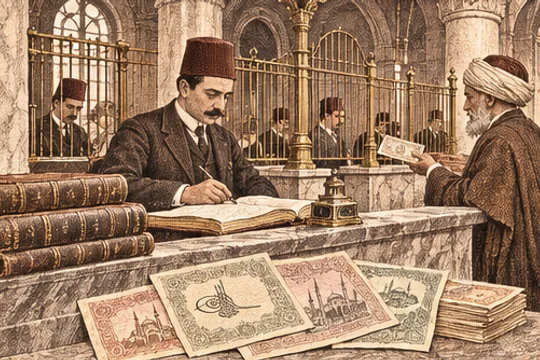
Had the Ottoman Empire’s financial authorities been made up of such idiots, a state that lasted 623 years would probably have vanished in six. When the Ottoman state was founded, there was neither mercantilism nor liberalism. So what distinguished Ottoman economic policy? Aren’t you curious? For those who are, one short sentence explains it all: “Sustain the people so the state may endure.”
You will find no practice in Ottoman public life that fails to take people into account. People were “entrusted by God” to those who governed. People were also at the center of the provisionist economic policy the Ottomans practiced for around four and a half centuries. Under that policy, all goods and services produced in the country were made available first for the use and welfare of its people. If the country produced two million tonnes of cotton and the guilds and the population together needed two million tonnes, none of that year’s cotton could be exported. If demand was one and a half million tonnes, however, the excess 500,000 tonnes could be exported. The Ottomans scrupulously applied this policy to almost every kind of good for centuries. Their officials knew very well that doing otherwise would bring domestic shortages and scarcity, and that those in turn would push up the general price level.
Provisionist economic policy kept Ottoman inflation low, allowed the general price level to rise moderately, and kept living standards stable for about 450 years.
The “high interest rates” that President Erdoğan raises at almost every opportunity are a problem shared by businesspeople, manufacturers, and everyone in Turkey who carries a credit card.
According to Treasury figures, each one-percentage-point increase in interest rates costs the Turkish Treasury an additional 6 billion lira a year, or about $2 billion. Just before the Gezi protests, rates had fallen to an unprecedented annual low of 4.61 percent in the history of the Republic of Turkey. The protests abruptly reversed the favorable mood in the country. As political risk increased, rates began rising rapidly, first to around 8 percent, and then to around 12 percent with what I call the judicial and police coup of 17 and 25 December 2013. This increase of roughly 7.5 percentage points cost the Turkish Treasury an additional 49 billion lira in a year and a half, equivalent to about $23 billion.
So what does that $23 billion mean?
Think what could have been done with the money paid out of the state treasury because of the central bank’s high-interest-rate policy. The presidential complex that opposition leaders and the FETÖ organization keep bringing up, for instance, cost a total of 1.35 billion lira. We could have built a copy of that palace in each of 39 other provinces in Turkey. We could have built 11 more Yavuz Sultan Selim bridges, at 4.5 billion lira apiece. At 7.2 billion lira for the Ankara–Istanbul high-speed railway, we could have built seven more lines like it. The Marmaray project, Turkey’s pride and joy, which links Asia and Europe beneath the sea, cost only 8 billion lira. With the money that went into rentiers’ pockets, we could have built six Marmarays beneath the Bosphorus.
I don’t want to get too caught up in this, but I would remind the economists who collect salaries in the tens of thousands of dollars and hold forth on the Turkish economy while guzzling whisky and rakı over fish on the Bosphorus of a proverb: “Speak if you know, so they take you for a scholar. Keep quiet if you don’t, so they take you for a man of substance.”
Now to what happened yesterday, a black mark in the history of Turkish sport. It is unacceptable that Galatasaray Sports Club rallied behind Arif Erdem and Hakan Şükür, members of FETÖ, at its financial general assembly and failed to expel them. The members of Galatasaray Sports Club who support members of FETÖ, which turned this country into a bloodbath in the July 15 coup, killing 250 people and injuring more than 2,000, should be tried under the Anti-Terror Law.
These fools who see opposition to the government as a sign of high social status or of being an intellectual have left us with nothing more to say.
Seeing all this leaves you at a loss for words. It is hard to fathom how one country could have so many traitors.
May God help us…
Dr. Mehmet Hakan Sağlam
Translated from the Turkish original. Türkçe