
Who are Keynes and Friedman next to Başçı?
22 January 2015 · Tarafsız Haber
John Maynard Keynes developed the economic theory that bears his name to address the problems created by the Great Depression, which erupted in America in 1929. Banks, firms and individuals were going bankrupt one after another. Keynes’s recommendations were adopted and put into practice in many countries, foremost among them the United States, and they succeeded. He is among the rare economists whose theory found a practical application. From 1940 to 1946 he was a financial adviser to the British government. He held that money, interest rates and prices should be regulated according to the needs of the national economy rather than exchange rates, and that the state should intervene in the market when necessary.
Keynes saw clearly how both the First World War of 1914–18 and the Second World War of 1939–44 brought national economies to their knees. He knew how hard it was to get the wheels turning again. The Great Depression began in the US in October 1929 and from early 1930 took hold of every other country except Soviet Russia. The chief cause of the crisis was excessive growth in output. Demand was dwindling while output remained high, so the general price level fell rapidly.
The First World War had impoverished the people and economies of Europe. Large stockpiles of goods began to accumulate in industrialised countries, especially America, the leading producer at the time. Industrial firms could adjust fairly easily to falling demand, but agriculture could not. Excess agricultural output therefore made prices collapse. Stocks grew particularly large in food markets, and prices fell to levels that drove producers bankrupt. American farmers suffered most. The sudden collapse in agricultural markets quickly hit industries that depended on farming. Stocks of industrial goods began to swell while prices fell.
By selling manufactured goods and farm products to virtually every European country during the First World War, the United States had gained control of those markets. This let it modernise its technology and expand its productive capacity, and in 1929 it had created two major car brands, General Motors and Ford. Its large exports to Europe produced growing trade surpluses in almost every year, while it protected its own market against countries that wanted to sell to it. Countries buying American goods wanted to sell to America in return but could not get past its protectionist rules.
In 1929 communism already held sway in Soviet Russia, which pursued a closed economic policy. Stalin set himself the goal of industrialising at any cost. By 1937 he had made Russia the world’s second-largest exporter of industrial goods, behind the United States. Franco declared his dictatorship in Spain from 1936, while Marshal Piłsudski did the same in Poland in 1926. General Metaxas took power in Greece in a coup and established a controlled regime, while Benito Mussolini seized the reins in Italy from 1922. Nearly all Europe was falling into the hands of fascist and dictatorial rulers.
Roosevelt won the US presidential election held in 1933 while the economic crisis known as the Great Depression, which had gripped the world since 1929, was still under way. Taking over from the Republican president Hoover, Roosevelt introduced a series of measures to get his country back on its feet. Together they are called the New Deal.
To pull his country out of the economic crisis, President Roosevelt followed the recommendations of the British economist Keynes in developing an interventionist national policy under which the state would regulate and guide the economy. Plummeting agricultural prices and farmers’ inability to repay their debts had driven most small banks to failure. Industrial stocks had swelled and output fallen rapidly as markets stagnated. In 1929 the country had 4.6 million unemployed people; by 1933 the figure was approaching thirteen million. Some 659 banks failed in 1929, 1,352 in 1930 and 2,294 in 1931. Most were small local or regional institutions with just one branch or a handful of branches.
Roosevelt passed thirteen major laws to address the country’s social and economic problems. Introduced one after another in mid-1933, they were intended to get the economy working again. A new banking law barred banks from speculative stock-market dealings and introduced protections for savers. The New Deal also brought changes to industrial production, markets and relations between workers and employers. To end the industrial slump, the main aims were to curb overproduction, raise wages, reduce working hours and improve pay. In particular, higher wages were expected to revive aggregate demand, increase sales and clear accumulated stocks. Alongside measures to support and encourage private enterprise, substantial funds were set aside for public investments and services. The Public Works Administration (PWA), which was charged with organising this work, used a total of $13.2 billion from 1933 to 1942 to help create new jobs. In that period the PWA built 122,000 homes, 664,000 miles of roads, 77,000 bridges and 285 airports. Public investments planned by the state came into effect one after another. Roosevelt launched projects for reforestation, flood prevention and soil conservation, putting 300,000 people to work in 1933 and creating a belt of 200 million trees from North Dakota to Texas.
To get the economy going again, Keynes proposed creating jobs for the unemployed and having the state concentrate on infrastructure projects that served a social purpose. President Roosevelt followed the Keynesian economic policy to the letter. As a result of the policy pursued from 1933 to 1945, the United States shook off the effects of the Great Depression.
Almost every country touched by the crisis adapted Keynes’s proposed remedy to its own circumstances. Britain revived construction to get its economy out of the slump. Homeowners were given grants to tear down and rebuild old houses. Germany concentrated on building motorways throughout the country and investing in its arms industry, while many other countries increased spending on railways, roads, dams and other public works. Turkey followed a similar course. Under the principle of statism, the government built numerous industrial facilities, railways and roads.
Increasing state spending and running budget deficits in line with Keynes’s recommendations reduced unemployment in times of crisis and let output grow rapidly. In later years, however, increasing expenditure and pumping more money into the market through deficit budgets in response to every wave of unemployment increased inflationary pressure in nearly every country. Some countries began to see double-digit inflation in the 1960s and triple-digit inflation in the 1970s.
At this point a group of economists led by Milton Friedman entered the debate. These economists, who called themselves monetarists, took the following view:
1) Changes in the quantity of money are determined by the decisions of governments and central banks rather than by the workings of the economy.
(Keynes argued the opposite: that money, interest rates and prices should be regulated by the needs of the national economy, rather than by exchange rates.)
2) Unemployment is essentially caused by inflation. To combat unemployment, the principal thing to fight is inflation itself.
3) Inflation is a monetary phenomenon. Expanding the money supply increases nominal incomes and thereby raises inflationary pressure. Reducing the money supply reduces nominal incomes and thus lowers inflation.
4) Money is only a medium of exchange. An increase in the money supply therefore raises aggregate nominal demand and, since the economy is assumed to be at full employment, prices rise.
5) Interest is the price of credit, not the price of money. The interest rate therefore balances the supply of and demand for credit rather than the supply of and demand for money.
Central bank officials in Turkey today are acting in exactly this way, as if they had agreed on a common line. For them the central bank has only one duty: to fight inflation. President Erdoğan has insisted since his days as prime minister that rates should come down. The officials disregard this because they take the monetarist view that inflation arises entirely from money.
Monetarists argue that expanding the money supply will raise interest rates rather than lower them. Rates may fall at first, because the extra money initially meets demand for cash loans. The effect is short-lived: the expansion pushes up prices, and nominal rates rise accordingly. Monetarists therefore accept that the theory of liquidity preference may apply in the very short run while extra money is being introduced into the market. But the theory does little to explain interest. Monetarists have been unable to explain how the rates that influence spending decisions are formed. In their view rates are determined by the supply of and demand for credit rather than for money. Expanding the money supply therefore cannot lower rates and stimulate investment in this way. The extra money can raise output without affecting prices in the short term, but in the long term it only causes inflation and does not raise output.
Monetarists say there is no need to upset market equilibrium to prevent unemployment. It arises temporarily, and the natural forces of the economy will restore full employment. In Friedman’s analogy, expansion and contraction are like pressing the accelerator and then the brake. Because their effects arrive with a lag, they can produce the opposite result.
We have two economists and two very different economic policies. One is Keynes, whose ideas pulled America and practically every other country hit by the Great Depression of 1929 back onto solid ground. The other is Friedman, who argues that rates follow the supply of and demand for credit rather than for money, a weak point in his theory.
The monetarists see money as the principal cause of inflation and overlook production entirely. Yet even people who understand nothing of economics know that when a product is in short supply relative to demand, its price naturally rises. If this happens with all other goods as well, the general price level rises. That is what we call inflation.
Can people’s demand be balanced in an economy that produces nothing, or too little, simply by moving interest rates up and down? Higher rates might discourage demand for the most luxurious goods. But how do you balance demand for necessities? No matter how high you raise rates, people will go on demanding essential goods.
It should now be clearer why central bank governor Erdem Başçı and the members of the monetary policy board refuse to lower rates. Economics students are taught the main schools of thought, from mercantilists and physiocrats to liberals and monetarists, in the course on systems of economic thought. Their instruction is not exhaustive, but it is adequate. Keynes’s interventionist policy puts the reins in the hands of governments. Friedman’s monetarist doctrine gives central bank governors all the authority and has the character of a system of tutelage, which suits Turkey perfectly. Who would want to lose that power?
It is by no means easy to break the influence of the institutions of constitutional tutelage that hold sway in the judiciary, police, military, Constitutional Court, Court of Cassation, High Council of Judges and Prosecutors and many other bodies. The struggle with many of them is still going on.
After seeing such resistance from central bank officials, it would be fair to say that the bank has become a new institution of tutelage. How does Friedman’s monetarist policy explain the harm that high interest rates do to the Turkish economy, and the damaging effects on investment, output, exports, employment and wealth? I think the officials would reply, “If we cut interest rates, inflation will explode.”
As the saying goes, “A bad tenant turns you into a homeowner.” All Turkey’s institutions of tutelage seem to be joining forces to make a nuisance of themselves, giving us every reason to replace the entire 1981 Constitution. Sooner or later it will change, and we will be rid of the bureaucrats who run the Central Bank of the Republic of Turkey with no more than the most basic knowledge of an economics graduate.
Had people of this kind run Ottoman finances, the state that lasted 623 years would probably have disappeared from history in six. The Ottomans knew neither mercantilism nor liberalism. Keynes and Friedman had not yet been born in those centuries. What kind of economic policy did the Ottomans have, then? For anyone who is, a four-word sentence in Turkish explains everything: “Keep the people alive so that the state may live.”
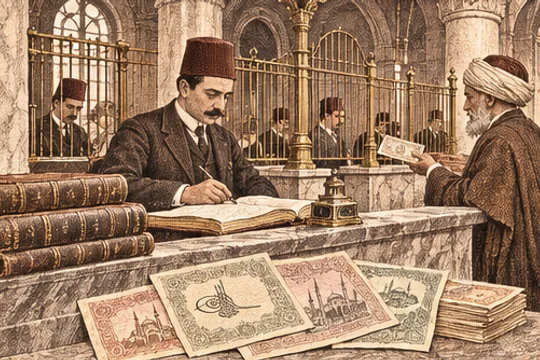
Ottoman social, political, legal and economic life was built on that principle. It was the point of reference for every official in the Ottoman state. The sultan says, “Let’s make a decision we will not have to reverse, so we won’t have to eat our words.” The jurist says, “Let’s hand down a sentence that can be carried out.” The finance official says, “Let’s levy a tax people can pay.” The founder of an endowment says, “Let us establish an endowment that serves people for centuries and that will endure.” You cannot find a practice in Ottoman public life that didn’t take people into account. God had entrusted people to those who governed the state. The economic policy we might call provisionism that the Ottomans followed for about four centuries put people first too. All goods and services produced in the country were to be made available to its people first. If the country produced two million tonnes of cotton and the guilds and the public needed that much, none of that year’s cotton could be exported. If demand was 1.5 million tonnes, the surplus 500,000 tonnes could be exported. The Ottomans applied this policy meticulously for centuries to almost every kind of product. Ottoman officials knew very well that doing otherwise could produce shortages and scarcity at home and push prices up. When this happens to other goods too, it produces what the Ottomans called galâ-yı es‘âr, a rise in prices, and what we now call inflation. Provisioning kept Ottoman inflation very low for about 450 years. The general price level rose little and people’s living standards stayed stable. Until when? Until the signing of the Treaty of Balta Limanı. That is why inflation in Ottoman economic history totalled 300 per cent over four and a half to five centuries, while it reached 100 million per cent over eighty years of the Republic.
Grand Bazaar traders have a crucial quality that few people know about. Almost everyone who does business and makes money there has a remarkable nose. I mean the ability to sniff out which way the market will move that day, rather than the distinctive smell of the Grand Bazaar. Will foreign exchange go down or up? Will demand for gold rise or fall? Will it be a busy day for leather jackets or handbags? No one answers those questions more accurately than the traders themselves.
Başçı is in charge of the money, has such a poor nose for the market, and tries to run the central bank of a whole country with the deep knowledge he acquired from economics textbooks. Next to him, Keynes and Friedman don’t even rate a mention, do they?
Translated from the Turkish original. Türkçe