
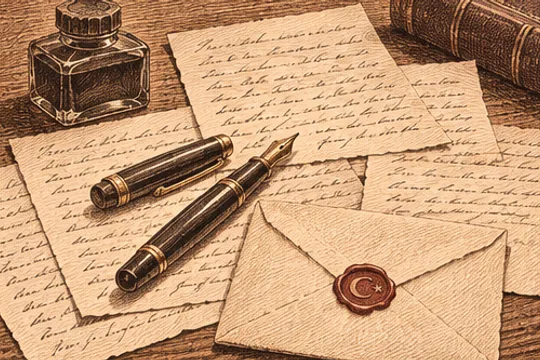
What’s written on this piece of paper?
9 January 2017 · Personal website
(Article 129 — 9 January 2017)
Over the past week I have written a number of columns arguing that some of the civil servants removed from their posts on the grounds of FETÖ membership had been dismissed unjustly. “Touch a sore spot and hear a thousand sighs,” as the saying goes. As soon as my column appeared, an astonishing number of messages poured in, and I witnessed the silent outcry of people who had lost their jobs unfairly. A scholar, a craftsperson, an artist or a specialist in any given field will each see a particular incident differently. Let people from a range of professions watch two strangers come to blows in the street, and each will see the fight from a different angle and offer a different analysis. Let me give you an example of a kind of question used in IQ tests.
A man had worked for years at a bank in Germany. Close to retirement, on the day he decided it was time to return home, he thought he might as well treat himself to a night out and went to a bar. He was having his drink when a very beautiful woman sat down opposite him. Quite taken with her, he called the waiter over, wrote “May I introduce myself?” on a slip of paper and had him deliver it to the woman.
The woman took the slip, read it and gave him a meaningful look. Then she wrote something on the back and sent it back to him. He looked and looked, but couldn’t make head or tail of it. It wasn’t German or English or French. It was some language he didn’t know. He took it to his closest friend. “A woman wrote this to me. I can’t understand it. What does it say?” The moment his friend read it he said, “Don’t ever call me again. Our friendship is over,” and walked away…
The man went home in a bewildered state and asked his parents, “You’re old-fashioned, you know? You should know what’s written here.” When his parents read the paper, they rejected him as their son. They showed it to his wife, who then filed for divorce. The man was now at his breaking point. He went to the best doctor, saying, “This is so confusing, like they wrote it in a complicated way.” When the doctor read the note, he entered the room in a very calm manner, after about two hours had passed. But, when our man went into the room, he found the doctor hanging from the ceiling.
At last he gave up. “That piece of paper has brought me nothing but trouble. I’d better keep it from ruining anyone else’s life.” So he put it in the safe at the bank where he worked and went home. As luck would have it, thieves broke into the bank that very night. They took all the money from the safe. Just as they were about to make off, their leader spotted the note. The moment he read it he said, “Quick, put the money back!” And once they had put every last bit back in the safe, off they went.
QUESTION: What does this paper say?
I’ll give the answer later in this column. The reason I told this story about perspective is that in Turkey today practically everyone is focused on the FETÖ affair and busy throwing people out of public institutions. Heads of public bodies even take pride in how many employees they have branded as FETÖ members and suspended. As we are told a certain story about FETÖ, I’m afraid our attention is being drawn away from the real issue.
Now let’s come to the heart of the matter and ask for answers to a few questions.
First, let’s talk about the movement’s private exam-preparation schools. At the time, was there any law that prohibited opening them? Wasn’t it the Ministry of National Education and its provincial directorates that authorised them to open? And those administrators who took action against people dismissed from public service for enrolling their children in those schools: didn’t they send their own children there too? Suppose the annual fee was 5,000 Turkish liras and you were told, “If you subscribe to Zaman or pay with a Bank Asya credit card, we give you a 30 per cent discount.” Could you say no to an offer that would make such a difference to the family budget? In the 1990s and 2000s, when there were so few exam-preparation schools, was there anyone who tried to get their child into a good high school or university without ever crossing the threshold of one of the movement’s schools?
Now consider the movement’s universities. Didn’t the Council of Higher Education establish them? Weren’t they all set up in accordance with the laws of the Republic of Turkey? Didn’t the council appoint their rectors and deans? Haven’t numerous prime ministers, ministers, MPs, undersecretaries, directors-general, advisers and other statesmen and officials, past and present, sent their children for one reason or another to universities belonging to the movement, above all to Fatih University? Indeed, didn’t many who enrolled their children there sing the praises of these institutions to their friends and relations, saying, “At least our child will grow up devout here”?
What about the bureaucrats who removed “certain” people from public service simply because they had a credit card account at a particular bank or a subscription to Zaman, people who had nothing whatsoever to do with the movement and were trying to make it to the end of the month on a pittance? When it came to themselves, could those bureaucrats bring themselves to put their own names at the top of the suspension lists? Of course NOT.
What, then, should we do? Instead of ruining lives on such absurd grounds, shouldn’t we remove from the system those whose links to the movement are established by concrete evidence and findings?
Some busybodies out to curry favour are, regrettably, quietly undermining the AK Party and President Erdoğan. Unjustly punishing people who have no connection with the movement, sacking them, listing them as FETÖ members and leaving them unable to show their faces in public will shake people’s faith in justice and in the state. It will also destroy what standing the country’s leaders have in the public eye.
Let me now give the answer to the question I posed earlier and bring it back to this column. The answer to “What is written on this paper?” is the very story set out in the question, word for word. People are told a story and led away from what they were actually asked. Surely the question was “What is written on this paper?” All the candidates have to do is copy everything on the sheet in their hands exactly as it stands onto their answer sheets. There’s no need to look for any other answer.
In my previous post, I wrote about being confronted with an asymmetrical conflict and how seemingly minor events could distract people’s attention, allowing undesirable occurrences to infiltrate society during that distraction. Events like the murders of Uğur Mumcu and Hrant Dink and the process of 28 February form a series of acts calculated to distract us and draw us away from the real issue. If we look at the Mumcu case simply as a murder, one of Turkey’s foremost investigative journalists was killed by a bomb placed in his car, and the perpetrator has still not been found. Yet the real objective in this case was to incite secular people against conservatives and polarise society. There were very different motives at work behind the murder of Hrant Dink, too. The new evidence emerging today points to FETÖ having planned and carried out the killing of Dink as well. The aim was to create the impression that “minorities in Turkey are under threat and at risk”, so that Western countries would put pressure on Turkey.
The actions and attacks of groups like al-Qaeda and ISIS are also causing people to distance themselves from the actual events, much like the question “what does it say on paper?” This raises the question: does the al-Qaeda terrorist organization originate from the Afghan Taliban? And was the Taliban organization actually established by the U.S. CIA? Were they not fighting against the Russians, who invaded Afghanistan in 1979, by years of training them and equipping them with the most modern weapons? Instead of ceasing its function when the Soviet occupation in Afghanistan ended, did this organization not enter the Middle East under the pretext of preventing the US occupation in Iraq?
Didn’t the United States itself invade and occupy Iraq on flimsy pretexts? On 11 September 2001 al-Qaeda attacked the Twin Towers in New York with aircraft. The United States then claimed Saddam had organised the attack and occupied Iraq. Almost all the terrorist organisations now active in the Middle East insist that they are fighting there, supposedly, to end the American occupation and drive imperial powers out of the region. Look at the relationships, the connections and the reasons given, and it may seem impossible to tell who is in league with whom. But appearances are deceptive.
There’s a narrative circulating currently concerning Taliban, al-Qaeda, ISIS, Daesh, and the FETO organization, and with it, a question: What is written in this document?
There is just one thing written on this paper: responsibility for everything that has happened in this part of the world over the past forty years rests with none other than the CIA and, through it, the United States of America.
I believe the asymmetrical conflict is continuing at full speed. The inclusion of numerous individuals in the Ergenekon and Balyoz cases, and the subsequent removal of unrelated individuals from investigations related to FETÖ, will further undermine public confidence in operations targeting this group.
Dr. Mehmet Hakan Sağlam
Translated from the Turkish original. Türkçe