
If President Erdoğan were to gird the 117th Ottoman caliph with a sword one Friday at Hagia Sophia Mosque…
12 August 2014 · Tarafsız Haber
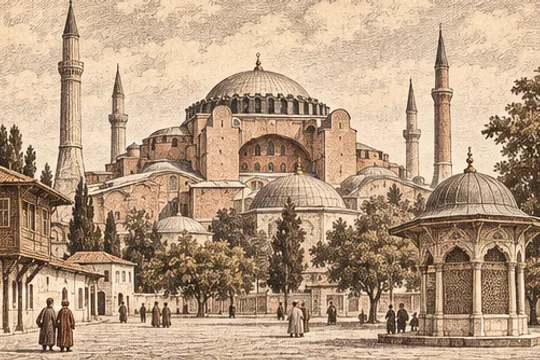
The Ottoman sultan Selim I, known as Yavuz, took Cairo on 24 January 1517. On 4 February he entered the city in a grand ceremony and brought to an end the Abbasid caliphate under the Mamluks of Egypt.
On 6 July 1517 the personal possessions known as the Sacred Relics, among them the Prophet Muhammad’s mantle, a tooth, his standard and his sword, were sent from the Hejaz to Sultan Selim.
At a grand ceremony in Hagia Sophia Mosque on 29 August 1517, Selim received from the last Abbasid caliph, al-Mutawakkil III, the title of Hadim-i Haremeyn-i Şerifeyn, or Servant of the Two Holy Sanctuaries, Mecca and Medina. He thus became the religious and political leader of all Muslims.
According to tradition, al-Mutawakkil III took the pulpit and announced that he had transferred the caliphate to the Ottoman ruler, Sultan Selim Khan. With his own hands he took off the robe he was wearing and placed it on Selim’s shoulders, then fastened the sword, one of the insignia of the caliphate, about the sultan’s waist.
Following those rulers, all subsequent Ottoman sultans also used the title of “Caliph” in addition to “Sultan” and “Padishah.” The office of Caliph remained within the domain of the Ottoman State for 407 years, until November 1, 1922.
The last sultan to hold this title was Mehmed VI Vahdettin, the 115th caliph of Islam. During the War of Independence and the founding of the Republic, stories were fabricated in an effort to undermine the caliphate. The promises İsmet İnönü made to the British about the caliphate when he went to the Lausanne negotiations brought the institution to an end. The British knew very well that the office of caliph carried a certain weight, particularly among the Muslims of India.
Following promises made to the British behind closed doors by Mustafa Kemal and İnönü, these gradually began to be implemented. On November 1, 1922, the TBMM (Turkish Grand National Assembly) separated the Sultanate and Caliphate, abolishing the Sultanate, and limiting the Caliph’s powers to solely religious matters. Following the departure of Sultan Vahdettin, Abdülmecit Efendi, from the Ottoman dynasty, was subsequently elected as the 116th Caliph by the TBMM.
Although the Treaty of Lausanne was signed by Turkey on July 24, 1923, England did not sign the agreement for a year. This was due to the Turkish Grand National Assembly not abolishing the office of the Caliph. England only signed the treaty on July 16, 1924 – four months after the office of the Caliph was officially abolished on March 3, 1924. As a result, the office of the Caliph, which had been under the control of the Turks for a full 407 years, was eliminated by Republican administrations lacking vision and unable to foresee the future, effectively severing it from the Muslim world and the Middle East. Following this date, the office of the Caliph remained vacant and without a guardian. However, to this day, Friday prayers are still being delivered in Moro and Aceh in the name of the Ottoman Caliph. Ottoman sultans and caliphs never used the office of caliph for their personal or political affairs. Throughout the 407-year Ottoman caliphate, neither our own archives nor those of foreign countries, have revealed a single complaint document related to the office of caliph.
The entire fabrication and lies surrounding the notion that the Caliphate has been used for religious purposes were created by the slanderous and lacking-in-character administrators of the Republic.
The authority of the Christian caliphate is the Vatican. Today, no one is questioning the existence of the Vatican. However, the removal of the Islamic caliphate has eliminated the most important reference point for Islam, leaving it without leadership and oversight.
The removal of this position serves the direct interests of many Western countries, including the Vatican. The British Government has adopted the removal of the Ottoman Islamic Caliphate as a state policy, taking into account the potential effects and dangers on India and other Muslim colonies. Today, it is abundantly clear how the termination of the Caliphate has led to a state of impasse throughout the Islamic world, particularly in the Middle East.
For years, Egypt has been seen as the leader among Islamic countries, and those who, due to the bizarre and questionable rulings of the unorthodox imams and mollas of Al-Azhar University – who see them as the authority issuing these rulings – have recently begun to understand how crucial the position of Caliph was.
Those who accuse Iran of exporting the Islamic Revolution could not explain how to reconcile the Vatican’s missionary activities promoting Christianity. Imagine if someone were to suggest that the Vatican’s supposed divine identity should end. Wouldn’t even Protestant England initially oppose such a suggestion? Because they are well aware that the collapse of the Catholic Church will lead to the emergence of hundreds of new sects, and that this will create new power dynamics in Europe and around the world in the medium and long term, and they act accordingly. However, Mustafa Kemal and his group were unable to grasp the importance of the Ottoman Caliphate, a matter directly concerning us as Muslims, and the disadvantages that will arise from the absence of this institution.
The abolition of the Caliphate has left the Islamic world feeling rudderless. In the Middle East, the Arab states established with the support of the British and Mustafa Kemal have seen all their connections with each other dissolve. This sense of vulnerability has accelerated sectarian divisions and driven different faith groups into conflict.
The leader of a terrorist group called ISIS has declared himself caliph, inviting Erdoğan, the most powerful leader in the Muslim world, to pledge allegiance to him. Currently, a major underlying cause of the problems being experienced in the Middle East and the Islamic world is the absence of this group.
To establish a lasting peace and security environment in the Middle East, designed and implemented through our own initiative, Turkey needs to take radical decisions and take steps that would fundamentally alter the course of the Lausanne Treaty. At this point, it is necessary to repeal Law No. 431 of 1924, “The Law Regarding the Abolishment of the Caliphate and the Exclusion of the Ottoman Dynasty from the Properties of the Turkish Republic,” and to declare the oldest living male of Ottoman descent as the Caliph. The position remains under the authority of the Ottoman dynasty according to Islamic and customary laws, and it is impossible for any institution, including the Turkish Grand National Assembly, to abolish it. Furthermore, all sacred relics representing the Caliphate are still under our authority at Topkapı Palace. (The Ottoman sultans have always shown great care for the sacred relics, as exemplified by the Caliph III…) Following the reigns of the previous rulers, these “emanet” (loans/gifts) received from the former rulers were continuously added to, and rare and valuable items found within them were purchased.
The Caliphate is the most important institution for all of the world’s Muslims. This institution will not weaken the New Turkish Republic; on the contrary, it will strengthen it and enhance its reputation worldwide. Just as the British Queen is as symbolic in England as the Pope is in the Vatican, the new Ottoman Caliph will be equally symbolic. However, it is impossible to even estimate the political and regional power that this position will bring to Turkey. The re-establishment of the Caliphate would bring Turkey to a respected position worldwide. This would effectively dismantle the existing influence of countries like Egypt and Saudi Arabia within the Muslim world. Turkey would become a symbolic leader for the entire Muslim world, yearning for justice and righteousness.
The salvation of this sacred institution, wrested from the clutches of groups like ISIS, which now pose a threat not only to the Middle East, but also to all Western countries, will create a genuine and heartfelt sense of joy and celebration among Muslims worldwide. Turkey’s influence and power within international organizations, including the United Nations, will increase, and institutions such as the Organization of Islamic Cooperation or the Islamic Development Bank, which currently lack any real validity on the world stage, will be reshaped under Turkish leadership.
Could you imagine a “New Turkey” that, like in the past, would once again hold the Caliphate, encompassing cities like Mosul, Karkheh, Şam (Damascus), and Halep (Aleppo)?
Do you know what would happen if, on the day Hagia Sophia Mosque opens for worship, President Erdoğan were to invest the eldest male member of the Ottoman dynasty with the robe and sword of the caliphate as the 117th caliph of Islam?
On that day, the sky wept. The Prophet Muhammad, Hz. Ebubekir, Hz. Omer, Hz. Osman, and Hz. Ali, stood at the very forefront. Along with Sultan Fatih Mehmet Han, who gifted this sacred city to Islam and Turkishness, and all other Ottoman Sultans, they made prostrations in a state of deep reverence and a thousand prostrations.
On that day, those who had fallen – every single soul who died in the name of Islam, in cities like Aleppo, Egypt, Damascus, Jerusalem, Diyarbekir, Crimea, Tiflis, Sarajevo, Athens, and all other lands under the foot of Islam – were gathered in Hagia Sophia, wrapped in pristine white shrouds.
On that day; all Muslims around the world would give thanks to God, and you wouldn't be able to find a single square inch in Istanbul – from Sultanahmet to Topkapı – where a prayer rug could be laid.
On that day, the degrading clauses that threatened Turkish honor were eliminated one by one, and a fully independent, strong Turkey was established.
Translated from the Turkish original. Türkçe