
If President Erdoğan were to gird the caliph of Islam with a sword
12 August 2014 · Personal website
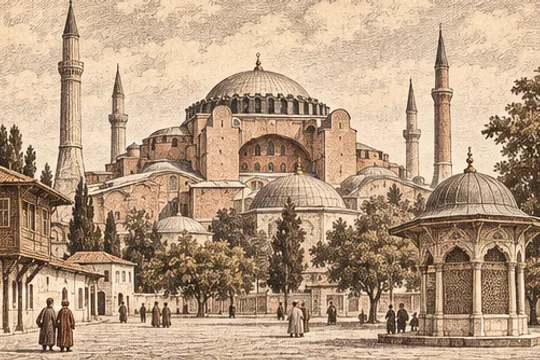
Ottoman Sultan Yavuz Sultan Selim conquered Cairo on January 24, 1517, and, in a grand ceremony, brought an end to the Abbasid Caliphate, which was dependent on the Mamluks of Egypt, on February 4.
On July 6, 1517, the “Sacred Relics,” including items belonging to Prophet Muhammad such as his cloak, sash, flag, and sword, were sent to Sultan Yavuz Selim from the region of Hijaz.
Yavuz, on August 1517, received the title of “Hadim-i Haremeyn-i Şerifeyn” – “Servant of the Sacred Cities of Mecca and Medina” – in a grand ceremony held at the Hagia Sophia. From that moment on, he became the religious and political leader of all Muslims in the world.
According to reports, Sultan III. Muhteşem announced to the assembly that he was transferring the Caliphate to Sultan Selim, the Ottoman Sultan. He personally dressed the robe he wore to resemble Sultan Selim’s, and fastened the sword, one of the honors bestowed upon the Caliph, to the Sultan’s belt.
Following those rulers, all subsequent Ottoman sultans also used the title “Caliph” in addition to “Sultan” and “Padishah.” The office of Caliph remained within the domain of the Ottoman State for 407 years, until November 1, 1922.
The last sultan to hold the title was Mehmed VI Vahdettin, the 115th caliph of Islam. During the War of Independence and the founding of the Republic, fabricated reports were used to undermine the caliphate. The promises İsmet İnönü made to the British at Lausanne concerning the caliphate brought the office to an end.
The English, were very aware that the office of the Caliph held a significant authority over the Muslim population of India. Given that the office of the Caliph represented a major threat to British imperialism, it was considered necessary to remove it – to take it – from the hands of the Turks and Muslims.
During the Lausanne negotiations, Mustafa Kemal and İnönü’s promises made to the British were gradually fulfilled. On November 1, 1922, the Sultanate and Caliphate offices were separated, the Sultanate was abolished, and the Caliph’s authority was limited to religious matters. Following Sultan Vahdettin’s departure from the country, Abdülmecid Efendi from the Ottoman dynasty was elected as the 116th Islamic Caliph by the TBMM (Turkish Grand National Assembly).
Although the Treaty of Lausanne was ratified by Turkey on July 24, 1923, England did not sign the agreement for a year. This was due to the Turkish Grand National Assembly not abolishing the office of the Caliph. England only signed the agreement on July 16, 1924 – four months after the office of the Caliph was officially abolished on March 3, 1924. As a result, the office of the Caliphate, which had been under Turkish control for a full 407 years, was eliminated by Republican administrations lacking vision and unable to foresee the future, effectively severing ties between Turkey and the Muslim world, and from the Middle East.
Following this date, the office of the Caliph was vacant and without a holder. However, even today, Friday prayers are still being delivered in Moro and Aceh in the name of the Ottoman Caliph. Ottoman sultans and Caliphs never used the office of the Caliph for their own personal or political affairs. Neither our own archives nor those of foreign countries have revealed a single negative document concerning the office of the Caliph.
All the baseless accusations and lies suggesting that the Caliphate position was “used for political purposes” have been fabricated by those in charge of the Republican administration.
The position of Caliph, traditionally associated with the Christian faith, is now held by the Vatican. Today, no one is debating the Vatican’s role in this position. However, the removal of the Islamic Caliphate has effectively eliminated one of the most important reference points for Islam, leaving it without a central authority and oversight.
The removal of this office serves the direct interests of many Western countries, including the Vatican. The British Government viewed the existence of the Ottoman Islamic Caliphate as a significant threat, considering its potential impact on India and other Muslim colonies. Today, it is clear how the termination of the Caliphate has led to a state of impasse throughout the Islamic world, particularly in the Middle East.
Do you know what would happen if someone were to try to end the Vatican’s ultimate identity? Initially, Protestant England would oppose such a desire. Because they are well aware that the destruction of the Catholic Church would lead to the emergence of hundreds of new faiths, and that this would create new power dynamics in Europe and worldwide in the medium and long term, and they act accordingly.
Republican officials, much like those before them, failed to grasp the significance of the Caliphate and were unable to foresee the problems that would arise in the years to come due to its demise.
The removal of the Caliphate has left the Islamic world leaderless, completely severing Turkey’s ties with countries in the Middle East. This has exacerbated sectarian differences and driven various faith groups into opposition.
To establish a lasting peace and security environment in the Middle East, designed and implemented through our own initiative, Turkey must take radical decisions and take steps that would dismantle the Treaty of Lausanne. Specifically, the 1924 Law No. 431, concerning the Abolishment of the Caliphate and the Exclusion of the Ottoman Dynasty from the Properties of the Republic of Turkey, should be revoked, and the oldest living male of Ottoman descent should be declared as the Caliph.
The Caliphate remains under the authority of the Ottoman dynasty, according to both Islamic and customary laws, and this position cannot be eliminated by any institution, including the Turkish Grand National Assembly. A person’s religious beliefs cannot be determined or removed by law.
The Sacred Trusts, which represent and symbolize the Caliphate, are currently held within Topkapı Palace. The Ottoman sultans took great care of the Sacred Trusts, and the collection steadily grew over time, with successive sultans adding to it, including the acquisition of rare items, inherited from the Caliph III. Mütevekkil.
Caliphate is the most important institution within the global Muslim world. This institution does not weaken, but rather strengthens, the New Turkish Republic, and enhances its standing in the world. Just as the British Queen is so symbolic in England, and the Pope is so symbolic in the Vatican, the new Ottoman Caliph will be equally symbolic. It is almost impossible to estimate the political and regional power that this position will bring to Turkey. Restoring the Caliphate would bring Turkey to a respected position worldwide. This would effectively dismantle the influence of countries like Egypt and Saudi Arabia, which currently have no real influence over Islamic nations. Turkey would become a symbolic leader of the entire Muslim world, yearning for justice and righteousness.
This terrorist organization, comprised of groups like ISIS, which poses a threat not only to the Middle East but to the entire world, must be rescued from this sacred institution. This will create a sense of joy and celebration among Muslims. Turkey’s effectiveness and power within international organizations, including the United Nations, will increase, and institutions such as the Organization of Islamic Cooperation or the Islamic Development Bank will be restructured under Turkey’s leadership.
Do you know what would happen if, on the day Hagia Sophia Mosque opened for worship, President Erdoğan were to invest the eldest male member of the Ottoman dynasty with the caliph’s robe of honour and gird him with the sword as the 117th caliph of Islam?
On that day; the sky will weep. The Prophet and the Caliphs will be at the forefront.
With Sultan Fatih Sultan Mehmet, and all other Ottoman sultans, weeping and prostrating themselves in reverence, this sacred city was presented as a gift to Islam and to the Turkish people.
On that day, the ground was shaking.
In Aleppo, Egypt, Damascus, Jerusalem, Diyarbekir, Crimea, Tiflis, Sarajevo, and Athens, as well as in all other lands where Islam has taken root, every soul who dies fighting for Islam will be laid to rest in Ayasofia, wrapped in white shrouds.
On that day, all Muslims around the world would be weeping and giving thanks to God.
It’s impossible to find even a small patch of ground in Istanbul, from Sultanahmet to Topkapı, where you could lay down a prayer rug.
On that day, the degrading clauses of the Treaty of Lausanne, which threatened Turkish honor, were eliminated one by one.
And on that day, a fully independent and strong Turkey would be established.
Translated from the Turkish original. Türkçe