
Dictator İnönü’s shaving set worth 400 gold coins…
31 March 2017 · Personal website
(Article 146 — 31 March 2017)
The CHP came to power in 1923 and governed the country under single-party rule for a full twenty-seven years, until the election of 14 May 1950 brought the Democrat Party to power.
Has any of you ever wondered how the CHP governed this country?
At harvest time, removing wheat, barley or any other crop from the field without telling the state was an offence. First the tithe collector would come and take away the state’s share. Whatever was left was yours, and nobody could object. The state took more than half the crop. A tractor? Where would you find one? In the summer heat an ox was harnessed to the threshing sledge. Those who had no ox harnessed themselves to it.
In the forties you couldn’t find bread. Honey, tea, sugar and fat were out of the question. Anyone who had bread was someone to point out in a crowd. In the villages only the landowners had it at home. It was sold on ration cards: a family of eight was entitled to no more than four or five loaves a day, and only those with money could buy even that.
To ward off hunger people gathered wild greens. With no wheat to be had they mixed the greens with barley flour and baked little loaves. In the days when bread, kerosene and sugar were rationed, it was forbidden to carry flour from one town to another. You had to live on whatever food and drink your own district could provide.
In the villages it was hard to find even an ox to draw a wooden plough. Sheep and goats were subject to a livestock tax, the ağnam. People unable to pay their tax debt were put to work on the roads for at least twenty or thirty days under what was called the “whip tax”. Machinery on the roads? Rock and mountainside alike were broken through with muscle and pickaxe. In those years the tax was one lira per sheep and sixty to eighty kuruş per goat. The tax on one goat was reckoned equivalent to a day’s wages. Someone with twenty goats or sheep who could not pay had to work on the roads for twenty days.
In town and village alike, people lacked everything. Jackets, trousers, hats, shoes: everything was patched. To go into town you would borrow a slightly better robe from a neighbour and find someone to lend you an overcoat. Even getting dressed relied on borrowing. Hats were compulsory. People who couldn’t afford one stitched something vaguely hat-shaped out of thick cloth and put it on their heads.
When soldiers came to a village they would round up anyone wearing a skullcap, throw it to the ground, stamp on it and give its wearer a beating. Even carrying a pocketknife or a knife was a crime. Offenders were beaten half to death at the station and dumped in the village square as a lesson to all. At the cry of “The soldiers are coming!” people hid their Qurans. Copies that were found were burned or torn up. Those who read or taught the Quran were beaten and left in custody without food or water.
Under single-party rule the call to prayer was in Turkish. People were afraid even to go to the mosque. On Fridays the gendarmes stood watch there to check that the call was made in Turkish.
In those days the word of God was taught secretly in stables. At funerals only the Fatiha was recited. Recitations of the Quran and prayers of supplication were forbidden. Almost everywhere in the country it was hard to find an imam to wash, shroud and bury the dead.
In many districts of eastern and southeastern Anatolia, cloth was so scarce that boys and girls alike wore a long garment called a zıbın. We can see it in the black-and-white photographs that have come down to us.
Every household under single-party rule was charged a six-lira road tax. Those unable to pay had to do forced labour on the roads. A watchman or a gendarme collected the tax and took defaulters away, no questions asked. A day’s labour was reckoned at one lira, so a six-lira bill meant six days’ work.
The poverty of those years defies description. No shoes on your feet, no cardigan on your back, not even drawers to cover your backside. Some spent eleven months building roads in rubber sandals. They swung sledgehammers and pickaxes all day with nowhere to bathe. Their most luxurious meal was bread with onion and cheese.
And don’t mistake “well off” then for what we call well off today. A family deemed comfortable in those days could afford baklava barely once a year. Scarcity was extreme. Civil servants drew their salaries and lived at ease while ordinary people were ravaged by want.
In a courtroom in the 1940s, the wife of a man shot dead by a watchman as he stole fruit from a garden for his sick child defended her husband in these words: “We thought it would be no sin to steal to keep alive the life God had given.”
The Second World War had broken out. Inflation reached 103 per cent in 1940 and 165 per cent in 1941. The economy kept shrinking. The army took 61 per cent of Turkey’s budget. National income per head was 1,600 dollars.
Malnutrition brought a rise in lung disease, and theft increased. Newspapers regularly carried reports of parents who killed children they could not feed, babies abandoned in the streets, and fights breaking out as the bread ration was distributed.
Amid all this privation there were those who lived it up. Foremost among them was the dictator of the day, President İnönü. While people were gathering weeds to fill their bellies, the extravagant demands of İnönü and his family were regularly forwarded to ambassadors abroad, invariably marked “urgent”.
On 7 February 1940 Kemal Gedeleç, secretary-general at the Çankaya presidential residence, wrote to Behiç Erkin, ambassador in Paris. The letter, marked “Private”, concerned a car for İnönü’s child:
“We wish to purchase a Delahaye sports car for the sons of our President. I would be most obliged if you would advise me at what price one of the finer models of this make, with an eight-cylinder engine, could be obtained, payable in freely convertible currency and delivered duty-free in Istanbul. If possible, kindly also send a photograph of the model selected. With my deepest respects.”
On 5 April 1940 the secretary-general again wrote to Ambassador Behiç Erkin in Paris, this time with requests prompted by the National Chief’s passion for billiards.
“I would be obliged if you would kindly arrange to obtain the articles required for our President’s billiards, particulars of which, together with the address of the shop where they are sold, appear in the attached memorandum, and have them forwarded with the invoice. I take this opportunity to renew the expression of my deepest respects.”
On 18 April 1940 the president’s secretariat wrote instead to Tevfik Rüştü Aras, the ambassador in London, requesting two dozen cakes of soap. It seems that Turkey, the country that was to rise to the level of contemporary civilisation, had run out of soap. An order went to London.
“My dear and esteemed Dr Aras, may I ask you to have two dozen cakes of the shaving soap advertised in the enclosed notice sent to us. It is sold at Morny’s on Regent Street in London. I take this opportunity to reaffirm my deepest respects.”
And what did the ambassadors do when such requests arrived? Let’s look at a few of the replies.
From the reply sent to the presidential residence on 20 March 1940 by Ambassador Behiç Erkin, who rescued Jews in occupied Paris from the Nazi genocide:
“My most esteemed Mr Kemal Gedeleç, I respectfully acknowledge your instruction of 11 March and your telegram of 18 March. I have personally examined the cloth samples and placed the order for the riding outfit requested for our exalted President. The tailor has ordered the cloth from London… I considered sending samples for a moment but decided against it so as not to delay matters. Today I went to the motor works. I saw the colours for the paint, folding hood and upholstery and could not reach a firm decision. I submit three samples for the car’s colour, numbered 1, 2 and 3. After you have examined them I await your instructions by telegram as to the colours of both the car and the leather, for example ‘No. 3 and yellow leather’.”
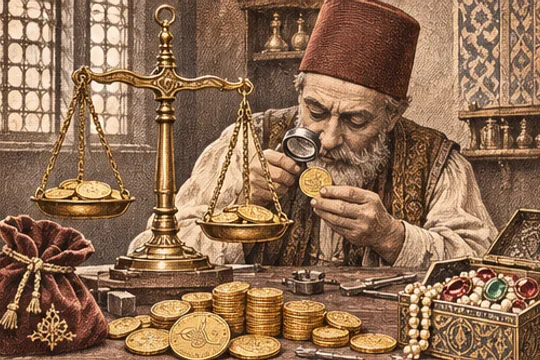
As for the gold shaving set that the president requested from abroad in 1939, Saran, the jeweller on İstiklal Avenue who took the orders, wrote as follows to the secretary-general at Çankaya:
“I have arrived in Istanbul and begun work on the orders entrusted to me. Having calculated how much gold the boxes and the dressing set will require, I shall need four hundred gold liras. Today I ordered the brushes, mirror, comb and crystal bottles for the dressing set from Paris by telegram. They will arrive in your name. Should the diamonds to be mounted on the pieces and the silk velvet prove unobtainable here, we shall probably have to order those from Paris too.”
A story my late father told me says a great deal. In the forties my grandfather, a blacksmith, was the elected head of his neighbourhood and comparatively well-off by the standards of the day. Yet famine and poverty were so widespread that there wasn’t a grain of wheat in the house. Grandfather’s white donkey had to eat too. The household barley went to the donkey first. My late grandmother would pick what grains remained out of its droppings, wash them and bake barley bread for the family.
On one side, people eating barley gleaned from donkey dung. On the other, DICTATOR İNÖNÜ’s shaving set at four hundred gold liras!
For the blockheads who say, “So what? He was the great National Chief. Why make a fuss over a shaving set worth four hundred gold liras? Look how much the man did for his country,” let me put that gold into Turkish liras for you: FOUR HUNDRED THOUSAND LIRA, exactly.
The left-wing mentality that says NO to constitutional change, a relic of the Committee of Union and Progress, bases its whole idea of the state on one principle: “We are Turkey’s true owners.”
In that view, the people are there to be trodden down, while the elite, meaning themselves, get to govern and administer.
If we are to challenge that mentality and change it at its roots, I suppose we have little choice but to vote YES.
Dr. Mehmet Hakan Sağlam
Translated from the Turkish original. Türkçe