
Yes, the dollar reached five lira. But when did Turkey produce so many out-and-out sons of b…?
4 August 2018 · Personal website
(Article 242 – 4 August 2018)
At the personal direction of the US president, sanctions were imposed on the Turkish ministers of the interior and justice. There are in fact many reasons behind that decision. With aggressive moves of this sort, the United States is turning further inward by the day and eroding its standing.
The threat of force is your most potent weapon. It is more frightening than actually using force against your enemy. If power goes to your head, you drown in your own arrogance and turn the threat into action, the whole situation can change in an instant. Someone you never expected will come along and say, “Thinking of hitting me? Go on, hit me if you’ve got the guts.” And if you can’t, from that moment on you’ve made an utter fool of yourself.
By deciding to impose sanctions on Turkey and going so far as to withhold the aircraft Turkey was due to receive under the joint F-35 programme, the United States has “pissed on the mosque wall.”
This has damaged relations between the United States and Turkey beyond repair. Nothing will ever be the same again.
So does this American hostility toward Turkey stem solely from the imprisonment of a terrorist by the name of Pastor Brunson? Of course it doesn’t. The real aim is to trip up Turkey as it grows stronger and moves steadily toward becoming a global power.
The Qatar crisis a year ago showed how important and indispensable Turkey is to this region. Were it not for Turkey, and Erdoğan in particular, there would be no state called Qatar today.
History is being rewritten in this region. With the Trans-Asian Railway, a new, modern Silk Road is taking shape on land and at sea. Turkey is undoubtedly the most important link in the new railway route from China to London.
Over the next ten years, the countries that stand with Turkey, Russia, and China will grow richer while the West grows poorer.
Goods from China, Kyrgyzstan, Uzbekistan, Turkmenistan, Russia, Iran, Azerbaijan, Georgia, Turkey, and all the other countries and towns along this route will pour into Europe by way of the Trans-Asian Railway and the Yavuz Sultan Selim Bridge, just as they did 500 years ago. Shipping costs and transit times will drop to a minimum. Goods from the Far East that take two or three months to reach European ports by cargo or container ship will reach the heart of Europe in just two weeks.
The rail corridor is largely complete. Once it is fully operational, freight transit between China and Turkey will fall from 30 days to 10. Goods from Beijing that used to take two months to reach Turkey by sea will reach Istanbul in seven or eight days. The overland distance will also be reduced by 3,000 kilometres.
Marmaray, the Yavuz Sultan Selim Bridge, the Baku–Tbilisi–Kars railway, and the Edirne railway projects form the middle corridor of the modern Silk Road. This project is the main source of the West’s anxiety and fear. The Cape of Good Hope, discovered by Bartolomeu Dias in 1488, which led to the impoverishment of Eastern countries, is rapidly losing its importance.
Once the new Silk Road comes into operation, shipping and container lines, insurers, customs businesses, and port operators across Europe will go under, factories will close, and continental Europe will be left with an army of unemployed people.
The Persian Gulf and the Red Sea are of great importance to the maritime leg of the new Silk Road. Over the past few years, Turkey has taken major steps to secure logistics in both waters, establishing military bases in Qatar, on the Persian Gulf, and Somalia, on the Red Sea. These bases matter greatly to maritime security in Africa and the Middle East and to the security of the countries in the region themselves, as the Qatar crisis showed.
Disturbed by Turkey’s transformation, the United States first tried to get people out onto the streets through FETÖ, the organization it had cultivated, and orchestrated the Gezi protests in May 2013. When that failed, the same organization was used to launch the 17–25 December 2013 judicial and police coup and set a corruption trap for four government ministers. When that failed too, came the 15 July 2016 coup.
After the July 15 coup failed, the US administration grew exceedingly aggressive. It dispensed with the FETÖ, PKK, ISIS, and DHKP-C terrorists as intermediaries and began attacking Turkey openly. Trump and Pence’s push for sanctions over Pastor Brunson was the high point of that attack.
Pence and US President Donald Trump’s threats against Turkey came after important talks held by President Erdoğan and Treasury and Finance Minister Albayrak. Among Washington’s chief concerns were Erdoğan’s talks with the presidents of China and Russia during the BRICS meetings, the purchase of S-400 missile systems from Russia, and discussions with the Chinese president about using each country’s own currency in bilateral trade and having China build Turkey’s fourth nuclear power plant.
An agreement with the world’s largest bank is another sign that the threats are no coincidence. Treasury and Finance Minister Berat Albayrak announced that Chinese financial institutions had finalized a $3.6 billion loan package for private businesses, public institutions, and banks to invest in the energy and transport sectors.
Another target of the threats is what Turkey’s economy stands to gain from the US–China trade war. The international credit rating agency Fitch Ratings had said that the escalating trade war between the United States and China might benefit Turkey’s economy next year and in 2020.
America’s attempt to blackmail Turkey with sanctions and threats came just as Turkey was taking these important steps toward growth. Once more, it is plain that this dirty operation is no coincidence. The targets are Turkey’s growing economy and the strategic steps it is taking in its bilateral relations.
Now to the dollar.
For Turkey to gain financial independence and keep certain powers from repeatedly targeting its economy, it needs to “build up its own capital.” Capital is built by producing and exporting. But the fact is that Turkey’s exports are growing nowhere near as quickly as they did between 2002 and 2015. Exports climbed rapidly from $35 billion to $160 billion, yet for the past four or five years they have barely budged. The main reasons include limited export diversification, insufficient capacity, shrinking markets, a failure to establish brands, a shortage of patents and know-how, economic troubles in the countries we export to, economic, political, and military crises worldwide, high interest rates, growing pressure on the exchange rate, and domestic political and economic risks.
But there is one thing more important than all of these, which we cannot afford to overlook. You can have a driver’s licence and a very nice car, but you still need petrol in the tank to get it running. The chief thing that will keep the wheels of the Turkish economy turning is that “petrol,” meaning money and finance. Unfortunately, money is a scarce resource in Turkey.
Because we have been unable to solve the financing problem, many investors, notably banks, borrow abroad at high interest rates. They convert the loans they obtain in foreign currency into Turkish lira, add the cost of exchange-rate risk, and lend the money to borrowers in Turkey. In the process borrowing costs climb from 3.5–4 percent to as much as 22 percent.
I have written about this time and again. Claims like “We’ll bring the exchange rate down,” “Anyone buying foreign currency will get burned,” and “This rise is artificial” are all just talk.
First we need to deal with “dollarization” in the Turkish economy. Homes and business premises are rented in foreign currencies, cars and houses are sold in foreign currencies, and state privatizations and build–operate–transfer tenders are conducted in dollars or euros. Currency exchange offices spring up one after another, like liquor shops on almost every street. Isn’t this a serious problem?
Wouldn’t it be more effective for central bank officials to act more sensibly and for lawmakers to adopt measures that reverse the trend toward dollarization? Suppose, for example, the government decided that when a dispute arises, a lease denominated in foreign currency cannot be litigated in court. Would anyone sign another lease or purchase agreement in dollars or euros?
Foreign-currency borrowing from abroad must be subject to clear criteria. Yes, money is scarce in Turkey. But if financing is obtained from abroad, how it will be repaid and what kind of investment it will fund are also very important. If, for instance, someone secures a $5 million loan abroad to produce and sell in Turkey, we should tell them to stop. At this stage it would make sense to require exports worth two, three, or five times the amount borrowed abroad. Foreign loans could then be repaid out of export earnings, relieving pressure on the domestic foreign-exchange market.
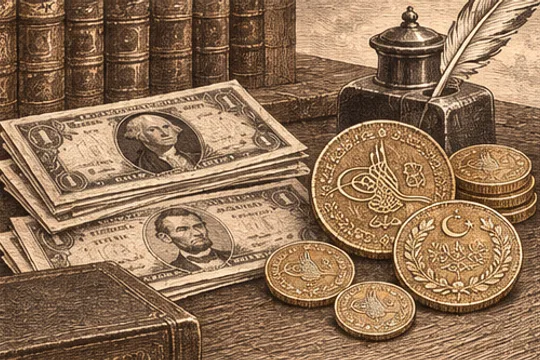
Turkey and the United States are at odds, and the dollar has risen to five Turkish lira after the US sanctions decision. It is hard to believe that some people are posting against TURKEY in the midst of all this.
A rabble of rotten people who put “T.C.” before their names and use Mustafa Kemal’s portrait as their profile picture are all but applauding the United States for its sanctions. This shameless crew is beside itself with joy, so much so that they would lick US President Trump’s ass if they could.
These dimwitted idiots see the decision as a rebuke to Erdoğan more than an action against Turkey. They haven’t a shred of love for their country or a grain of patriotic sentiment.
When I see shameless people practically dancing for joy over America’s decision and posting “DID WE STICK IT TO YOU?” on social media, I can’t help asking myself: “When did Turkey spawn so many traitorous, dyed-in-the-wool sons of b—s?”
Dr. Mehmet Hakan Sağlam
Translated from the Turkish original. Türkçe