
The game being played against Turkey through the dollar…
16 May 2018 · Personal website
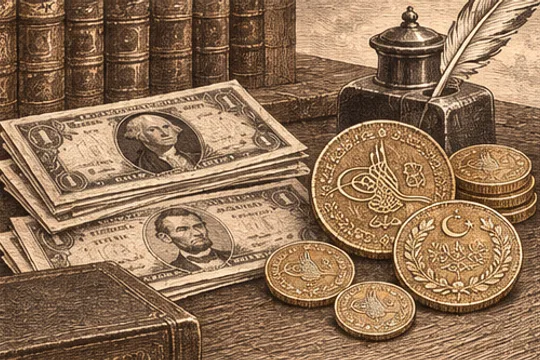
(Article 228 – 16 May 2018)
US President Trump announced live to the world his final decision on whether the United States would withdraw from the nuclear agreement reached with Iran under Obama: “I am announcing that we are withdrawing from the nuclear agreement.” Trump called it “a disgraceful, one-sided, terrible agreement” and made a point of adding, “If I let the nuclear agreement stand, there will be an arms buildup in the Middle East!”
The same Trump lit the fuse in the Middle East on 15 May 2018 by moving the US embassy from Tel Aviv to Jerusalem. The result? Nearly a hundred Muslim Palestinians were killed by the bastards of the terrorist state of Israel, and thousands were wounded.
Yet isn’t it the United States itself that has made the Middle East into an “arms market” of sorts and hands out weapons for free to practically every terrorist organisation, foremost among them the PYD, YPG and PKK? Unfortunately, might makes right, and that rule never changes in this world.
The US withdrawal from the Iran nuclear agreement and talk of new embargoes and sanctions against Iran have already started to alarm many European companies. The hardest-hit sector will undoubtedly be aircraft manufacturing. The $38 billion agreement between Tehran and the aircraft manufacturers is in jeopardy, and in my view it’s finished. Europe’s Airbus faces a greater risk than its US rival Boeing. The Iranian government’s national airline, Iran Air, had ordered 200 passenger aircraft with a list price of $38.3 billion. It planned to buy 100 from the European company Airbus, 80 from its American competitor Boeing and 20 from ATR, the Franco-Italian venture.
The US embargo decision will take effect in two phases, on 6 August and 4 November 2018, and will be tougher than the embargoes imposed on Iran in earlier years. In the first phase:
The Iranian government will be barred from transacting in US dollars.
Trade in gold and precious metals will be blocked.
Imports of graphite, aluminium and steel, as well as coal and products for software development, will be banned.
Countries seeking to export these products to Iran will also face sanctions.
Iran will be prevented from controlling its resources held outside the country.
Iran will be prohibited from holding government bond auctions or selling bonds.
Restrictions will be imposed on the automotive sector.
Sales of food and carpets from Iran to the United States and related financial transactions will be suspended.
Sales of passenger aircraft, equipment and services to Iran will stop.
In the second phase, on 4 November 2018:
All oil transactions and services connected with Iran will stop.
Purchases from Iran of all petroleum-based petrochemical derivatives will be prohibited.
Transactions between Iran’s central bank and all foreign banks and financial institutions will stop.
The flow of global economic news relevant to Iran’s central bank and financial institutions will be prohibited. All Iran-related insurance transactions will stop.
Embargoes will take effect against Iran’s entire energy sector, including oil.
The country’s port operators, shipyards and shipping industry will also be covered by the embargo.
The apparent aim of the embargo is to isolate Iran, but its real target is to obstruct Turkey, which trades extensively with Iran. Turkey buys oil and natural gas from Iran and in return sells it practically everything under the sun. What has kept Iran on its feet through thirty-five years of embargo is above all having a neighbour like Turkey. When Iran is in a tight spot, the “first country” to extend a hand is undoubtedly Turkey. The reasons are the presence of Azerbaijani Turks, who account for nearly half of Iran’s population, and two thousand years of living together in this part of the world.
Iran struck a nuclear deal with the US during Obama’s term and escaped the pressure of the embargo. Its biggest mistake lately was to try to put itself at the very centre of the Syrian war. Iranian-backed Shia militias committed ruthless acts against Sunni Muslims in both Iraq and Syria. Iran gradually started moving into Syria at Assad’s invitation. That was enough to frighten Israel, and Trump, unable to withstand pressure from the Jewish lobby any longer, unilaterally withdrew from the international agreement with Iran.
President Erdoğan said that the United States would suffer most from the collapse of the agreement, and that assessment is quite right. Until fifteen or twenty years ago people in this region felt sympathy for the US. It has given way to intense hatred. You won’t find a single sensible Arab citizen who feels any affection for America.
Only three or four states in the Middle East still give the US unconditional support: Israel, Saudi Arabia, the United Arab Emirates and Bahrain. In the long run things will end very badly for Israel, and for the other three, believe me, they will end badly in the short run.
A few days ago UAE forces landed on Yemen’s island of Socotra. The aim is to control the entrance to the Red Sea. The country called the UAE has a population of nine million. Its army is scarcely better than that of Africa’s “Mokoko” tribe, running barefoot with spears in hand! Egged on by America and Israel, this excuse for a country thinks it matters and now keeps picking fights with Turkey and Iran. As people would say, “the UAE is itching for trouble”. The main reason a country that could be flattened with a flick of the finger has entered a contest for power with Turkey and Iran is the backing the US and Israel give it. What happens when they withdraw their support? The keffiyeh-wearing Arab has got so carried away he doesn’t even think about it.
History repeats itself. How unfortunate that officials in the UAE, Bahrain and Saudi Arabia cannot see how many countries in this part of the world have recently been stabbed in the back in an instant by people they thought were friends. They don’t even remember how the US, which stood solidly behind Saddam in the Iran–Iraq War, turned on him during the First Gulf War.
Nor do they remember how, a hundred years ago, Sharif Hussein of Mecca rose against the Ottoman state after the British promised him the kingdom of the Arabian Peninsula, only to come away empty-handed and die in exile.
You will see that Saudi Arabia, Egypt, Bahrain and the United Arab Emirates, who now go to any lengths to ingratiate themselves with the United States, will fall into the pit they dug and watch their countries slip through their fingers.
As for Iran, as I said at the start, the target here is “Turkey”. Turkey has become the most strategically important and powerful state in this part of the world. Nothing Turkey disapproves of can be done in Syria, Iraq, Sudan, Somalia, Yemen, Qatar or Kuwait. The US, Britain, France and Germany are well aware of it.
The Middle East’s oil reserves will continue to whet Western appetites for the next hundred years. The scent of oil brings all the colonial powers together like sharks scenting blood in the ocean. Everyone wants a slice of the pie, and hardly a day goes by without a new move. Trump’s cancellation of the Iran agreement, the UAE landing troops on Socotra, France and the US establishing military base areas in northern Syria, Saudi Arabia bombing Yemen and Israel attacking Iranian military positions inside Syria: don’t these show how carefully planned and systematic this series of attacks is?
Turkey will hold presidential and parliamentary elections on 24 June. Credit rating agencies such as Standard & Poor’s and Fitch lowered Turkey’s rating to the level of such African “tribal states” as Uganda and Nairobi. Foreign-owned HSBC and Global Menkul Kıymetler then drove the Istanbul stock exchange down by selling stocks and bonds heavily, and the US dollar was pushed from around 3.80 to 4.35 lira. These are the clearest signs that someone has launched an economic assassination.
All these events show one thing: the time has come to create our own payment system, our own payment instruments and our own financing model to build a fully independent and strong Turkey.
If we want to stop the United States from using SWIFT, the Society for Worldwide Interbank Financial Telecommunication, to track every dollar around the globe in real time, from fining banks, financial institutions and companies around the world billions of dollars on the pretext that they used its banking system, and from using its influence at the United Nations to impose embargoes on countries it wants to punish, the time has come to take some radical steps.
President Erdoğan’s proposal to link international trade to gold is a genuinely reasonable way to break our dependence on the US dollar and avoid being subjected to US financial operations of this kind. I am a gold specialist. My master’s research was on “Gold Smuggling in Turkey”, and my doctorate was on “The Operation of the World’s Gold Exchanges”. In 1994 I took an active part in setting up the Istanbul Gold Exchange. The Turkish people’s fondness for gold is well known. At weddings, circumcision celebrations and on special occasions, people give one another gold both as a present and as a gesture of solidarity. In 1994 I surveyed how much gold the Turkish people had saved over the centuries and found a reserve of some 5,000 tonnes. It is now quite likely that the figure has reached about 7,000 tonnes.
In 1998, at the request of India’s Ministry of Finance, I prepared a report on gold banking. Thanks to that report, gold banking made considerable progress in India, and a substantial portion of the gold Indian citizens had kept under their mattresses was brought into the banking system. My recommendations went unheeded in Turkey, however, so we fell well behind in this area.
Turkey must accumulate its own capital if it is to gain financial independence. Capital is accumulated by producing and exporting. But it is a fact that Turkey’s exports are no longer rising nearly as fast as they did between 2002 and 2015. Our exports climbed rapidly from $35 billion to $160 billion, but have been virtually treading water for the past four or five years. The main reasons include a failure to diversify exports, limited capacity, shrinking markets, an inability to build brands, a shortage of patents and know-how, economic difficulties in export markets, global economic, political and military crises, high interest rates, growing exchange-rate pressure, and political and economic risks at home.
There is something more important than all of this that we must never overlook. You might have a driving licence and a very nice car, but don’t forget that you need petrol in the tank to start it. What the Turkish economy needs most to keep its wheels turning is undoubtedly money, in other words financing. Money, unfortunately, is scarce in Turkey.
Because we haven’t resolved the financing problem, many investors, especially banks, borrow abroad at high interest rates. They convert their foreign-currency loans into Turkish lira and lend the money to borrowers in Turkey, adding the cost of exchange-rate risk. In the process the cost of borrowing climbs from around 3.5–4 per cent to 22 per cent. One of the main reasons for that rise is that the central bank requires reserves of 10.5 per cent on lira deposits and 12 per cent on foreign-currency deposits.
The central bank’s attitude is like that of someone who pours petrol over a wooden building, strikes a match and then has the cheek to ask, “I wonder why there’s a fire here!”
The Turkish lira has traded at around 4.50 to the US dollar. The central bank bureaucrats have plainly botched it.
I’ve written about this again and again. Statements like “we’ll bring the exchange rate down”, “you’ll get your fingers burned if you buy foreign currency” and “this rise is artificial” are just stories.
The first thing to do is to end dollarisation in the Turkish economy. Homes and workplaces are let in foreign currency. Cars and homes are sold in foreign currency. State privatisations and build–operate–transfer tenders use currencies such as dollars and euros. Exchange bureaux are opening one after another on almost every street as if they were liquor shops. Isn’t that a serious problem?
Wouldn’t it be more effective for the central bank’s managers to act more rationally and make decisions to reverse the trend towards dollarisation? Suppose the government decided that disputes between the parties to leases denominated in foreign currency could not be heard in court. Would anyone ever again sign leases or purchase agreements in dollars or euros?
Wouldn’t that decision be more effective than empty pronouncements from central bank managers swaggering like neighbourhood toughs, saying, “We’ll hang anyone who buys dollars, we’ll cut them down, we’ll take the necessary steps”? Suppose a citizen told them, “Come on then, if you’re man enough, take a step and let’s see you do it.” What could they do? Nothing, of course. The dollar keeps climbing against the lira precisely because people know the officials can do nothing.
What should we do, then? First, stop the empty talk. Next, end the Turkish economy’s love affair with foreign currency. Finally, take measures to increase production and exports over the medium and long term.
Those who want to listen will listen. Nothing ever happens to those who don’t…
This is what happens when institutions like the central bank are handed to people who have never bought or sold so much as a single lemon in their lives…
Dr Mehmet Hakan Sağlam
Translated from the Turkish original. Türkçe