
Kurds and Turks as the call to prayer rings out in Eğri…
17 November 2014 · Personal website
(Article 042 – 17 November 2014)
Talks on the peace process, which nearly broke down during the events in Kobani, have entered a new phase. The process will continue. That is as it should be. The alternative would have set the Kurds on a course whose outcome no one could foresee. With the examples of Iraq and Syria before us, surely no one would welcome Turkey descending into a similar conflict. Iraq, its army and military might destroyed in the 1991 Gulf War, fell apart in a mere ten years. What remains of the old Iraq? Shiite Basra, Sunni Baghdad, and the Kurdish administration in northern Iraq, based in Erbil and encompassing Mosul and Kirkuk.
So where does that leave us? A hundred years on, the map drawn by Sykes and Picot has reverted to its earlier form. In the lands the Ottomans governed for four centuries as the provinces of Mosul, Basra and Baghdad, the spring has unwound and the old Ottoman map has reappeared. Clearly, attempts to divide or unite these lands artificially do not take hold.
Now look at Syria. In Ottoman times the area known as the provinces of Syria and Beirut included the districts of Hama, Tripoli, Syria, Mount Lebanon and Acre, the governorate of Jerusalem and the district of Hauran.
The province of Aleppo, which included Kilis and Antep, comprised the districts of Maraş, Urfa and Aleppo. Why did the Ottomans divide an area as large as Aleppo province into just three districts, yet divide the provinces of Syria and Beirut into seven administrative units? Because people of different religions and beliefs lived in each of those divisions.
Foreign intervention and artificial little states do no one here any good. Whatever you do, things eventually return to their old shape.
Today nearly two million Syrian citizens live in Turkey under the protection of this great state. It goes largely unreported, but probably as many again live here as tourists. In Iraq and Syria, Sunnis, Shiites, Kurds and Turkmens lived largely in their own areas, with sharp divisions between them. Nor did they have the dense ties of kinship we have here. That is why Iraq after 1991 and Syria after 2010 fragmented so rapidly and abruptly. In Turkey, by contrast, Kurds and Turks have shared a destiny for a thousand years. We have married into one another’s families, taken up one another’s languages, shared joys and sorrows. I have often wondered what would happen if we turned on one another, tore everything apart and finally went our separate ways. The answer is clear: utter disaster.
Eight years ago I wrote a piece imagining that future, but I never published it, because in the turmoil of those years, both Kurds and Turks would have reacted fiercely to what I had to say. Even today, little has changed. If I had to name two turning points in the thirty-year war between Turks and Kurds, they would be the 2013 Newroz celebrations and the unrest for which Kobani served as a pretext. After the Newroz celebrations attended by Prime Minister Erdoğan and Masoud Barzani, president of the Kurdistan Region of Iraq, both the people of the region and the Kurds tasted peace and tranquillity. The Kobani events of 6 and 7 October reminded people what could happen if we abruptly abandoned the peace process. There is no going back. Back lies chaos and collapse.
The Sykes–Picot order scripted and staged by the British and French in the Middle East has failed. Only one power remains in the region: the Republic of Turkey. The masterminds who used the Kobani protests as a pretext to bring the Kurds onto the streets and caused 48 deaths had a single purpose. They wanted to turn Kurds and Turks in Turkey against each other again, this time to make them fight on virtually every front, split the country for good and leave Turkey weak and pitiful. Just like the Turkey of old, which, after the Ottoman Empire broke up, retreated into its shell from 1923 to 2002, unable to utter a word on the international stage. Today there is a Turkey that challenges Western injustices, stands with dignity and honour on almost every national issue, brings its citizens home from one crisis after another, grows and prospers. That suits nobody’s interests. Those who want a third country appointed as an observer in settling the dispute between Kurds and Turks are in fact trying to condemn the peace process to deadlock. Turks and Kurds must settle this between themselves, reckon with their past, embrace one another and carry their thousand-year brotherhood forward.
In 2013, just as the PKK terrorist organisation was about to lay down its arms and withdraw from the country, the Gezi protests broke out and the process stalled. The Kobani events too were simply an operation to end the peace process. Abdullah Öcalan is undoubtedly the central figure on the PKK side of the Peace and Brotherhood project. After meeting Hakan Fidan, Öcalan gave the Kurdish side the warnings it needed and said, “Continue the process.” The Kurdish movement that began under his leadership made sense in the circumstances of those days. Having seen what has since befallen the Middle East, it makes just as much sense for him to say today, “The struggle is over.” A great deal of water has passed under the bridge, many bodies have come down from the mountains and, above all, the balance of power in the Middle East has changed completely. For Turkey to prevail in today’s Middle East, all we need do is reach out to the region.
We can solve this problem if one of our hands is Kurdish and the other Turkish. Otherwise, far from holding sway in the Middle East, we shall lose these lands too. Our nation must be more vigilant than at any time in its history. The strength of a united people once took the Ottomans to the gates of Vienna in Europe, to Algeria in Africa, to Yemen on the Arabian Peninsula and, in the north, far enough to turn the entire Black Sea into a Turkish lake. Division and fragmentation have brought us to the point where, from Bodrum, we listen in sorrow to the roosters crowing on the island of Meis, right under our noses.
In the history of states, fifty or a hundred years is a short time. The Ottoman Empire broke up and fell. Artificial states emerged in its place, that much is true. But the people of the lands that parted from us are still Ottoman. From the Balkans to the Arab lands and Africa, people still speak Turkish in many of our former territories. Nothing remains of the peace and security of Ottoman times. The last surviving Ottoman citizens remember those days with longing.
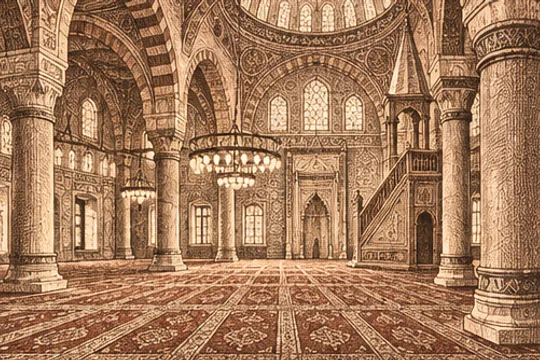
Hüseyin Ersoy, religious affairs attaché at Turkey’s embassy in Hungary, was invited to a conference at Eger (Eğri) Castle on 14 November 2014 entitled “Life in Eger in Ottoman Times.” He climbed the 97 steps of a forty-metre minaret built in the late sixteenth century and gave the first call to prayer in exactly 327 years. The Kethüda Mosque had been built in the district of Eger, under Ottoman rule from 1596. When it passed to the Austrian Empire at the end of 1687, the mosque itself was demolished, but its minaret survives to this day.
Doesn’t it make your heart ache just to read that news? Lands that were ours slipped through our fingers. Mosques lost their domes, minarets their call to prayer, people their protectors. In the lands that broke away, the Turkish presence was gradually assimilated or vanished altogether.
“When I heard the cry ‘Jerusalem has fallen,’ a bomb went off in my head. I wept for days,” an Arab citizen of the Ottoman Empire writes in his memoirs. How could he not weep? Hasn’t Israel swallowed Palestinian land before the eyes of the whole world? Aren’t the Palestinians left with just a handful of land in Gaza and the West Bank? If this goes on, in ten years they won’t even be able to find a mosque in which to pray or a grave in which to bury their dead.
President Recep Tayyip Erdoğan attended the closing ceremony of the First Summit of Muslim Religious Leaders from Latin American Countries, hosted by the Presidency of Religious Affairs at the Conrad Hotel in Istanbul. Yalçın Akdoğan and Mehmet Görmez opened the summit and Erdoğan brought it to a close. As he entered the hall, all 197 religious leaders rose in tears and applauded him for several minutes.
In his closing address Erdoğan sharply criticised the United Nations. “The UN does not serve world peace. Just as Africa’s diamonds and Latin America’s gold were exploited, the oil of the Middle East was exploited under the same dirty scheme. That scheme is stained with Muslim blood. Every kind of ploy is being tried to weaken Muslims and turn them against one another. These are no conspiracy theories. These things are happening before our eyes. Where are the peace envoys? Where is the UN? Which of them said ‘Stop’? I have said it many times and I will say it again: the United Nations needs reform. It does not serve world peace. The UN has 197 members, but only five permanent members. There isn’t a single Muslim country among them. If one of them says no, you cannot get a resolution through. And even if one passes, it goes unenforced! Were the resolutions on Israel enforced? When Muslims are involved, law disappears, democracy disappears, universal values, European values, Western values, human values and the dictates of conscience all disappear.”
Erdoğan also criticised Israel’s attacks on Al-Aqsa Mosque. “What would the world do if something like that happened to their places of worship in our countries? We would never allow any such thing. Why? Because our religion has no place for such attacks, such burning and destruction. Al-Aqsa is one of the two directions of prayer for Muslims everywhere, not just for Palestinians. We all have a duty, a responsibility. Yet listen: the world is silent. Our forebears defended the rights of Muslims in al-Andalus. Our ancestors served the holy places for centuries.”
Under Erdoğan’s leadership, Turkey today is the hope of Muslims the world over. That hope explains why an Egyptian television presenter whose country was under military rule gave a Saudi citizen a blistering rebuke for calling Erdoğan a Freemason and an Armenian, knowing full well that he himself could lose his job or be arrested by the coup leaders. From the Middle East to America there is tremendous enthusiasm for Erdoğan. It is why a Muslim of Algerian origin selling fast food in Boston’s historic market, his eyes lighting up when he learned I was Turkish, said “Tayyip Erdoğan” and insisted on taking no money from me. I have often seen similar affection for Erdoğan in France, England, Spain and Italy. I am sure many Turkish citizens encounter much the same thing when they travel abroad.
I wonder if you have noticed: a new world is taking shape. And whether the West likes it or not, a new Turkish empire is rapidly emerging in this region.
Translated from the Turkish original. Türkçe