
The Enderun Palace School: a plane tree six centuries old
21 December 2014 · Tarafsız Haber
Today, I came across an issue of the *Time* magazine. It features 100 inventions that are changing the world – including chip technology, the internet, nanotechnology, mechatronics, cell and gene technologies, DNA, fiber optic communication technologies, radio, telegraph, telephone, telex, fax machines, mobile phones, satellites, and nuclear technologies, among many others. But, of all these, how many of them are the result of human effort? And how many can we honestly say “we created this”? None of them.
When we ask ourselves where Turkey stands in terms of scientific advancement, unfortunately, we find it difficult to articulate our concerns. We addressed this topic in a program broadcast on A Haber approximately six to seven years ago, and we provided explanations regarding the number of patents held by world universities. I’ve been highlighting that while the top 150 universities in America hold approximately one and a half million patents, the same number of universities in Europe have around 900,000. Furthermore, I’ve pointed out that only four of the 170 universities in Turkey are able to produce patents, and even those four only managed to produce 276 patents in total, effectively criticizing our universities and researchers. Following the publication of my work, I received a large number of congratulatory messages filled with genuine and warm sentiments. However, I also received some abusive messages on my Twitter account, where individuals expressed their opinions in a disrespectful and offensive manner. I had, in fact, stated clearly and sincerely that “let’s move beyond empty rhetoric and reveal the actual results.” Of course, there are many highly respected and accomplished scientists. I am speaking with the utmost respect and distance. While there are incredibly valuable academics at Turkish universities today, their numbers are so small and they face so much pressure that they struggle to survive; those who cannot cope often flee and move to another country. Those who apply pressure and harass these valuable individuals are, more often than not, academics holding the title of ‘professor’. Individuals lacking knowledge, morality, and refinement, who are already a “nothing” from a scientific perspective, are concerned about blocking the path of successful people, with the worry that their nonexistent reputation will be completely destroyed.
I was saddened to witness that some research assistants are working with artificial skin or artificial electronic eyes, and traveling to universities in Germany and the US. In our country, where there are no performance evaluation criteria, anyone who manages to gain access to any department at any university has, from that moment on, only one goal: to retire from there without getting into trouble. But who will deal with science and science, and when? Yet, no one asks this, and even fewer examine it. Many professors, aside from their master’s and doctoral theses, live a life largely detached from science, ultimately passing away surrounded by the Turkish flag. If a tourist were to see this coffin, draped in a flag, during a funeral and then learned that the deceased was a member of the academy, they would assume he was a scientist like Newton or Asimov. However, most of our academics have only published a single article.
Unfortunately, we have an education system that is heavily focused on social sciences. We produce countless economists, international relations specialists, business owners, public officials, statisticians, and lawyers, but we don't have a single scientist who develops original economic theories. Given our reliance on simply copying and pasting, it’s simply not possible to create anything truly innovative. If universities in the US and Europe implement annual contracts based on performance, I assert that only about 5% of the academics working at our universities would truly be successful; the rest would struggle to find even a single word to fill the blanks in the extended academic evaluation forms.
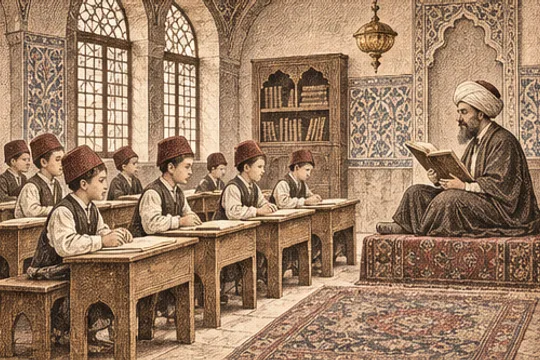
Our wish is for Turkey to reach a level comparable to leading civilizations in science and technology. However, this requires us to cultivate and nurture strong academics. Those who identify as left-wing and progressive criticize the Ottoman era, which successfully achieved this through institutions like the Enderun (military academy). The individuals involved in the Enderun system – including the sultans, grand viziers, muftis, governors, and local administrators – were carefully cultivated and, for 600 years, constituted the most vital human resource of the state. We also need structures similar to the Enderun today. We must establish schools modeled after Enderun – not just for state administration, but also in the fields of science and technology. We need to transform our universities, moving them beyond simply being diploma-granting institutions, and elevate them to a high-quality, internationally recognized status, focused on developing creative, innovative, and practical individuals. Despite being assigned significant responsibilities in the areas of science and technology, the Ministry of Science, Industry, and Technology, which essentially functions as an ineffective and cumbersome organization, needs to be completely overhauled. This type of inefficient and sprawling structure is not suited for a new and modern Turkey.
A Turkish scientist working at a prominent university in America called me. He recounted how his American professor, a Turk, had traveled to Istanbul the previous year to work in a university library. When he initially requested to enter the library, the university refused. However, after obtaining permission from the Rector’s office and relevant authorities, he was then able to enter and found the reading room empty. When he later wanted to return to the library the following day, he was forced to go through the same procedure all over again. At MIT and Harvard, they can move around freely, even take time off, but when they come to Turkey, they are treated differently. How can scientific research be conducted with a mindset that is restrictive, controlling, intrusive, reactionary, and focused solely on the individual?
About ten years ago, I asked my students a supplementary question during an economics exam, telling them that anyone who answered correctly would receive an additional 25 points. The question was: “Describe democracy in the simplest way possible, and then explain what you do when you go to the bathroom in the morning, considering your description of democracy.” I asked this question to approximately ten different classes. However, the percentage of students who answered correctly never exceeded 3 or 4%. Democracy, at its simplest, is “the equal use of rights.” When considering this, one example is that a person who goes to the bathroom in the morning washes themselves, cleans their hands and face, and then leaves. However, beyond this, the most important thing a person must do after using the toilet is to pull the flush, so that those who come after can also enjoy a clean and hygienic toilet. After telling themselves the correct answer to this question, I noticed that the school’s restrooms were being used more cleanly. Years later, a student who recognized me at a hotel on Mount Uludağ in Bursa, told me that he hadn't forgotten the question about “restrooms,” and he went on to tell everyone about it. As you can see, a clear purpose had been established.
The universities in our system are simply providing students with nothing beyond a mere diploma; they need a complete overhaul and a serious, radical transformation. Large campuses, thousands of students, and thousands of academics, proximity to or distance from the city, and international collaborations – these numerical criteria alone will never make a university a “major university.”
Size; is measured by achievement, scientific success, and the quality of the people being nurtured and those being nurtured.
The Enderun School operated within a relatively small building inside Topkapı Palace, yet it nurtured countless valuable bureaucrats – from sultans and princes to grand viziers and chief ulema – for nearly six centuries, overseeing three continents.
Translated from the Turkish original. Türkçe