
The Enderun Palace School
21 December 2014 · Personal website
(Article 051 — 21 December 2014)
Today, I had the opportunity to examine an old issue of *Time* magazine. It compiled 100 inventions that have changed the world – including chip technology, the internet, nanotechnology, mechatronics, cell and gene technologies, DNA, fiber optic communication technologies, radio, telegraph, telephone, telex, fax machines, mobile phones, satellites, and nuclear technologies, among many others. But, considering all of these, how many of them were actually developed or contributed to by *our* people? And, how many can we honestly say “we created this”? Unfortunately, none of them.
If we were asked, “Where does Turkey stand in terms of scientific advancement?”, we struggle to answer. A recent program on A Haber addressed this topic, and discussed the number of patents held by world universities. I’ve been highlighting that the top 150 universities in America hold around 1.5 million patents, while the equivalent number of universities in Europe have approximately 100,000. In Turkey, I’ve pointed out that only 4 out of 170 universities are producing patents, and even those only manage to create 276 patents – thus criticizing both our scientists and our universities.
Of course, we have many highly esteemed scientists. In fact, some of them are achieving extremely significant successes on a global scale. However, the number of these individuals is very small, and they face immense pressure. Those who cannot withstand this pressure often flee to another country. Those who exert pressure and harassment on these individuals are, predominantly, “fake” academics with an “academic” title, who actively seek to block the progress of successful people, driven by the fear that their own work will be revealed as “nothing” from a scientific perspective.
I was saddened to witness that some research assistants, along with those using artificial skin or artificial eyes, are traveling to universities in Germany and the US. In our country, where there are no performance evaluation criteria, individuals who manage to gain access to any department in any university, seemingly without any merit, have a single goal: to retire without experiencing any trouble or misfortune. But who will engage in science and scholarship, and when will these activities take place? Neither are actively involved in research. Many professors, who have no scientific work beyond their master's thesis and doctoral dissertation, live in their own small worlds, detached from science, and end their lives wrapped in the Turkish flag. A tourist who saw this coffin, draped in a flag, during a funeral and then learned that the deceased was a member of the academy, would likely assume he was a scientist like Newton or Asimov. However, many of our academics have only published a single article.
Unfortunately, we have an education system that is heavily focused on social sciences. We are producing all the economists, financiers, international relations experts, business professionals, and public sector administrators we need – statisticians and lawyers as well – but we don’t have a single scientist who actually *creates* an economic theory. Given that we operate primarily on a “copy-paste” approach, it’s simply not possible to produce anything original.
If Turkey were to implement an annual performance-based contract system similar to that used by universities in the US and Europe, I assert that only about 5% of the academics working at our universities would truly be successful; the rest would struggle to find even a single word to fill the empty spaces in the academic evaluation forms designed for them.
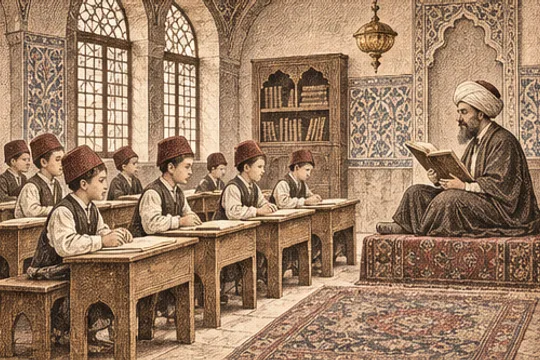
Our wish is for Turkey to reach the level of modern civilizations in science and technology. However, this requires us to find and cultivate strong academics – something that intellectuals who identify as left-wing and progressive dislike, as the Ottoman Empire successfully accomplished this through the Enderun School. Within the Enderun system, individuals crucial to the functioning of the state – including Grand Viziers, religious scholars (Şeyhülislam), governors (valiler), and district administrators (kaymakamlar) – were carefully cultivated. This institution has served as the central hub for the state’s most important human resources for 600 years.
Turkey needs to move towards structures similar to those established during the Enderun system. We must establish Enderun schools, not just for state administration, but also in the fields of science and technology, transforming universities from institutions solely focused on awarding diplomas into centers that cultivate creative, developing, and practical individuals, achieving a level of quality and international recognition. Structures that simply focus on providing diplomas and essentially do nothing beyond that are not suited for the New Turkey.
A few days ago, a Turkish scientist working at a prominent American university called me. He recounted how, as an American professor who was also Turkish, his professor had traveled to Istanbul the previous year to work at a university’s library. However, when he requested to enter the library, the university administration refused, but after obtaining permission from the Rector’s office and relevant authorities, he was then able to access the reading room. Yet, when he later wanted to return to the library the following day, he encountered the same procedure being applied from the beginning. At MIT and Harvard, they can move freely around, enter and leave the libraries, but in Turkey, they are treated this way. How can science be conducted when it’s met with a restrictive, controlling, and interventionist mindset?
About ten years ago, I asked my students a question during an economics exam – that I promised would award 25 points to anyone who answered correctly. The question was: “Describe democracy in the simplest way possible, and then explain what you do when you go to the bathroom in the morning, considering your description of democracy.” I asked the same question to approximately ten different classes. However, the percentage of students who answered the question correctly never exceeded 3 or 4 percent. Democracy, at its simplest, is “the equal use of rights.” A person, upon entering the bathroom in the morning, uses the toilet, washes their hands and face, and then, crucially, they must “flush the toilet” afterward, so that those who come after them can also enjoy a “clean toilet.” After telling my students the correct answer to this question, I noticed that the school’s restrooms were being used more cleanly. One of my former students, who approached me at a hotel I was visiting in Bursa, Uludağ, and who was the first to say to me, “Mr./Ms. [Teacher’s title], I haven’t remembered any of the lessons I took during university, but I haven’t forgotten your question about the restrooms,” was particularly striking.
The universities in our country need a fundamental restructuring and a serious, radical transformation, as they simply provide students with a diploma without actually adding anything to their education. Large campuses, thousands of students, and thousands of academics, along with factors like proximity or distance to the city, and international collaborations, do not make a university “a large university” – they only represent numbers.
Size; is measured by achievement, discovery, scientific success, and the quality of the people being nurtured and those who are nurtured.
The Enderun School, located within Topkapı Palace, operated for centuries in a relatively small building, yet it succeeded in producing highly esteemed statesmen and bureaucrats who governed for 600 years across three continents.
Translated from the Turkish original. Türkçe