
Erdoğan — the madman of these lands…
7 August 2014 · Personal website
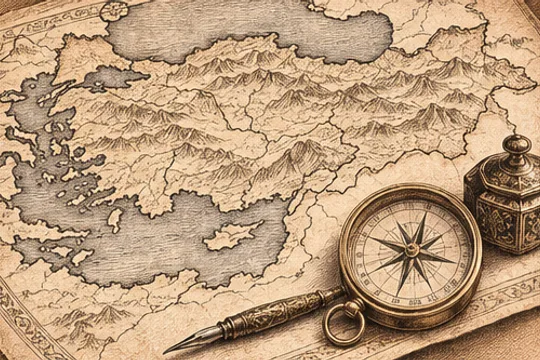
(7 August 2014, Tarafsız Haber)
I follow events in Turkey online. When I look at how Turkey and its neighbours appear to people on the other side of the ocean, all I can do now is laugh at Turkish intellectuals who think the world revolves around us. In a country where even the Israeli–Palestinian issue gets two or three minutes on television, why would anyone discuss other countries’ problems? From morning to night they interview people on the street and ask them questions as if conducting a poll. Usually it is something like: “What do you think of Obamacare? Are you hopeful about the future? How do you think the economy is doing?” Curiously, everyone gives a negative answer, as if they had agreed beforehand.
Meanwhile, dozens of television channels broadcast sermons from morning to night by peddlers of religion who invent creeds and denominations to suit themselves, fleecing Americans in the process. As you can see, peddling religion pays on every continent and in every country. All sorts of Christian denominations promote themselves not only on television but even on street corners. “Denomination” may be the wrong word, given how many different kinds of congregation have emerged. If the Vatican cardinals of the Middle Ages were here today, the Inquisition would work around the clock, burning these heretics in the streets from dawn to dusk.
There is one rule of the American economy that never changes: “Whatever happens, we have to keep the wheels of the economy turning, so anyone who loves their country should spend.” That is precisely why household saving across the United States is so low. The ones building up savings are the giant corporations. The annual profits of companies such as GM, Apple, IBM and Intel are almost equal to Turkey’s gross national product for an entire year. Turkey’s foreign exchange reserves stand at $135 billion, while Apple’s annual net sales are around $150 billion. Seen from this perspective, Turkey has no choice but to give priority to technology-intensive industries.
The role assigned to the Turks at Lausanne a hundred years ago was to farm and raise livestock on the land left to them. The Ottoman Empire lost its most fertile territories, and traitors in our midst handed the lands with oil and natural gas to Western invaders. This state of affairs went on for years. While we are on the subject of Lausanne, let us linger over it for a moment. Every Turkish citizen should read this document of betrayal line by line. The original text of the Treaty of Lausanne is online and anyone can find it. Read it to see how Egypt, Sudan, Yemen, Arabia, Baghdad, Basra, Mosul, Kirkuk, Aleppo, Damascus, Beirut, Jerusalem, Palestine, Cyprus, Rhodes, Lesbos, Western Thrace, the Dodecanese, the Dardanelles, the Bosphorus and hundreds of other Turkish territories were torn from us. Read it to learn how İsmet İnönü, who signed it, and the traitors in the Grand National Assembly who ratified it put us in chains. They handed our sacred homeland over to the Western powers and even made Arıburnu at Gallipoli British territory, land for which 253,000 died as martyrs and where the enemy could not take a step inland from the beach. What can one say about people who made Arıburnu, the most strategic point on the Dardanelles, British territory in the Treaty of Lausanne?
The Cyprus Peace Operation of 1974 was a watershed for both the Turks and the Western powers. In 1923, Turkey had been made to swear what amounted to a solemn Catholic oath that it would never venture beyond its borders. It broke that oath and, for the first time in nearly half a century, extended its territory by setting foot on Cyprus. The Western powers immediately turned their eyes on Turkey. Countries we called our friends and allies, which had made a point of taking something from the Turks at every opportunity, began imposing embargoes on Turkey in every sphere. It was just what they are doing now to Russia after it annexed Crimea.
In Turkey in 1974, everything from needles to thread was imported. Domestic production was virtually non-existent. The economic and military embargoes had an immediate effect. All over the country there were shortages of petrol, electricity and bottled gas, as well as flour, sugar, cooking oil, food, medicine and other basic necessities. As embargoes shut factories for lack of energy and raw materials, unemployment and trade union action mounted, and clashes between the left and the right, a staggering feat of social engineering, reached their height. The Cyprus Peace Operation, the first move towards an imperial Turkey, alarmed Britain above all, as well as the United States. The left–right conflict that emerged as a joint creation of MI6 and the CIA ravaged the country from end to end for about five years. Ahmet, who wanted no part of socialism, and Mehmet, who stood against capitalism, fired at each other, and thousands of young people perished in between.
Then in 1980 the balance in the Middle East suddenly shifted and the Iran–Iraq War broke out. Khomeini flew into Tehran airport from exile in Paris. Iranian students occupied the American embassy and took its staff hostage. The need to evacuate American and other Western nationals from Iran and Iraq and the possibility of using the İncirlik base in a military operation against either country increased the need for Turkey. Then came the military coup of 12 September 1980, an American project. All the young people of the right and left at the addresses provided by the Americans were rounded up in a single day, and the left–right conflict in Turkey was over.
But Turkey could not be left in peace. Somehow a new problem had to be invented to divert the country’s energies elsewhere. And so it was. The new problem was called ASALA. French and American intelligence were at the head of the team that created it. ASALA carried out numerous operations between 1979 and 1983. Armenian terrorists carried out 110 attacks in 21 countries, killing 42 Turkish diplomats and four foreign nationals. ASALA’s first terrorist attack inside Turkey was the bombing at Ankara’s Esenboğa Airport on 7 August 1982. Nine people died and 72 were wounded. The Armenian terrorists were caught and immediately executed. The organisation made its greatest mistake when it bombed the Turkish Airlines counter at Paris Orly Airport in July 1983. When eight French citizens were killed and 52 people wounded in what went down in history as the Orly massacre, ASALA’s time was up. The Western powers, which had done nothing to help Turkey fight it, promptly buried it themselves.
When ASALA’s terror came to an end, Turkey breathed a sigh of relief. But even that was considered too much for the Turks. A problem had to be created that would be Turkey’s alone, with operations carried out in Turkey and spilling into Europe under no circumstances. A new exercise in social engineering began. This time, though, there were a few more players around the table. America’s CIA, Germany’s BND, Israel’s Mossad, Britain’s MI6 and France’s DGSE produced a masterpiece: the PKK (Partiya Karkerên Kurdistan), the Kurdistan Workers’ Party.
The PKK carried out its first armed attacks in Eruh and Şemdinli on 15 August 1984. Around 35,000 people lost their lives in the attacks that continued until 2013. Some $350 billion that could have gone into roads, dams, schools, hospitals and education instead lined the pockets of American, British, Israeli, German and French arms companies. The architects of the PKK had thought through every detail and planned every attack meticulously. Sometimes unarmed soldiers were lined up and shot, sometimes civilians were killed, and each attack aimed at Kurds, Alevis, Turkmens, Syriacs or Arabs sowed the seeds of new hatreds. Every attack had a story, a purpose and a message for a particular group. Eventually, the struggle was abandoned altogether and the situation was left to take its course.
The year 1993 was a grim, dark time for Turkey. Unsolved killings, assassinations, terrorism spreading into the big cities, bombings, chaos and unrest all marked that year. It was also the year President Turgut Özal, who favoured ending PKK terror by peaceful means and then uniting northern Iraq with Turkey, personally entrusted the task to General Eşref Bitlis, the commander of the gendarmerie. After the Cyprus Peace Operation of 1974, Turkey’s voicing of imperial ambitions for Mosul and Kirkuk deeply troubled the countries in question. Bitlis believed PKK terror could be ended through peace and was holding talks with leading figures from the region to find a solution. On 7 February 1993, General Bitlis declared, “US planes taking off from İncirlik Air Base are dropping supplies to the PKK.” Just ten days later, on 17 February 1993, his plane went down for reasons that have yet to be explained, and the general died in the line of duty. Other high-ranking officers on Bitlis’s team, including Rıdvan Özden and Bahtiyar Aydın, were later killed while on duty. It was now the turn of Özal, who had gone too far by saying, “Let’s go into Mosul and Kirkuk.” Exactly two months after Bitlis’s death, on 17 April 1993, Özal was poisoned at the Çankaya Mansion. The operation was complete.
Turgut Özal’s death changed the entire balance in Turkey overnight. Süleyman Demirel handed his party over to Tansu Çiller, moved into the Çankaya Mansion as president and took the seat of Özal that he had so coveted. The years from 1993 to 2001 were a period of collapse. Governments were painfully assembled and rapidly fell apart, one after another. Coalitions broke down, elections came early and the country endured economic crises and terrorist attacks. Mafia groups held sway in the cities and collaborated with politicians, police officers and members of the press and media. Hanging over everything was the immense pressure of military tutelage. The authority of the state ebbed, the economy ground to a halt, domestic government borrowing rates approached 400 per cent and overnight interbank rates reached 7,500 per cent. Ahmet Necdet Sezer was elected president and threw a copy of the Constitution at Prime Minister Bülent Ecevit in a meeting of the National Security Council. Turkey then suffered its greatest economic crisis, Kemal Derviş came to the country, politicians schemed, state banks were plundered and failed banks cost the public treasury $250 billion. And there was much more besides.
The 2002 elections were held in precisely this climate. The French newspaper Le Figaro found the headline that best captured the results: “The Turks have emptied their bowels.”
A party that no one had bothered to take seriously until then came to power with broad backing from a Turkish public exhausted by the other parties’ habit of creating problems and leaving them unresolved.
It would take more pages than I have to describe what the AKP did in twelve years in government. Exports rose from $35 billion to $160 billion. Foreign exchange reserves rose from $27 billion to $135 billion. Gross domestic product went from $250 billion to nearly a trillion dollars. The treasury, which filled with the 283 tonnes of gold Sultan Selim I brought back from Egypt as spoils in 1517, reached 560 tonnes of gold in 2014, for the first time in 497 years. There were reforms in education and healthcare, the repayment of all $27 billion owed to the International Monetary Fund, investments in roads, airports and railways, the Marmaray project, Istanbul’s third airport and the third bridge over the Bosphorus, the removal of travel visa requirements for Turkish citizens, Turkey’s growing standing in the region and around the world, and much more.
Let us look at the matter from another angle. The Ottoman economy was governed by a principle known as “provisionism.” What is provisionism? Under a provisionist policy, the population’s welfare comes first, and nothing produced in the country may be exported until domestic demand and needs are met. To take a simple example, if the Ottoman lands produced 500,000 tonnes of wheat in a year and total domestic demand was 450,000 tonnes, then no more than 50,000 tonnes could be exported, whatever price foreign buyers offered. Any more would create a wheat shortage at home and drive prices up. If the same happens with other goods, you get what the Ottomans called galâ-yı es’ar, a rise in prices, and what we call inflation. For about 450 years this provisionist policy allowed the Ottomans to keep inflation very low, prevent steep increases in the general price level and sustain the population’s welfare. Until when? Until 1838, when the series of Balta Limanı trade agreements was signed.
The agreement put an end to the Ottoman yedd-i vahit system, the practice of granting monopolies, and removed restrictions on the export of Ottoman goods. Ending the provisionist economic policy pushed up the general price level. The Ottoman economy encountered budget deficits for the first time and, in 1854, had to borrow from a foreign country for the first time in its history to finance the Crimean War.
The loan of five million Ottoman gold liras obtained from Britain in 1854 was followed by sixteen more loan agreements in the space of twenty years. By 1874, the Ottoman state could no longer pay its debts, admitted that it was bankrupt and declared a “moratorium.” The Russo-Ottoman War of 1877–78 forced the empire to seek new financing. When it could not raise money on foreign markets, it borrowed from the Galata bankers. Immediately after the war the Administration of the Six Revenues was set up and assigned six sources of tax revenue to repay the domestic loan.
Then, in 1881, the Ottoman Public Debt Administration, the IMF of its day, was set up to allow foreign creditors to recover what the Ottoman state owed them. From 1881 to 1914 it collected the Ottoman debts many times over. Whatever it could not collect, it laid on the shoulders of the Republic of Turkey under the relevant clauses of the Treaty of Lausanne. In 1954, exactly a hundred years after the Ottomans took out their first foreign loan, the government of Adnan Menderes paid off those debts.
Pay close attention here. For the Western powers, a debt-free Turkey was out of the question. Turkey had to be put back in debt at once and its economy brought back under Western control. Between 1956 and 1958 the trade deficit began to grow. By 1958 the country could no longer service its foreign commercial debts. A drastic devaluation in August sent the US dollar from 2.80 to 9 Turkish liras. Then came the coup of 27 May 1960. Prime Minister Adnan Menderes, one of the Turkish people’s best-loved statesmen, and two of his ministers were executed. Turkey’s bid to move from an agricultural to an industrial society came to an end.
The first thing the coup government did was sign Turkey’s first stand-by agreement with the IMF in 1961. In the half-century that followed, Turkey signed nineteen such agreements, and by 2002 it owed the IMF nearly $27 billion. The AKP government paid off this debt in May 2013 and on top of that lent the IMF $5 billion. Nothing like it had happened in Turkish history in 175 years. Moreover, for the preceding twelve years Turkey had been among the three fastest-growing countries in the world.
At a ball on the night of 9 January 1853, at Grand Duchess Elena Pavlovna’s palace in St Petersburg, the Russian tsar Nicholas took the British ambassador, Sir Hamilton Seymour, aside and said: “Your Excellency, we have a sick man on our hands. We have no desire at all to see him die, for if he does, no one knows who will seize his inheritance. But if the sick man slips from our grasp, the British must never occupy Constantinople. We shall leave Constantinople alone too, but we must keep the sick man alive. Our interests require it. To keep him alive we can take possession of Constantinople as his protector. We must keep the sick man alive, but under supervision, and allow no cure. Let us keep the patient alive until we have decided who gets what from the inheritance.”
A hundred and sixty years after the phrase “sick man” was coined, Turkey began to make serious economic progress, and the Western powers began saying, “These Turks are going too far now.” The man behind all these developments was Prime Minister Erdoğan. He had to be ousted at once. The wolves convened once again and put together a grand alliance. The outside players were the same: America, France, Germany, Britain and Israel. This time they widened the coalition to enlist players inside Turkey as well. It included mainstream media executives, secular nationalists, socialists, nationalist conservatives, businessmen from the old Turkey, industrialists whose fortunes had turned, rentiers who lent money to the state, and all the figures of the “Parallel Structure,” including in the police, the judiciary and the media.
The first move was the outbreak of the Gezi protests on 31 May 2013. For fifteen days demonstrators spread terror across Turkey. Then came the judicial coup of 17 and 25 December 2013. Some members of the government were accused of corruption, and mayors and contractors working on Turkey’s most important investment projects were detained on fabricated allegations. Attempts followed to arrest the prime minister and Hakan Fidan, the head of the National Intelligence Organization (MİT), on charges of treason. Each operation increased popular support for Erdoğan. None of the manoeuvres of forces at home or abroad paid off. Erdoğan was also determined to fulfil the two dreams of President Turgut Özal, who had been poisoned. The first was a project of national unity and peace to end terrorism. The second was to bring northern Iraq into Turkey. Erdoğan stood beside Barzani at the Newroz festivities in Diyarbakır in March 2013 and referred to northern Iraq as “Kurdistan.” When he signed a fifty-year oil agreement with Barzani, the Western powers went completely mad.
The PKK’s campaign of terror is now winding down. It will come close to ending altogether in the near future. It is only a matter of time before Mosul and Kirkuk become part of Turkey. Bringing northern Iraq into Turkey means tearing up Lausanne.
A new and powerful Turkey will come into being through the unity of Kurds and Turks.
10 August 2014 will be the day the 175-year-old game is foiled, Lausanne is thrown in the bin, Middle Eastern history is rewritten and a new, strong and greater Turkey is founded.
Translated from the Turkish original. Türkçe