
A law to cull traitors and “beasts born of beasts”…
31 December 2017 · Personal website
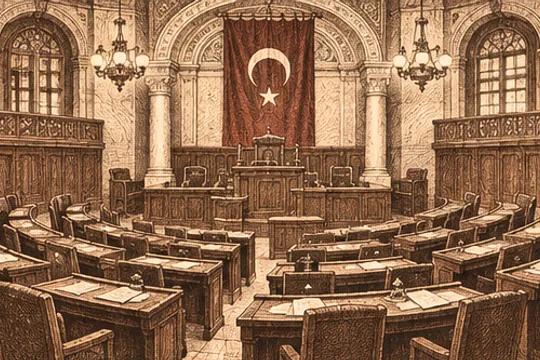
(Article 199 — 31 December 2017)
As an academic, I wholeheartedly support Decree-Law No. 696, issued by the Council of Ministers, down to the last comma.
I consider the decree timely and well drafted. It contains some of the most democratic decisions the government has issued in recent years, decisions that put the public conscience at ease.
Those who remember will know that in the aftermath of what I call the December 17–25 judicial and police coup, TUSKON chairman Rızanur Meral gave a speech that I regard as an open threat to Erdoğan. His speech on March 1, 2014, drew a standing ovation from the people at the meeting, whom I consider disgraceful. Meral said, “Soon everyone will see who lives in dens, who will be looking for a den to hide in, and who is a mere draft and who is the real thing.”
How can people who do business and earn their living in this country be so sure of themselves that they openly threaten the state and its leader at a public meeting? The author describes them in dehumanizing terms.
The author portrays the decree as authorizing the killing of people he accuses of betraying their country, state, and nation. [The call for violence is summarized.]
The author assigns that role to Turkish citizens whom he considers loyal to their country, nation, and state.
The author then imagines a response from people he mocks as “White Turks,” self-styled intellectuals, nationalists, and generals he considers inept. He imagines them objecting that ordinary people would not distinguish right from wrong and that indiscriminate violence would result.
My reply is this: “If you want to know whether the Turkish people can tell right from wrong, look at the night of July 15. Look at the election results that kept the CHP mentality out of power. Look at how the Arab Spring did not spread to Türkiye.”
If the people I derided above trusted the judgment of this nation, everything would change. Yet they simply cannot bring themselves to trust or accept these people. As the Turkish saying goes, “If God does not grant it, what can Sultan Mahmud do?” Unfortunately, the author says, this is precisely the predicament of the country's intellectuals and those he brands traitors.
The decree stated that the provisions of the first paragraph would also apply to anyone who acted to suppress the coup attempt and terrorist acts of July 15, 2016, or acts that followed from them, regardless of whether they held an official title or were discharging an official duty. The author says this brought an end to proceedings against those who, in his view, risked their lives to resist the coup plotters that night.
When the usual groups that oppose nearly every government decision immediately raised their voices and argued that this one was wrong, I knew we were on the right track.
The CHP hit the roof as soon as the decree-law was published. The heads of the Istanbul and Ankara bar associations criticized the exemption from criminal liability granted to civilians who opposed the coup and terrorist acts. They called the two latest decree-laws “the last two nails in the coffin of the law.”
When they spoke of “the last two nails in the coffin of the law,” did they mean the unlawful treatment of Recep Tayyip Erdoğan? The author says he was imprisoned solely for reciting the poem “The Minarets Are Bayonets, the Domes Are Helmets,” which the article attributes to Eşref Ziya Terzi. Headlines said Erdoğan could never again be elected even as a neighborhood head.
Or did they mean the archaic treatment of female students barred from enrolling at university because they wore headscarves?
Or did they mean the sentences handed down after the Sivas events, in which the Madımak Hotel was set on fire and 37 people died? The author blames Aziz Nesin for provoking the events and alleges FETÖ involvement. The author claims the defendants merely chanted slogans and had no weapons, yet 33 were sentenced to death, four to 20 years each, one to 15 years, 27 to seven and a half years each, two to five years each, and one to two years in prison.
Or did they mean what happened under the DYP–CHP coalition governments, when, according to the author, candidates who did not sympathize with the party were rejected at interview as Justice Ministers Seyfi Oktay and Mehmet Moğultay recruited 2,000 judges and prosecutors? The author describes a speech by Moğultay at a provincial party congress as an admission of patronage: “Yes, I secured five thousand positions from the government to be filled by examination. Should people from the east and southeast go hungry and jobless? Should I have given those positions to the nationalists instead of my party organization? In Seyfi Oktay's term and mine, we recruited two thousand judges. Those we recruited are democrats who will come into their own. If what I did is a crime, I will keep doing it. I will not give up or leave this office.”
When the officers behind the February 28, 1997 “postmodern coup” sent tanks through the streets of Sincan, they shouted that February 28 would last a thousand years. Headlines followed one after another, and people from university rectors to media owners clamored for a coup. It was the military's moment. By the early 2000s, three years later, the officers still called the shots. The generals could have editors they disliked removed from newspapers and get columnists to run the headlines they wanted. One of the most prominent and energetic commanders of the day was General Çevik Bir.
Bir wanted to become chief of the General Staff after February 28 but was retired before he could achieve that ambition. Media figures enamored of military rank had little trouble persuading him to run for president. After all, it was an old Turkish political tradition for a senior officer to ascend to Çankaya after a coup. Demirel still had six months left in his term, but Bir threw himself into the effort and began making what the author calls ridiculous public remarks. The urge to talk when he had nothing to say, which the author attributes to almost every soldier, was particularly strong in Bir. He could not resist a microphone or camera and, as a self-styled defender of the secular republic, criticized nearly everything the government did. He was deputy chief of the General Staff, but everyone treated him as the real chief. Otherwise, the author asks, who would even have known him?
In what the author calls a clumsy move, Bir announced his presidential ambitions on the television channel of the Rumelian Businessmen's Association, reigniting the debate over Demirel's successor. He was confident that his hawkish posturing during the coup would carry him to Çankaya, and mainstream media backed him, making much of virtually every speech, visit, and facial expression. But his hopes lasted only fifteen minutes. During the program's question-and-answer segment, the prominent television presenter Murat Birsel asked what his most important move would be in his first hundred days as president. Bir had not expected the question. He grew angry and practically scolded Birsel in front of everyone. The mood soured. After the broadcast he kissed Birsel on the cheeks, apologized, and said he had thought it was a joke, but the damage was done. Bir no longer had the rank on his shoulders to excuse his harshness.
After that, Çevik Bir frequently came under fire from journalists. Two years earlier he had made them line up in close military formation before him. Now he was taking criticism from all sides. The final and decisive blow came from his fellow officers. Of Bir, whose frequent public appearances made him look as though he answered to no one in the military, Chief of the General Staff Hüseyin Kıvrıkoğlu said, “Neither the place, the timing, nor the people involved in his announcement were appropriate.” He formally declared that the army did not back Bir. With that, Bir's hopes of reaching Çankaya fell apart, and he entered retirement with his reputation diminished.
Bülent Ecevit was prime minister at the time, heading a coalition of the DSP, ANAP, and MHP. On January 6, 2000, he made a new proposal regarding the presidential election: “Türkiye is going through a period of stability. I believe that if Mr. Demirel's presidency could be extended for another term, that stability could continue and grow stronger.” In the author's view, stability was precisely what Türkiye lacked at the time. The MHP, a major coalition partner, and a majority in Parliament immediately backed the idea. The military wanted Demirel as well. After all, he rarely refused its requests. But reelecting Demirel required an amendment to the relevant article of the constitution.
On March 7, 2000, the proposed amendment went to the Constitutional Committee with the signatures of 406 members of parliament from the DSP, MHP, ANAP, and DYP. Virtue Party leader Recai Kutan opened a new debate by asking, “How can the country's stability depend on one person?” Mesut Yılmaz also wanted to reach Çankaya and could achieve that goal if Demirel were out of the running. Bahçeli had no desire to become president, and Ecevit did not qualify because he lacked a university degree. Recai Kutan and Tansu Çiller, both shunned by the military, had been among the victims of February 28. That left Yılmaz alone. If he stood, the author argues, Parliament would have to elect him by the fourth round at the latest. Otherwise Parliament would be dissolved and a new political crisis would follow.
On March 29, 2000, the proposed constitutional amendment concerning Demirel came before Parliament. Its sponsors were confident. After all, 406 members of parliament had signed it. But the coalition partners had miscalculated, and the proposal fell short of the 330 votes it needed to pass. A second vote on April 3 likewise produced no result. Ecevit had failed to keep Demirel in Çankaya for another seven years. Demirel reluctantly left the presidential residence and moved back to his home on Güniz Street.
On April 25, 2000, in an unprecedented move, all parties nominated Ahmet Necdet Sezer for president. Parliament convened on April 27, but neither of the first two rounds produced the required majority. When Parliament convened for the third round on May 5, Sezer's election seemed assured. News reaching Parliament briefly threw the proceedings into confusion. The army had sent Ecevit an unequivocal message that it did not want Sezer. In the end, Ahmet Necdet Sezer was elected the tenth president with 330 votes.
Ahmet Necdet Sezer, the tenth president, served for seven years, three months, and twelve days. During his term he sent back 72 laws, seven decree-laws, 14 Council of Ministers decisions, 769 joint decrees, and 30 Council of Ministers decisions concerning appointments. In the author's view, he was one of the most passive presidents in the republic's history. He rarely set foot outside Çankaya. He took no holidays during his term and never used the state guesthouse at Okluk Bay. He gave no interviews to the press and did not much like being photographed or filmed. He attended opening ceremonies only when necessary and, on the rare occasions he went, would not even pick up scissors to cut the ribbon.
In 2004 Sezer held his son Levent's wedding at the Çankaya presidential residence. Alcohol was served to guests at the wedding, which took place on the night commemorating the Prophet's Ascension. He attended a reception at a five-star hotel hosted by Kanaltürk, a broadcaster critical of the AK Party, but chose to skip funerals for fallen service members and the Gallipoli commemorations.
The defining moment of Sezer's presidency, however, came at the National Security Council meeting on February 21, 2001. For the first time in Türkiye's history, an argument at a council meeting became public. During the dispute, Sezer threw a booklet containing the constitution at Prime Minister Bülent Ecevit. Speaking to the cameras afterward in a voice close to tears, Ecevit said the president had turned the council into an arena and had acted disrespectfully. Türkiye then faced what the author calls the worst economic crisis in its history. The stock market collapsed, foreign currencies surged, and interest rates climbed. Within hours, $7.6 billion in foreign currency left the country. Overnight repo rates reached roughly 7,500 percent, and compounded bond yields exceeded 200 percent. The dollar rose from 683,000 lira on the first day of the political crisis to more than one million and reached 1.35 million a week later. The crisis, dubbed Black Wednesday, led to the state taking over 27 banks, hundreds of thousands of companies closing, and millions of people losing their jobs. According to estimates cited by the author, the direct and indirect cost to Türkiye exceeded $250 billion.
At a ceremony at Anıtkabir during Ramadan in 2003, President Sezer did not hesitate to drink water in full view of Parliament Speaker Arınç, Prime Minister Erdoğan, and the ministers. Nor did he shy away from warning of a “reactionary threat” at ceremonies marking the anniversaries of the higher courts.
The author says Sezer went down in history as the first president to use his statements to complain about the state to the state itself. In the author's view, Sezer skipped the Organization of the Islamic Conference summit held in Mecca on December 7–8, 2005, for purely ideological reasons. The author calls his exercise of presidential appointment powers undemocratic, saying he broke with convention by consistently choosing second- or even third-ranked candidates over those who received the most votes when appointing the chief public prosecutor at the Court of Cassation and university rectors.
On November 20, 2002, President Ahmet Necdet Sezer and his wife Semra left for Prague to attend the NATO summit of heads of state and government. Parliament Speaker Bülent Arınç and his wife Münevver, who wore a headscarf, saw them off at the airport. The farewell sparked a debate over headscarves. From then on, the author says, Sezer discriminated against legislators whose wives wore headscarves by sending them different invitations.
Many people liked what the author describes as Sezer's impartiality toward the CHP and bias against the AK Party.
He stopped at red lights and queued at the supermarket.
He seemed close to ordinary people, but never really got close to them.
During his term, Sezer barely toured the country. In seven years he made only 48 trips abroad, compared with Demirel's 125. He never let civil society organizations visit him at Çankaya. He did not own a mobile phone or drive a car. No one saw him swim in the sea or in a pool. He had a house built for his retirement in Gölbaşı, Ankara. He did not want Abdullah Gül to have the same handover ceremony he had received from Süleyman Demirel seven years earlier. In the author's view, this was because Sezer regarded all AK Party members and voters as religious reactionaries.
He coined the definition of “public space,” whose meaning, the author suggests, he alone understood. He frequently called on the Presidential State Supervisory Council to deal with matters involving headscarves, although he did not use it to investigate corruption. The author even alleges that Sezer enlisted building caretakers, rather than officers of the National Intelligence Organization, to find out whether the wives of prospective appointees wore headscarves.
For his Republic Day receptions on October 29, he invited people on good terms with the state and excluded its critics. He did not even congratulate Orhan Pamuk, the first Turkish writer to win a Nobel Prize. A former president of the Constitutional Court, Sezer never parted with his supposedly sacred copy of the constitution and threw it at the prime minister's face. The author blames that incident for a political and economic crisis that cost Türkiye $250 billion. The author says Emin Çölaşan was the only journalist Sezer liked. Sezer gave no exclusive interviews to radio or television stations, newspapers, or magazines. Kenan Evren, who led a coup, vetoed 26 laws, while Sezer vetoed 72. In the author's view, he left Çankaya as the most withdrawn and unremarkable of presidents.
His last move came just before he left. The author claims that Sezer extended his seven-year term at his own discretion and held the office without justification for another three months and twelve days. Then one night he abruptly vacated the Çankaya residence and disappeared from view. Today no one sees or hears from him, speaks fondly of him, or asks how he is doing.
What I have described so far sums up the old republic for which the White Turks yearn.
At the time, the CHP, the bar associations, and civil society organizations raised no objection to Ahmet Necdet Sezer's actions. They even gave him a standing ovation.
Look how far Türkiye has come in fifteen years…
The author condemns those who were silent when Erdoğan was imprisoned and later criticized the Turkish people who risked their lives to stop the July 15 coup attempt.
Do you wonder when this country will see the last of those the author calls traitors and scoundrels?
The author says that in another coup attempt, whether by FETÖ or another group, the other side would suffer the deaths.
The author cites 36 deaths among coup participants on July 15 and threatens mass retaliation in the event of another attempt. [The threat is summarized.]
The author says that this country is our only home and warns his opponents.
The author says that the public is taking note of those it considers traitors, people without honor or shame, and supporters of terrorism.
The author concludes by threatening that civilians would kill those he labels traitors in the event of another coup attempt. [The call for violence is summarized.]
Dr. Mehmet Hakan Sağlam
Translated from the Turkish original. Türkçe