
The homeland of Nur, a Turkmen from Aleppo, and the new Turkish Empire…
27 March 2015 · Personal website
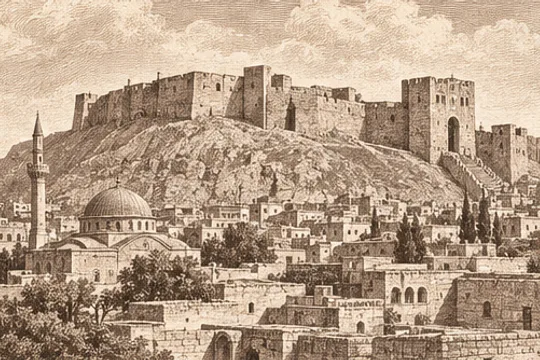
(Article 068 — 27 March 2015)
We are in Kilis at the invitation of Governor Süleyman Tapsız. The governor gave us an excellent presentation, with detailed information about the refugees at the Elbeyli and Öncüpınar camps and the services provided there. Fifty thousand people live in these camps, and each has a story. To see their circumstances makes your heart ache. And you find yourself getting angry when you see how the world can stay silent in the face of such things and stand by as thousands, tens of thousands, hundreds of thousands of people die.
It was 1978 or 1979. A new bookshop had opened across from the Kilis post office. In those days there was just one TRT channel, and it was broadcasting a series called Roots. It told the story of Kunta Kinte, who was kidnapped from Africa by slave traders in 1767 and sold at a slave market in America. Kunta Kinte leads an ordinary life in Africa until slave hunters capture him and lock him in a ship’s hold. He is torn away from his tribe and family and taken to another land. In the New World he is given the name Toby, but he refuses to use it. His roots keep him going, and his deeds are passed down through the generations until they reach a young man raised in Tennessee. Alex Haley, a seventh-generation descendant of Kunta Kinte, makes his name known to the world. Viewers cannot hold back their tears. They see how the Europeans’ capitalist and colonial mentality led them to exploit Africa. Even people who had never seen the series would never forget the name Kunta Kinte again.
Roots was one of the first books I bought with the pocket money I had saved. The shop did not have it, so I asked them to order it from Istanbul. It reached me fifteen days later and I began to read. I had seen the series, but the book itself helped me understand those people’s circumstances, what they were feeling and the conditions under which they were brought to America. Kunta Kinte’s story, as he was called on screen, deeply affected almost everyone who watched. We had never seen a Black person in our lives, yet we began to sympathize with Black people and came to hate white Americans. Most of us had never seen an American of any kind, either. Little did we know that even then we were being subjected to efforts by American imperialism to shape how we saw the world. We often visited the second-hand booksellers by the wall of the Maarif Club, across from the Özyurt Cinema, to read the comics people could never put down, Tex, Captain Miki, Zagor and many more. We were also frequent visitors to the shop diagonally across from the institute that sold salty ayran and charged customers to read similar comics.
Anyone who read those comics knows the pattern. The good guys were always America’s white invaders, though we did not know in those days that they were invaders. The bad guys were the ones called “palefaces” or, in other words, Indians, the original owners of the land who were subjected to genocide.
Just look at that. They see nothing wrong with turning the massacres they committed against humanity into comics and passing them on to us. The British, Spanish and Americans, who systematically subjected nearly 80 million of the continent’s Indigenous inhabitants to genocide and wiped them out, tell the world about the genocide with remarkable ease and even humour, do they not?
No one should underestimate American efforts to mislead world opinion. Did we not see excellent examples not long ago during the invasions of Vietnam, Afghanistan and Iraq? Iraq supposedly had chemical weapons, and there were supposedly nuclear weapons loose in Afghanistan. It soon became clear that it was all a lie and that the real aim was oil and the creation of new energy corridors. America portrayed Saddam as a cruel and terrifying dictator, but it caused the deaths of nearly 2.5 million civilians in the Gulf wars and the invasion of Iraq after the attack of 11 September 2001. Saddam was captured, tried swiftly by Shiite judges in a sham court and executed by Kurdish executioners. So the supposed “dictator” was gone. Did democracy take his place? Hardly. The country was effectively divided into three and now faces a new scourge called ISIS. Dozens or hundreds of people die in another massacre or bombing almost every day.
The same deaths, the same loss of life, have continued in Syria for four years, with no purpose or reason. The West displays its hypocrisy, partisanship and indifference relentlessly in virtually every corner of this region. Take a moment to list what has happened in Yemen over the last month. In this former Ottoman territory at the southern end of the Arabian Peninsula, an attempt is being made to create another Syria and Iraq. Saudi Arabia will soon become part of the same game and civil war will break out there too, just like Tunisia, Libya and Egypt. War and internal conflict are the fate of this region since the Ottomans. Should those who call the Ottomans colonialists, foremost among them the Arabs themselves, not look at the last hundred years of Middle Eastern history and ask who the colonialists really were? Assuming, of course, that when they start asking, they still have a patch of land they can call home.
I had just finished secondary school in 1984 when my father sent me to London to study the language. The daughter of Syria’s ambassador to Britain sat next to me at the language school. When she learned I was Turkish, she started treating me with an inexplicable coldness, as if I had done some harm to her family. One day I asked her what was bothering her. This is exactly what she said: “You Turks aren’t Muslims. In Turkey, they’re tearing down mosques and building churches in their place.” I was astonished. “Do you know that all the mosques where you pray in Aleppo, Damascus, Hama and Homs were built by Turks?” I asked. “Why would we tear down the mosques in our own country when the Turks built hundreds and thousands of mosques even in the lands where you live today?” “That’s what it says in the textbooks in Syria,” she said. Sadly I could never persuade her that Turkey was not tearing down mosques. In those days there was neither the internet nor television. Words cannot describe how thoroughly the Turkish and Arab peoples were turned against one another. There was one gesture that reintroduced Arabs and Turks to each other: Prime Minister Recep Tayyip Erdoğan’s “One Minute” intervention at Davos. If the first real meeting between the Arabs and the Turks was at the Battle of Marj Dabiq in 1516, the second came with “One Minute” in 2009.
But nothing else has repaired the way Arabs see Turkey, once and for all, like the unstinting support offered to Syrian refugees over the past four years. This help, this loyalty, this friendship has no equal anywhere in the world. No wealthy country, including the United States, Britain, Canada or Japan, would or could spend six billion dollars over four years on 2.5 million refugees. Above all, no such country would ever welcome that many refugees on its own soil. In a twist of fate, our latest meeting with the Arabs, five hundred years on, is at Elbeyli camp on the Marj Dabiq plain, where Sultan Selim I set foot in the Middle East.
We know which refugees the West will welcome: the wealthy with money and scientists it has a use for. The rest do not matter. If not two million but twenty million Syrians, Iraqis, Yemenis, Tunisians and Libyans died, no one would even care. During the First Gulf War, an oil-soaked cormorant featured in Western newspapers and on television for months, while the millions who died in the war were not even considered newsworthy.
Tens of thousands of people live in the guest accommodation centres in Kilis. I asked Governor Süleyman Tapsız if I could see the camps. He kindly agreed, and we toured them together. The camp has hundreds of container homes and just as many streets. Children and grown-ups alike are bustling about. As many people live in these camps as in Kilis itself. Everyone here has a story to tell. Their memories hold every kind of pain: yearning, homesickness, grief and more besides. Ask, “Is anything troubling you?” and virtually everyone answers as if with one voice: “May God bless the Turkish state.” People talk about everything here, but you will not hear a single complaint about the Turkish state.
Look closely at the condition of the Middle East today and compare the present state of the Arab lands with To the Martyrs of Çanakkale, written by Mehmet Akif Ersoy a hundred years ago. What did Akif say?
“…
Thunderbolts tear the horizon apart over there,
While earthquakes heave up the depths over here.
The lightning of bombs descends on the brow of every trench,
And dies against the chest of that lion of a soldier.
Thousands of mines beneath the ground, a hell below,
Each mine that goes off burns hundreds of men.
The skies rain down death and the earth spits out the dead.
What a terrible blizzard it is: human wreckage whirls…
Head, eye, torso, leg, arm, jaw, finger, hand and foot
Pour down on ridges and valleys in torrents.
…”
What we lived through at Çanakkale a hundred years ago is what the people of the lands that separated from us are living through now, and will continue to live through for a long time.
The people of this region need a new model for government, economics and politics that makes no distinction of religion or sect. Capitalism will keep exploiting the peoples of the Middle East to the last drop, not of their blood, but of the last barrel in the oil wells. Those who think the prosperity brought by oil and natural gas will last and are busy amusing themselves in London, Paris and New York will experience the hereafter on earth when that day comes. By the time those who are living it up on an economic policy built on consumption see how their hundreds of billions of dollars in foreign exchange reserves have melted away, it will be too late. Mehmet Akif, one of the greatest poets the world has ever known and a son of the Ottoman world, wrote in a remarkable state of mind:
“What a terrible blizzard it is: human wreckage whirls…
Head, eye, torso, leg, arm, jaw, finger, hand and foot
Pour down on ridges and valleys in torrents.”
Exactly what those lines describe happens in this region nearly every day. Under the pretence of a coalition force, the “human wreckage” scattered by the bombing of Iraq, Syria, Yemen, Libya, Afghanistan and many other places is Muslim, not Christian.
As I walked around Kilis, I wanted to see how the locals treated Syrian refugees. When I visited two years ago, there had been a strong reaction to the growing Syrian population. This time I saw an incredible degree of affection and harmony between the two peoples. I should add that there are now more Syrians in Kilis than native residents. Almost all the shopkeepers are content. Everyone has found a way to make a life for themselves. In short, they have grown accustomed to one another.
What I was most curious about was the condition of the camps. Governor Süleyman Tapsız and Dr Cemil Ertem, the president’s chief economic adviser, took us first to Öncüpınar camp. There are 25,000 people living there, and Turkey meets almost all their needs. The streets are laid with paving stones and everything is spotless. We toured the new two-storey container units. With a kitchen, toilet, living room and bedroom, they are ideal for a family. The psychosocial support centre, the Turkish-language teaching centre and the technical coordination centres serve people with extraordinary dedication. Almost everyone we passed in the street embraced the governor like a father. Their affection for Turkey and the Turkish people is beyond words. From there we went to the newly built Elbeyli camp, which also houses 25,000 people. There is just one thing I would say about it. If you want to feel your humanity, see what your state can do and soften your heart, you must visit this camp. You have to see the nursery for tiny children who lost their parents in the war.
The Syrians are keen to take Turkish lessons, from little children to people in their seventies and eighties. There is no describing the commitment of the staff or the affection and warmth they show the refugees. I know no one whose heart would not ache and whose eyes would not fill with tears listening to Nur Kahveci, an Aleppo Turkmen girl of eleven or twelve, recite a Turkish poem about longing for her homeland. How could you hear an eighty-year-old Arab man who speaks not a word of Turkish recite a poem about Çanakkale in Turkish and not cry? Young Arabs sang a folk song about Yemen and the song We Are All Brothers, accompanied by the saz, and moved everyone there deeply. The Aleppo House built in the camp has become a place to welcome guests. We sat on divans, and they immediately served us the coffee called mırra. Three artists from Aleppo sang a magnificent song, every word expressing gratitude, thanks and affection for the Turks, Turkey and President Recep Tayyip Erdoğan. They also sang Arabic songs in a free rhythm, much like our Barak airs. I cannot tell you what those moments were like, put them on paper or describe them. It was one of those rare experiences in life that you can only live through to understand. Even the most heartless person with a heart of bronze would be moved here and remember their humanity.
I understood better why there was a need for the eighteen-classroom school that a businessman from Antalya and his wife were considering building for Syrian children who had lost one or both parents. I have to say I could make little sense of why Mayor Hasan Kara had not given permission for the school to be built. One often hears people say he saw his move from Parliament to the mayor’s office as a demotion and has not thrown himself into the job. Politicians should definitely pay attention to what ordinary people are saying. It is equally hard to understand why the mayor closed the boulevard in front of the main campus entrance to traffic over a dispute with the rector of Kilis 7 Aralık University.
People traumatized by the war receive psychological support in the camps. Women and girls are taught a range of trades. They have even set up a medium-sized carpet weaving workshop in the camp and sell the carpets made there. People make traditional Aleppo textiles, handicrafts, paintings and sculptures. I was told that those working earn an average of 300 liras a month.
The camps have a separate laundry facility, and people can book a slot to do their laundry on certain days of the week. If the electricity or water fails in a container home, residents contact the coordination centre and the problem is fixed as quickly as possible.
Almost everywhere in the camp you can see flags of Turkey and the Free Syrian Army painted on the walls by refugees. Nothing here is put on. The Turkish state has gone well beyond what it could be expected to do for these people, and they have responded with abundant gratitude and affection. The man who turned all these services into a success story is Governor Süleyman Tapsız. He is a man of heart, one of the most valuable and rare public servants the Republic of Turkey has produced. I wish you had seen him embrace the tiny children left without parents and stroke their heads. Seeing his bond with the orphans reminded me of the verse Sheikh Saadi of Shiraz wrote for orphans: “When you see a dejected orphan, do not kiss your own child’s face in front of them. When the orphan cries, who will soothe them? When they grow angry, who will bear with them? Take care that they do not weep, for when the orphan cries the Throne trembles. Wipe away their tears with pity, and brush the dust from their face with tenderness. If the shade above their head is gone, nourish them with your own shade.”
That evening I met a police officer named Selim Bolat and spoke with him at length. I asked whether there were problems between Syrians and Turks in the city. This is what he told me: “The reports that crime increased here after the Syrians arrived in Kilis are completely untrue. Kilis is not a province where much happens in the first place. Murder, robbery and rape are practically unheard of here. When Syrians do break the law, it happens like this: the person doesn’t even realize what they’ve done is an offence in Turkey. There are a few minor incidents because people don’t know our laws. That’s all.”
As I wrote in an earlier article, the people of Kilis have been making history with the hospitality, help and friendship they have shown Syrians for four years.
A young lecturer from Aleppo University and an eighty-year-old man took the governor’s hand and said, “You stood by us in our hardest days, protected us and opened your homes and tables to us. We will not forget it or let it be forgotten. We thank that great man, Recep Tayyip Erdoğan, and the Turkish people so very, very much.” The old man expressed his thanks in Arabic with a few scattered Turkish words mixed in. I wish you could have seen his gestures, the smile on his face and the gratitude shining in his eyes.
You can see Greater Turkey and the New Turkish Empire being built anew, step by step. It is now our duty to turn a new page in history. When you see people here speaking Turkish, Kurdish and Arabic, you better understand what it is to be divided and how the Ottoman lands were torn apart by Sykes–Picot, the Ankara Agreement and the Treaty of Lausanne. I call all three agreements a bad dream. It is time to wake from a hundred years of sleep and begin a new day. No people other than the Turks can bring peace and tranquillity to an unstable Middle East. We can start in Syria.
My thanks, thousands upon thousands of times, to Governor Süleyman Tapsız of Kilis. With administrators and civil servants, soldiers and police, teachers, health workers, technical staff and many more, he has represented the Republic of Turkey here as it deserves to be represented. He has been the chief architect of an effort that can set an example for the whole world, and he has given us good reason to be proud.
May you live long and be honoured…
Translated from the Turkish original. Türkçe