
The Wahhabi unbelievers who turned Khadija’s house into a lavatory, Ajyad Fortress into a hotel, the space between Safa and Marwa into a palace, the Prophet Muhammad’s house into a car park, and the Kaaba into a money-making enterprise…
30 September 2014 · Tarafsız Haber
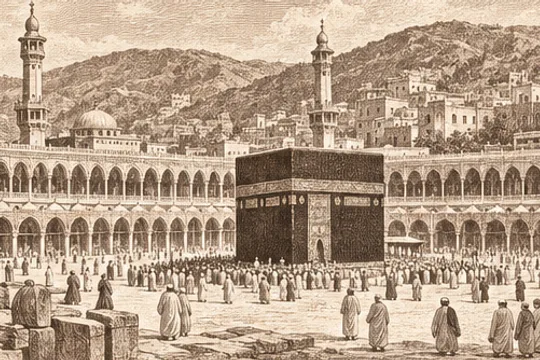
The author accuses the Wahhabi authorities, whom he denounces as unbelievers, of systematically destroying historic monuments throughout Mecca and Medina.
Prince Sultan bin Salman bin Abdulaziz belongs to the Saudi royal family, which the author calls the self-appointed guardian of Islam. As chair of the Saudi government commission responsible for tourism and heritage, he presented a paper to the Department of Architecture and Arts at Petra University in Jordan. In his remarks, he spoke about the royal family's experience in preserving architectural monuments and about the economic and environmental importance of protecting historic sites in cities.
Well, would you look at that! The author sarcastically marvels at how much the Wahhabi authorities, whom he derisively calls desert Bedouins, supposedly know about urban architecture.
Take a close look at Mecca and Medina today.
The author says that scarcely a trace of the places Muslims consider sacred remains in Mecca, Medina, or other cities. What visitors see instead are steel and concrete skyscrapers, shopping malls, and residential towers built entirely for profit.
In the author's account, the Prophet Muhammad's tomb is the only old building still standing in Medina. He claims that the Saudi authorities are waiting for a suitable moment to demolish it. The author interprets the Saudi king's wish to be buried at an undisclosed site in the desert as an attempt to legitimize the demolition and as a message for his family to carry it out if he cannot. He argues that only the prospect of outrage among Muslims worldwide has kept the tomb intact. In his view, it defies reason that people have killed one another over the destruction of far less important religious buildings, while no one acts in this case.
Muslim countries, the author says, seem powerless before Saudi Arabia, chiefly because it sets the Hajj quotas. He argues that Saudi authorities equate the buildings people honor as sacred with the idols the Prophet Muhammad broke and can obtain whatever religious rulings they want from their clerics. He accuses those authorities of removing Ottoman monuments, cemeteries, burial sites of martyrs, and graves associated with the Prophet, his family, and his Companions over the course of eighty years to make way for commercial developments.
According to architect Sami Angawi, who devoted his life to preserving the history of Mecca and Medina, only twenty sites dating to the Prophet Muhammad's time remain. The author says that Muslims and non-Muslims around the world have watched in astonishment and silence as these sacred monuments disappear, including governments, religious leaders, writers, and thinkers.
The few fourteen-hundred-year-old sites left untouched, however important they are, stand in ruins, awaiting demolition at the first opportunity. The author describes most demolitions as almost festive affairs carried out at the royal family's command and with religious rulings from Saudi clerics. In January 2002 Türkiye called for Mecca's Ajyad Fortress to be spared, warning that its destruction would amount to cultural genocide. The fortress was demolished. The Zamzam Tower, expected to generate millions of dollars in annual revenue, rose where the fortress had stood since 1780, protecting Mecca from those the author calls enemies of the faith.
The Ottoman state prohibited buildings around the Kaaba from rising above it or casting a shadow over it and observed that rule for centuries. The author condemns the Saudi authorities for surrounding the Kaaba with much taller skyscrapers. He alleges that weddings with music and dancing take place in rooms overlooking the Kaaba and that Saudis secretly hold parties involving alcohol and Captagon. He denounces what he sees as state-sanctioned immorality at Islam's holiest site and says that over eighty years profit-making establishments have surrounded the Kaaba and spread throughout Mecca.
The Saudi authorities demolished the Jarwal Barracks and turned the site into a parking lot. Abdülhamid II had built it as a guesthouse for poor pilgrims, and it became a military garrison shortly after the Second Constitutional Era began. Only a wall remains to recall what the author calls one of the most important Ottoman buildings. Abdülhamid's interest in photography is well known. To preserve images of his era for future generations, the sultan had almost every corner of the empire photographed and compiled an album of the historic sites of Mecca and Medina. Compare the two holy cities today with their appearance under Ottoman rule, the author says, and the first photograph will show who valued their history. Even when the empire was struggling with foreign debt, the Hejaz Railway was built entirely with public donations and with careful regard for religious sensitivities. When the line reached Medina, Abdülhamid II reportedly asked for felt beneath the rails and ordered quiet locomotives on a stretch of five or six kilometers so as not to disturb the Prophet's spirit.
Still, we should not underestimate their interest in history when it suits them! The author accuses the Saudi rulers, whom he calls pharaohs, of demolishing Khadija's home and putting toilets in its place, while making a museum of the house where Lawrence, the British agent who helped lead the Arab revolt against the Ottomans, had stayed.
The author condemns Saudi religious scholars for issuing rulings that sanction the royal family's destruction of historic sites, accusing them of obeying their rulers without question in exchange for money and position. He says even Safa and Marwa, the hills where Hagar searched desperately for water after Abraham left her alone with her child and where Zamzam was eventually found, were leveled to make way for a palace for former Saudi king Khalid bin Abdulaziz. He claims that the Prophet's tomb is now the Saudi authorities' target and that they have been waiting for a suitable moment to destroy it since 1926. In the author's view, they consider the removal of shrines and graves a duty under Wahhabism.
Who are the Saudis, who now rule these sacred lands, and what is Wahhabism? A brief account is in order. The Prophet Muhammad was born in 571 and received his prophetic mission in 610 at the age of forty. He began preaching Islam in Mecca and migrated to Medina in 622. There he laid the foundations of an Islamic state centered on Medina, and in 630 he conquered Mecca. By his death in 632, nearly the entire Arabian Peninsula had come under Muslim rule.
After Muhammad's death came the era of the four caliphs. Under Abu Bakr, Umar, Uthman, and Ali, the Islamic state expanded north to the Caucasus and Khorasan, south to the Indian Ocean, east to the Persian Gulf, and west into North Africa. In the Umayyad era (661–749), it encompassed all of North Africa, reached into Spain and France, and extended east into India and Turkestan. In the author's account, the Islamic state's borders thus stretched from the Atlantic and the interior of France to China.
The Abbasid era (749–1258) saw internal unrest, the Crusades, and the Mongol invasion. These holy lands later came under the Egyptian Mamluks (1250–1517). After conquering Egypt in 1517, Sultan Selim I brought Egypt, Syria, and the holy lands under Ottoman protection. The Arabian Peninsula remained under Ottoman rule into the early twentieth century. The author says that until 1918 the Ottomans provided services, sent aid to the poor through the imperial pilgrimage caravans, and saw to the needs of a population that lived in prosperity.
Before and during the First World War, the author says, British agents organized a campaign to discredit the Ottoman state and stir up hostility against it in the holy lands. Sultan Abdülhamid II regarded Sharif Hussein as a danger and required him to live in Istanbul as a member of the Council of State. The author faults the Committee of Union and Progress for letting him leave and appointing him Sharif of Mecca when it came to power in 1909. He alleges that Hussein made an agreement with Britain against the Ottoman state, came under British protection, and received £400,000 a year in bribes. Sharif Hussein began his revolt on June 27, 1916. As Ottoman control of the Hejaz slipped away, Fahrettin Pasha declared that he could not hand over the Prophet's tomb and defended Medina for two years and seven months.
Sharif Hussein ultimately achieved his aim, but after internal disputes he was defeated by Ibn Saud and driven out of the Hejaz. In the author's account, he was able to establish a small state in Jordan under British influence. The kings of Jordan descend from him.
As for the rise of Wahhabism and its ties to the House of Saud, in the 1740s Muhammad ibn Abd al-Wahhab founded the religious movement known as Wahhabism and settled in Diriyah near Riyadh. He allied with Muhammad ibn Saud, a local Arab tribal leader. The author says that a marriage to Ibn Saud's sister cemented their alliance. Ibn Saud adopted his brother-in-law's teachings and pressured the population to follow them by force of arms. This political and religious alliance sparked Wahhabi uprisings across the Arabian Peninsula. Their principal aim was to break away from the Ottoman state and establish an independent state founded on their own beliefs. They seized the Hejaz in the early nineteenth century. The Ottoman state recovered it through the governor of Egypt and severely punished leaders of both the Saudi family and the Wahhabi movement. The author says that two of Abd al-Wahhab's sons were killed and that Ibn Saud's son and his children were taken to Istanbul and executed.
The movement reemerged in the early twentieth century and signed an agreement with Britain. Under it, the Wahhabi emir Abd al-Aziz obtained a British guarantee that he would retain the territories he had seized in Arabia and that power would pass to his children upon his death. Following the Ottoman defeat in the First World War, the Wahhabis took Taif, Mecca, Medina, and Jeddah with British support, according to the author. Abd al-Aziz Ibn Saud defeated Sharif Hussein in the civil war and was proclaimed king of Najd and the Hejaz. The kingdom gained independence in 1927 and was renamed the Kingdom of Saudi Arabia in 1932. This, in brief, is the history behind its present political system.
Last week a British newspaper published an article claiming that the Saudi authorities spend $19 billion a year to “protect” Mecca and Medina. What is that money being spent on while the Prophet's home and sacred sites dating back fourteen hundred years are being demolished? The author asks whether it is being used to surround the Kaaba with skyscrapers and whether the sacred building itself might one day be destroyed.
The grave of Amina, the Prophet Muhammad's mother, was found in 1998. The author says it was immediately demolished with bulldozers and burned. He says that fewer than twenty buildings dating back fourteen hundred years remain in Mecca. Khadija's home was demolished and toilets were built in its place. The home of Abu Bakr, one of the Prophet's closest friends, was demolished, and its site became part of the Hilton Hotel grounds. A royal palace was built on the site of the twelve-hundred-year-old Abu Qubays Mosque.
The author says the Saudi kingdom's demolitions have continued unabated for eighty years. In his view, the authorities have gone further still and now threaten the house where the Prophet Muhammad was born. Redevelopment work is under way in the area.
How? By building a parking lot!
“We are witnessing the last days of Mecca and Medina. The farewell is near.”
The author says Wahhabi authorities believe the cave on Mount Hira, where the first verse of the Qur'an was revealed, should also be destroyed. He attributes to them the argument that the Prophet did not authorize people to climb the mountain, worship there, or touch its rocks. The remains of Khadija's grave were destroyed in 1950, the article says, and Saudi police kept watch around the clock to stop people from leaving flowers or paying their respects. The author recounts that the mosque containing the grave of al-Urayd, a descendant of the Prophet, was blown up and that Saudi police gathered around the ruins to celebrate.
The author argues that the Saudi authorities have overlooked an obvious question. If Islam's holiest sites in Mecca and Medina are destroyed, why would Muslims from around the world come? Why go there to see luxury concrete buildings, steel structures, hotels, and apartment towers of the sort they could see anywhere? The author closes with a derogatory generalization about Arabs.
Today, the author says, Western hotel chains occupy nearly every inch of Mecca and Medina. He says they charge $1,000 for an $80 room during the Hajj, and accuses both the companies and Saudi authorities of disregarding Muslims' religious feelings. How would Christians react, he asks, if a site sacred to them in the Vatican or elsewhere were demolished to make way for a hotel, shopping mall, or parking lot built for profit?
Why, the author asks, do Saudi authorities agree when it comes to destroying Islamic holy sites and symbols? He regards Wahhabism as a departure from Islam and argues that it has gained influence in several countries, especially Saudi Arabia, and served as a reference for terrorist groups such as ISIS. He attributes the group's destruction of shrines, mosques, and sacred sites to that influence. He also alleges that Saudi Arabia and other states he describes as Salafi joined the US-led coalition against ISIS in Iraq and Syria not to defeat it, but to justify indiscriminate strikes, destroy buildings and sacred sites, kill several hundred fighters, and increase local interest in Salafism. After Saddam invaded Kuwait in 1990, the United States formed an international coalition and attacked Iraq in the First Gulf War. The author claims that Iraq still pays the United States reparations out of its oil revenues and that Washington recovered military expenses from Kuwait and Saudi Arabia on the grounds that it had protected them. He says it is still unclear what reparations the United States sought for the second war, in which it invaded Iraq after the September 11 attacks and spent trillions of dollars.
Look at the US-led wars undertaken in the name of ending terrorism in the Middle East, Central Asia, and Africa, the author says. He sees a stark difference between conditions in Iraq, Sudan, and Afghanistan before and after intervention, and argues that military action made them worse. He says people now long for leaders like Saddam. Uncertain what tomorrow will bring, people in the Middle East are blown from place to place like dry leaves. Millions in refugee camps in Syria, Jordan, Palestine, Iraq, and Türkiye are far from their homes and lands, waiting and hoping to return.
The author urges readers to look at the broader history of the Ottoman Empire's breakup after the First World War. He argues that the peace and security he associates with Ottoman rule have vanished across the Arab world. Today, mention of the Middle East brings to mind war, bloodshed, tears, people trapped under rubble, crying children, people unable to find bread or water, and convoys of displaced families. He argues that this is not the region's inevitable fate, and that borders and states drawn at negotiating tables fostered sectarian divisions and belief systems to sustain their rule. He condemns Wahhabism and compares the violence of the medieval Inquisition with torture and executions in the Arab world today, including the killing of people for not knowing how to recite prayers. [The descriptions of violence are abridged.]
The author claims that the radical groups active in Iraq and Syria and those that may emerge elsewhere in the Middle East and Africa are all of Western origin. He says both Arabs and Western citizens take part, some shaping the groups' ideas and others joining as fighters. Some claim to travel to another Muslim country for jihad, while others, he argues, seek adventure or an outlet for their anger through killing. He portrays these groups as seeking to foment conflict in the Muslim world and stir up hatred of Islam abroad. In his view, Muslims are left defending their religion against the charge that it promotes violence, instead of being able to speak about what they value in it.
Defeating ISIS will not resolve the problem, the author argues. He locates its roots in what he calls artificial state structures in Saudi Arabia, Jordan, Palestine, Syria, Kuwait, the UAE, Yemen, and Iraq. He argues that deliberately placing mutually hostile populations within the same borders continually produces new conflicts. Unless the borders of the Middle East are redrawn, he says, we and future generations will have to endure such conflicts for centuries.
As for the possible demolition of the Prophet's tomb and the Kaaba, the author argues that in such a case Muslims from around the world would no longer need to go to Saudi Arabia, whose rulers he accuses of having forsaken their faith.
What if, following the plans and designs in the Ottoman archives, the Kaaba were rebuilt in Kilis, the land of the Companions, or in Urfa, the land of the prophets? The author proposes rebuilding it alongside the Ottoman arcades and Ajyad Fortress, which he says were demolished two years earlier, and opening the site to Muslims worldwide, together with the Sacred Relics from Topkapı Palace.
Translated from the Turkish original. Türkçe