
Two pharaohs, one Yunus…
21 May 2017 · Personal website
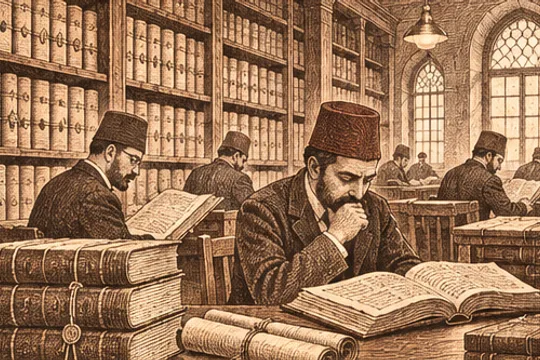
(Article 166 — 21 May 2017)
President Recep Tayyip Erdoğan addressed a significant issue during the opening ceremony of Ibn Haldun University, stating that during the February 28 process, thousands of rare and valuable works were discarded by the administration of Istanbul University.
This event is, unfortunately, accurate, but it’s not the whole story. I remember those days very well. When Kemal Alemdaroğlu was the Rector of Istanbul University, he initiated a comprehensive investigation across the university’s libraries, collecting all the old manuscripts he could find and then, under the pretext of “library restoration,” he had them stored in a damp, flooded basement area within the Rector’s office.
While Kemal Gürüz chaired the Council of Higher Education, Kemal Alemdaroğlu was rector of Istanbul University and Meral Alpay headed its library, the university’s staff records from its founding through to the 1970s were thrown away, along with thousands of works from the libraries.
There were all sorts of things within the pile of scrap paper – a real collection of items. Sultan Süleyman the Magnificent’s work titled “Muhibbi,” alongside the divans penned by Yavuz Sultan Selim and Fatih Sultan Mehmet, İdris-i Bitlisi’s “Heşt Behiş,” Piri Reis’s *Kitab-ı Bahriye*, Mevlâna’s *Mesnevi*, Kâtip Çelebi’s *Cihannümâ*, Evliya Çelebi’s *Seyahatname*, and unique and exquisite copies of the Holy Quran, and works by. Abdülhamid’s photo albums, maps – basically, everything.
When Yavuz Sultan Selim conquered Egypt, he prevented soldiers from looting the manuscripts held in the Library of Alexandria. He emphasized that these books belonged to the state and, upon collecting as many as possible, had them brought to the Topkapı Palace library. This careful approach towards books by Yavuz was later adopted by subsequent sultans, and all manuscripts seized from the conquered territories were gathered in Istanbul as state property.
When Sultan Abdulhamid II ascended to the throne, he began to govern his country from Yıldız Palace. Abdulhamid, who was extremely fond of reading, moved a portion of the books held in the Topkapı Palace Library – approximately 135,000 volumes – to Yıldız Palace and established a library there. When he was removed from the throne in 1909, the Yıldız Palace Library fell into obscurity. When the Republic was established in 1923 and the Istanbul Darülfünunu (a type of library and academy) was founded in 1933, these books, which were located in Yıldız Palace, were transferred to the Istanbul Darülfünunu by order of Mustafa Kemal Atatürk. Here’s a list of the following items: 20,037 handwritten works, 33,695 printed works, 1,555 maps, 2,290 periodicals, 728 newspapers, 3,520 European rare books, 640 calligraphy pieces, 911 photo albums (containing 3,6585 photographs), 693 printed albums (catalogs, drawings), and 358 musical scores.
The rector, Kemal Alemdaroğlu, has acted in a manner that cannot be explained by either humanity or scientific ethics. Appointed as rector in 1998, Alemdaroğlu, together with Kemal Gürüz, coordinated the academic aspects of the 28 February process – and frankly, he’s not a real scientist, and his work has no significance whatsoever.
The YÖK (Higher Education Council) General Board issued a warning to all rectors in February 1998 regarding the restriction on female students wearing headscarves attending universities. In March, Alemdaroğlu, who convened the deans of universities, requested the implementation of the General Board’s decision and instructed them to “prioritize scientific research if necessary” in order to enforce the ban on headscarves, and also demanded that faculty members adhere to the dress code regulations.
Professors who criticized these decisions are being systematically removed from their positions, one after another, and their ties to the university are being severed.
At the same time, a circular was issued by the Alemdaroğlu, which included stipulations such as: “dress in accordance with modern civilized standards.” The circular specified that “women and men should not wear sandals, men should not grow beards, men should get shaved every day, hair should not extend to cover the ears, but should be well-groomed and styled, beards should not extend beyond the length of the lips, and the overall length should be cut at the level of the lips.”
Alemdaroğlu was not hesitant to explain to journalists why he felt the discussions around headscarves had increased recently, stating, “When I looked out at the university grounds, I always saw women wearing headscarves, and it was disrupting our view.”
The graduation ceremony, held at the Conference Hall of the Faculty of Science and Letters at Istanbul University in June 2000, was attended by students and relatives wearing headscarves.
Using a pretext of an earthquake, the faculty of the Law Faculty’s main building instructed the professors to vacate their offices without informing them, and then sent thousands of books, including those of the late Professor Sıddık Sami Onar, to SEKA, intending to destroy them.
I was on the faculty of Istanbul University when Kemal Gürüz and Kemal Alemdaroğlu reigned like pharaohs. As a volunteer I was rendering into modern Turkish the Rare Books Library’s first inventory of its holdings, written in Ottoman Turkish. It wasn’t part of my job, but I loved books so much that I had made it my business. One day I turned up to find the library closed. They weren't letting anyone in. The staff were in tears. Boxes were being carried off towards the rectorate. Hostility towards Islam was already at a fever pitch in those days. The university’s senior management and administrators could not read Ottoman Turkish, so no one there appreciated what these works were worth. It was a time when even the smallest notice or poster written in Arabic script was seen as an act of rebellion against the state, and you would immediately find yourself under investigation.
Back then, I was simply a faculty member. It was a remarkable thing to be able to reach Rector Alemdaroğlu. I contacted the Secretary General and explained how important and valuable these books were. However, I didn't receive any result. At that time, an investigation had already been opened against me, and in 2001, my connection with the university was severed.
Upon hearing that the books in the law library were being sent to SEKA, I dropped everything and began investigating. I discovered that the key to the warehouse where the boxes containing the books for SEKA were being stored was a “Tokatlı” insecticide. I explained to him how incredibly important these books are, that they contain hundreds of handwritten copies of the Quran, and that destroying them would be a tremendous betrayal of our history. I pleaded with him to do whatever he could to save these invaluable works. “Thank you, sir. He admitted that this was the truth, and said, ‘If that’s the case, when the SEKA people arrive, there’s a room with the exam papers of law and economics students. We’ll deliver those bundles to them, sir.’ He expressed his gratitude, and the rare Ottoman artifacts, each worth millions of dollars, were saved from being turned into paper pulp.”
When Kemal Alemdaroğlu was removed from his position and Mesut Parlak was appointed in his place (in 2005), I contacted the university again and informed Mesut Parlak about the situation. He immediately moved the books back to their original location. However, no one can deny that Professor Yunus Soylet made the most significant contribution in this matter. Professor Yunus Söylet initiated a major project at Istanbul University, during his tenure as rector, focused on the restoration of all historical artifacts at the university, including the Nadir Eserler Kütüphanesi (Rare Books Library). He also commissioned an assessment of the university’s assets, including its financial and real estate holdings, and successfully transferred property located in the areas where Çapa and Cerrahpaşa campuses are situated, to the university’s legal entity. The university has relocated various departments to the historically restored buildings in the Süleymaniye district.
He restored the dilapidated and independent Nadir Eserler Library, removing the damp and humidity and returning the rare manuscripts to their original locations, while also digitizing them. Furthermore, Yunus Hoca not only saved the rare manuscripts, but also the historic buildings inherited from the Ottoman era, and he also worked to restore the reputations of faculty members who had been unjustly deprived of their positions during the Alemdaroğlu period.
It will always be a source of pride and an honour for me to have worked with a rector like him. And when it comes to Yunus, I have so many memories from Bostancı. I can tell you now that when the history of Istanbul University is written, a whole chapter will be devoted to Yunus Söylet.
In short, what two pharaohs, Kemal Alemdaroğlu and Kemal Gürüz, laid waste to, one Yunus put right.
May God be pleased with God and with those who brought him/her into being.
Meanwhile, this is an urgent appeal to the President: I request that all handwritten manuscripts currently held in Turkish libraries be gathered and established as a special library within the Presidential Complex. These manuscripts will be collected, page by page, and sold.
Dr. Mehmet Hakan Sağlam
Translated from the Turkish original. Türkçe