
Two poems, two truths and a university that gives us hope…
7 October 2017 · Personal website
(Article 186 – 7 October 2017)
Many people will have read my articles criticising Türkiye’s higher education system.
Ask where Türkiye stands in scientific development and, unfortunately, we have very little to say for ourselves. About two years ago I explored the subject on A Haber’s Yaz Boz programme and discussed how many patents universities around the world held. I said that the top 150 universities in the United States held around 1.75 million patents, that the same number of European universities held around 100,000, and that only four of Türkiye’s 170 universities had produced any patents, with a mere 274 between them. I criticised our scientists and our universities then, and I still do. Since that broadcast, I have raised the issue in countless panels and televised debates.
Of course we have excellent scientists, some of whom have made achievements of international standing. I leave them out of this criticism. Turkish universities have some exceptional academics today, but they are so few and face so much pressure that those who can withstand it stay and those who cannot leave for another country. The people applying the pressure and harassing them are mostly sham intellectuals with the title of professor. Spiteful people who lack both knowledge and decency keep blocking the path of successful academics for fear that their own scientific insignificance will be exposed.
I watched with regret as research assistants working on artificial skin or artificial eyes left for universities in Germany and the United States. In a country with no criteria for evaluating performance, people who somehow land a post in any department at any university have one objective from that moment on: to retire from it without mishap.
So who is to do the scholarly and scientific work, and when will they do it? Nobody asks and nobody looks into it. Many faculty members produce nothing beyond their master’s and doctoral theses, live in little worlds far removed from science and, when their time comes, are sent on their final journey with a Turkish flag draped over the coffin. A tourist who saw that flag-draped coffin at a funeral and learned the deceased was an academic might assume it was a scientist of the standing of Newton or Asimov. Yet most of our academics have never published a single article.
Unfortunately, our education system is weighted toward the social sciences. We turn out enough economists, international relations specialists, business and public administrators, statisticians and lawyers for the whole world, yet we have no scholar who has come up with a single economic theorem. That is hardly surprising when the prevailing method is “steal, copy, paste.” If Türkiye adopted the annual performance-based contracts used by universities in the United States and Europe, I maintain that only five percent of our academics would be assessed as successful. The remainder would struggle to find a single word to put in the blanks on their academic appraisal forms.
Mehmet Akif Ersoy’s Safahat, written 106 years ago in 1911, contains two beautiful poems. I often quote the one on repetition and learning from the past.
“They say we learn from the past… What a fairy tale!
Have five thousand years of stories taught us even half a lesson?
They define ‘history’ as ‘repetition.’
If anyone had learned from it, would it repeat itself?”
But few people know the master’s poem about universities.
“There are all these places they call schools of higher learning.
Ask what the nation pays for them. Millions.
What’s that? Civil service. This? Medicine. This one? Naval studies. And that?
That? Civil service. This one? Agriculture. Over there? Engineering.
Very good. I have nothing against any of them. Only,
What have they produced, I wonder? Tell us.
The moment we need work at the dockyard or out at sea,
We run straight to the English, as we always do.
For a broken bridge, a foreman comes from Belgium.
And a skilled physician is summoned from who knows where.
Say there’s a budget to work out. Nobody can do it…
Well then, send for Monsieur Laurent at the Finance Ministry.
Where are our workshops? Where is our industry?
In Brussels, in Berlin or in Manchester!”
About seven or eight months ago I came across an old issue of Time magazine. It covered a hundred inventions that changed the world: chip technology, the internet, nanotechnology, mechatronics, cell and gene technologies, DNA, fibre-optic communications, wireless radio, the telegraph, the telephone, telex, fax machines, mobile phones, satellites, nuclear technologies and many more.
So how many of these inventions owe anything to the work of our people?
Of how many can we say, “We made this”?
Unfortunately, none of them!
We hope Türkiye will reach the level of contemporary civilisations in science and technology. The way to do that is to find and train academics of real calibre. The Ottoman state that our self-styled leftist and modern intellectuals look down on and tear to pieces dealt with this at the Enderun Palace School. Guided by the principle of “the state first,” the Enderun carefully educated the sultans, grand viziers, chief jurists, governors and district governors who staffed the administration. It was indisputably the state’s most important source of talent for six hundred years.
Türkiye needs institutions modelled on the Enderun. We must open schools on that model for science and technology as well as for public administration. Our universities must move beyond handing out diplomas and become internationally recognised institutions of quality that train people to create, develop and put ideas into practice. The Ministry of Science, Industry and Technology has a vital part to play in advancing science and technology but has proved ineffectual, and needs to be overhauled from top to bottom. Cumbersome bodies that busy themselves with everything except science and technology and achieve nothing in practice serve no purpose in the New Türkiye.
About ten years ago I put a very simple question to my students in an economics exam and told them a correct answer was worth 25 points. The question was: “Define democracy in the simplest possible terms. With your definition in mind, tell me what you do when you go to the toilet in the morning.”
I put this question to about ten different classes, but the proportion who got it right never exceeded three or four percent. In the simplest terms, isn’t democracy “the equal exercise of rights”?
The answers invariably went something like, “I go into the bathroom in the morning, use the toilet, wash my hands and face, and leave.” But on top of all that, isn’t the main thing to flush? You should flush and leave the toilet clean so that the next person can exercise the same right to a clean toilet. After I told the students the answer, I noticed the toilets throughout the school were left cleaner. Years later, a student recognised me at a hotel in Uludağ, Bursa, and ran over. The first thing they said was that they had never forgotten the “toilet” question and had told everyone about it.
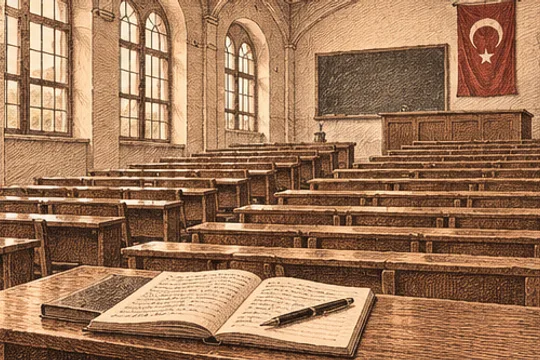
Our universities, which give their students nothing beyond a piece of paper, need restructuring and radical change. Vast campuses, tens of thousands of students, thousands of academics, proximity to or distance from the city, and international partnerships will never by themselves make a university great.
Greatness is measured by inventions, scientific achievements and the calibre of both the people who teach and those they educate.
The Enderun Palace School worked out of a relatively small building inside Topkapı Palace, yet it trained accomplished statesmen and officials who ruled across three continents for six centuries.
Mehmet Akif Ersoy wrote those two poems in that accursed “long century of the Turks,” when Sultan Abdülhamid II was deposed in 1909 and the Committee of Union and Progress took over the Ottoman administration and tore that vast empire apart in just six years. The Balkan Wars, the Dardanelles, North Africa, the Canal, Suez, Egypt, Libya, Basra, Baghdad and even Istanbul were ablaze. Even amid that chaos, Mehmet Akif was arguing that salvation lay in science and industry and that the universities had important work to do.
A century has passed. Has anything changed? I don’t think so. It is the same old story. A small minority calling themselves “intellectuals” work nine to five in their little university worlds and pocket salaries they have not earned, like the people in the old saying about a Kurd playing the music and a Roma person dancing.
For all the mediocrity and setbacks, good things do happen.
Three weeks ago I “visited” Biruni University’s teaching and research hospital in Florya. I had actually taken my mother there for a general check-up. But the care the hospital provided and the doctors’ attentiveness made it feel more like a visit than a trip to hospital.
After a succession of tests, analyses, examinations and findings, my mother went into surgery a week later and recovered her health.
Turks are quite different. They never forget a kindness, consideration or respect shown to them. Anyone who forgets a kindness done to them is certainly no Turk. It is in our genes. Isn’t that why we stand by the oppressed all over the world?
Isn’t that why we remember with prayers and gratitude the Muslims of India, Pakistan, Java, Burma, Myanmar, Afghanistan and Kashgar who gave us money during the War of Independence?
Isn’t that why we come to the aid of the Ahmets, Mehmets, Ayşes and Fatmas of Aleppo, Damascus, Raqqa, Mecca, Medina, Basra, Baghdad, Mosul, Kirkuk, Thessaloniki, Kosovo, Sofia, Cairo, Sanaa and the Hejaz when they are in trouble, remembering those who fell together at Gallipoli and lie side by side today?
“It is easy to die for a friend. What is hard is finding a friend worth dying for,” said Nâzım Hikmet.
And Rumi said, “If they are a friend, give them your life without a second thought. If they are no friend, don’t keep them waiting. Let them go.”
What, then, do we mean by vefa, that quality of faithful friendship?
To be faithful is to love and to show respect.
It is to remember a kindness.
It is one of the sure signs of friendship.
It is to keep your word, to be someone whose word can be trusted.
It is never to forget, always to remember, and to be remembered in turn.
It is the living embodiment of our saying, “A single cup of coffee is remembered for forty years.”
Mehmet Akif Ersoy saw the words “friendship” and “companionship” being emptied of meaning. In the poem that begins “The veil of modesty has fallen”, he describes a world bereft of faithfulness:
“The veil of modesty has fallen. Such shamelessness on every side!
What ugly faces that thin curtain must have hidden.
No loyalty, no reverence for a pledge: words devoid of meaning.
Lies are the common currency, treachery embraced; truth is a stranger everywhere.
It makes one’s hair stand on end, O Lord! What a fearful change has come about.
Neither religion nor faith remains: religion lies in ruins, faith has turned to dust.”
Nor should we pass over Sheikh Saadi of Shiraz’s definition of a friend: “Do not count as your friend the one who speaks of friendship and calls you ‘brother’ while you live in plenty. A friend is one who takes your hand when you are brought low, when you no longer know where to turn.”
In one hadith our Prophet prays, “O God, let me live so long as life is better for me, and take me when death is better for me.” What meaning those words give to death.
How fortunate we are to have a noble faith that teaches us that good and evil are ordained by God. Death is an instant, finer than a hair and sharper than a sword. At that moment, every breathing creature severs its ties to this world, and all at once everything stops and falls silent. As each living being departs this world in death and passes into another, those who loved them are left to learn to live with the pain.
They say that God gave the grief of bereavement to the mountains. They could not bear it and crumbled. He gave it to the rivers, and they wept themselves dry. He gave it to the winds, and they blew and blew until they were spent. At last they all found their voices and begged Him, “Take this sorrow from us. We cannot bear it.” So God took it from them and gave it to us. Human beings, the story goes, have the nerve to go on. We soon forget, we soon grow used to things. The grief that brought down mountains, dried up rivers and wore out winds could not wear us out. At first it scorched us through and through, again and again. In time we grew accustomed to it.
Yes, in time we do grow accustomed to it. It’s hard, but we do. Or we think we do. Or we fool ourselves into thinking that we have.
So many people work and strive to save lives and give others renewed strength. My deepest thanks to Dr Fatma Aygün, who operated on my eye at Biruni University’s Florya Hospital, Dr Alper Öztürk, who operated on my mother, Dr Yunus Öksüz, the hospital’s chief physician, and Mr Lütfullah Yafes, who, like me, once traded in the Grand Bazaar. We could never forget what we owe them.
Forget them? If we did, how could we ever be forgiven what we owe them?
There is a famous exchange of letters between Sultan Suleiman the Lawgiver and his chief religious jurist, Ebussuud Efendi. Walking in the gardens of Topkapı Palace, Suleiman noticed that ants had overrun the pear trees. He sent Ebussuud two lines asking what he ought to do: “If the ant should harm the tree, / Is it a sin to kill the ant?”
Ebussuud Efendi replied to Süleyman’s question, “When we stand before the Lord’s court tomorrow, the ant will have its due from Süleyman!”
Yes! Tomorrow everyone will appear before the Lord’s court and receive the reward for what they did in this world. A thousand thanks to everyone who helped us through my mother’s illness. We ask them to release us from any debt of gratitude we owe them.
What we owe others and what it means to be faithful matter to those who believe and understand…
Of course! Faithfulness goes beyond sitting round a table in good times, laughing and having fun over tea, coffee or a meal.
Faithfulness is the hand that reaches out to you when you feel helpless and alone, when you put your head between your hands and ask, “What will happen now, who will help us?”
It is bringing fresh life to another, sharing their sorrow and grief, feeling what they feel and weeping together as you embrace.
It is being able to shed tears at the grief of someone you have never met.
It is being able to say, “Don’t feel alone. We’re right behind you.”
We saw all of this and more at Biruni University Hospital.
Verse 32 of Al-Ma’idah in the Qur’an was revealed for faithful people like these: “Whoever kills a person, unless in retribution for a life or for spreading corruption in the land, it is as if they killed all humanity. Whoever saves a life, it is as if they saved all humanity.”
May God bless a thousand times everyone who treated my mother, welcomed her, cared for her or gave her so much as a drop of water.
Dr. Mehmet Hakan Sağlam
Translated from the Turkish original. Türkçe