
The Wahhabi unbelievers who turned the Kaaba into a money-making enterprise
30 September 2014 · Personal website
(Article 26 – September 30, 2014)
The author accuses the Wahhabis, whom he calls unbelievers, of systematically destroying the historic monuments of Mecca and Medina.
Prince Sultan bin Salman bin Abdulaziz, a member of the Saudi royal family, which claims to guard Islam, presented a paper to the Department of Architecture and Arts at Jordan’s Petra University in his capacity as head of the Saudi government commission responsible for tourism and heritage. In his speech he described his family’s experience in preserving architectural monuments and spoke of the economic and environmental importance of historic preservation in urban design.
Well, would you look at that! What experts in urban architecture these Wahhabi desert Bedouins turn out to be, the author remarks sarcastically.
Please take a good look at Mecca and Medina today.
The author says that scarcely a trace remains of the places Muslims hold sacred in Mecca, Medina, and the other cities. What one sees instead are towers of steel and reinforced concrete, shopping malls, and residential complexes built for profit.
The author calls the Prophet Muhammad’s tomb the sole surviving historic structure in Medina and speculates that the Saudi authorities are waiting for the right moment to demolish it. He reads the Saudi king’s alleged wish to be buried in an unmarked place in the desert as a signal that his successors should remove the Prophet’s tomb if he cannot do so himself. In the author’s view, only fear of outrage among Muslims worldwide has kept the tomb standing. He finds it hard to fathom that people have killed one another over things less precious than monuments already lost in Mecca and Medina, yet no one lifts a finger about their destruction.
Muslim countries are powerless against the Saudis, the author argues, chiefly because Saudi Arabia sets the pilgrimage quotas. In his account, the authorities equate buildings people revere and hold sacred with the idols the Prophet Muhammad broke, and can readily obtain whatever religious rulings they want. He accuses the Wahhabis of removing Ottoman monuments, cemeteries, memorials to martyrs, and the graves of the Prophet’s companions and relatives over eighty years and replacing them with commercial buildings. According to architect Sami Angawi, who has devoted his life to preserving the history of Mecca and Medina, only twenty sites from the Prophet’s time remain. Muslims and non-Muslims alike, including governments, clergy, writers, and thinkers, are watching in astonished silence as these sacred monuments disappear.
The few fourteen-century-old monuments left untouched stand in ruins, whatever their importance, awaiting demolition at the first opportunity. The author says most monuments are demolished on orders from the Saudi royal family and in accordance with religious rulings, amid an almost festive atmosphere. In January 2002 Turkey called for the preservation of the Ajyad Fortress in Mecca and said demolishing it would amount to cultural genocide. The fortress was demolished all the same. In place of the magnificent structure that, in the author’s words, had protected Mecca from enemies of the faith since 1780, the Zamzam Tower was built, bringing its investors millions of dollars a year.
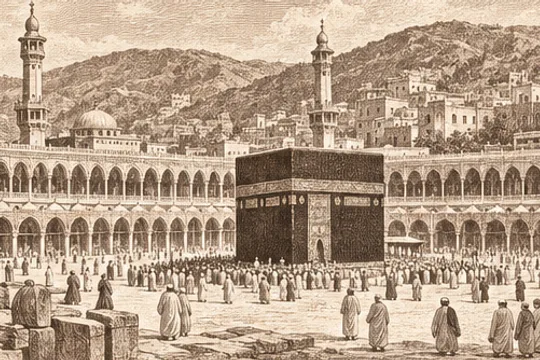
The Ottoman state, the author says, decreed that no building around the Kaaba could be taller than it or cast its shadow upon it, and observed that rule for centuries. He accuses the Wahhabi authorities of surrounding the Kaaba with much taller skyscrapers and claims people now hold weddings with music and dancing, as well as alcohol and Captagon parties, in buildings overlooking it. Look at what the author calls state-sponsored immorality in Islam’s holiest places: in eighty years, he says, Mecca and the Kaaba have been surrounded by profit-making establishments, a phrase he uses to evoke brothels.
The Saudi authorities also demolished Mecca’s Jarwal Barracks and turned the site into a parking lot. Abdülhamid I had built it as a guesthouse for poor pilgrims, and it became a military garrison just after the start of the Second Constitutional Era. Only one wall remained to recall what the author calls one of the most important Ottoman monuments. Abdülhamid II’s interest in photography is well known. To pass images of his time on to future generations, he had almost every corner of the empire photographed, including all the historic monuments in Mecca and Medina, and assembled the images in albums. Compare the two holy cities today with how they looked under the Ottomans. The first photograph will tell you who cared about history and the past.
Even when the Hejaz Railway was built, entirely with public donations at a time when the Ottoman Empire was burdened with foreign debt, religious values were treated with great care. When the railway reached Medina, Sultan Abdülhamid II, the author says, asked for felt to be laid under the rails to avoid disturbing the Prophet’s spirit and ordered quiet locomotives to run along a stretch of five or six kilometers.
Still, the author remarks sarcastically, the authorities’ interest in history should not be underestimated in certain cases. He accuses the Saudi rulers, whom he calls pharaohs, of demolishing Khadija’s home to build toilets while making a museum of the house where Lawrence, the British agent who stirred up the Arabs against the Ottomans, stayed.
The author accuses Saudi religious scholars of trading their principles for money and position by issuing rulings that sanctioned the royal family’s destruction of historic sites and obeying its orders unquestioningly. He also claims that even Safa and Marwa, where Abraham left Hagar with her child and where she searched desperately for water before Zamzam was found, were leveled to build a palace for the former Saudi king Khalid bin Abdulaziz. He says the next target is the Prophet’s tomb.
The author says the Saudi wish to demolish the site is longstanding. In his account, they have been waiting for the right moment to remove the Prophet’s tomb since 1926 and see destroying shrines and graves as a duty imposed by Wahhabism.
Who are the Al Saud, who now rule these holy lands, and what is Wahhabism, their religious doctrine? A brief account is in order. Muhammad was born in 571 and, at the age of forty, was called to prophethood in 610. He began preaching Islam in Mecca and migrated to Medina in 622, where he laid the foundations of a state centered on that city. In 630 he conquered Mecca. By the time he died in 632, nearly the entire Arabian Peninsula had come under Islamic rule.
The era of the four caliphs began after Muhammad’s death. During the successive caliphates of Abu Bakr, Umar, Uthman, and Ali, the Islamic state’s borders expanded to the Caucasus and Khorasan in the north, the Indian Ocean in the south, the Persian Gulf in the east, and the middle of North Africa in the west. Under the Umayyads (661–749), it extended through all of North Africa and into Spain and France, while lands in India and Turkestan were taken in the east. Thus, in the author’s account, the Islamic state stretched from the Atlantic and the interior of France to China.
The Abbasid era (749–1258) saw internal strife, the Crusades, and the Mongol invasion. The Mamluks of Egypt (1250–1517) took control of these holy lands after the Abbasids. When Selim I conquered Egypt in 1517, he brought the holy lands under Ottoman protection along with Egypt and Syria. The Arabian Peninsula remained under Ottoman rule into the early twentieth century. Until 1918, the Ottomans provided services, sent annual surre convoys to help the poor, and looked after the population’s needs.
The author alleges that British agents mounted a campaign of vilification against the Ottomans in the holy lands before World War I. Abdülhamid II regarded Sharif Hussein as dangerous and obliged him to live in Istanbul as a member of the Council of State. The author says that when the Committee of Union and Progress took power in 1909, it set free a man he calls a British agent and made him Sharif of Mecca. He alleges that Hussein made a pact with the British against the empire, accepted their protection, and received an annual bribe of £400,000. Hussein launched his revolt on June 27, 1916, in the author’s chronology. As the Hejaz slipped away, Fahrettin Pasha held Medina for two years and seven months, saying that he could not hand over his Prophet’s tomb to anyone.
In the end Sharif Hussein got what he wanted. But after internal struggles, Ibn Saud defeated him and drove him from the Hejaz. The author portrays him as a British puppet and credits him with establishing a small state in Jordan. The present Jordanian kings are descended from him.
King Abdullah I, who visited Atatürk in 1937, was Sharif Hussein’s son and Jordan’s first king. Abdullah was assassinated. His son and successor Talal developed a mental illness and, in the author’s account, lived out his days at Şifa Yurdu in Istanbul. The author says that other members of Hussein’s family became king and crown prince of Iraq and met violent deaths in a military coup. Hussein fled the Hejaz during the Wahhabi uprising and lived in captivity after the British detained him in Cyprus. In 1942, during World War II, İsmet Pasha sent Feridun Cemal Erkin on a diplomatic mission to Middle Eastern capitals, and Abdullah received him in Amman. In Thirty-Four Years in Foreign Affairs, Erkin recalls the king saying of his father: “My father suffered greatly. One day the palace band was giving a concert in the garden. It was hot and the windows were open. At one point the band began playing the İzmir March that we all know. I shut the window to keep so many of my father’s old memories from coming back…”
My father asked me to open the window. “Son, why are you shutting it? So the İzmir March won’t remind me of the old days, isn’t that it? I am a rebel who betrayed his benefactor, and my sin is great. I thought I would be king, but God sent me into exile. I fell ill and took refuge here. Open the window and let me hear the march. Let the old memories come alive and sharpen my remorse. Let that remorse deepen the suffering I endure in this world, so that Almighty God may forgive this sinful servant here and spare him greater punishment in the hereafter…”
As for the rise of Wahhabism and its ties to the House of Saud, the author traces it to the 1740s, when Muhammad ibn Abd al-Wahhab founded a religious movement and began preaching in Diriyah, near Riyadh. In his account Ibn Abd al-Wahhab allied with the local tribal chief Muhammad ibn Saud and married his sister. Ibn Saud adopted his brother-in-law’s doctrine and used force to make people accept it. The author says this political and religious alliance sparked the Wahhabi revolts in the Arabian Peninsula, whose chief aim was to break away from the Ottoman Empire and found an independent state on their own beliefs. The Saudis seized the Hejaz at the beginning of the nineteenth century. The Ottomans retook it through the governor of Egypt and severely punished Saudi and Wahhabi leaders. The author says two sons of Ibn Abd al-Wahhab were killed and descendants of Ibn Saud were taken to Istanbul and executed.
At the beginning of the twentieth century the movement regrouped and signed an agreement with Britain. Emir Abdulaziz secured a British guarantee that he would keep the territories he had captured in Arabia and pass power to his children on his death. After the Ottoman defeat in World War I, the Wahhabis took Taif, Mecca, Medina, and Jeddah with British support, the author says. Abdulaziz ibn Saud won the war with Sharif Hussein and was proclaimed king of Najd and the Hejaz. The kingdom gained independence in 1927 and took the name Kingdom of Saudi Arabia in 1932. That, in brief, is how the present political order came into being.
A British newspaper ran an article claiming that the Saudi authorities spent $19 billion a year on the “preservation” of Mecca and Medina. What is that $19 billion being spent on when the Prophet’s home and holy sites that go back fourteen centuries are being demolished? The author asks whether it could be intended to surround the Kaaba with skyscrapers and eventually destroy the sacred structure itself.
The author says the grave of Amina, Muhammad’s mother, was found in 1998, then immediately bulldozed and burned with gasoline. He says fewer than twenty structures dating back fourteen centuries remain in Mecca. He alleges that the home of Khadija, the Prophet’s first wife, was demolished and replaced with toilets, that Abu Bakr’s house was demolished and its site became part of the Hilton hotel grounds, and that a royal palace replaced the 1,200-year-old Abu Qubays Mosque.
Demolition under the eighty-year-old Saudi kingdom, the author says, shows no sign of stopping. He claims the authorities have now gone so far as to threaten the house where Muhammad was born. And how do they plan to redevelop the area? By building a car park!
“Today we are witnessing the last days of Mecca and Medina. The farewell is very near.”
The author says Wahhabis also want the cave on Mount Hira, where Qur’anic revelation came down, demolished. He quotes their reasoning: “The Prophet did not give us permission to climb this mountain, worship there, or touch the rocks.” He says the remains of Khadija’s tomb were destroyed in 1950 and Saudi police stood guard day and night to stop people from leaving flowers or paying their respects. He also alleges that a mosque housing the grave of al-Urayd, a descendant of the Prophet, was blown up and that Saudi police gathered around the ruins and celebrated.
The author disparages the Saudi authorities as desert Bedouins and asks what would draw Muslims from around the world to Mecca and Medina if their Islamic holy sites were razed. Why go there, he asks, to see luxury concrete buildings, steel structures, hotels, and residences like those found readily in other countries? He ends with a disparaging remark about what he calls “Arab reasoning.”
Western hotel chains now occupy nearly every inch of Mecca and Medina. The author says they charge $1,000 during the pilgrimage season for rooms normally worth $80 and care as little about Muslim religious feelings as the Saudi authorities do. How would Christians react if a place sacred to them in the Vatican or anywhere else were demolished to make room for a profit-making hotel, shopping mall, or parking lot?
Why, then, do the Saudis agree to requests to destroy Islamic holy places and symbols? That, for the author, is the question. He describes Wahhabism as a doctrine he considers heretical, influential in Saudi Arabia and elsewhere and invoked by terrorist groups such as ISIS. He attributes ISIS’s destruction of shrines, mosques, and other Muslim holy places to that influence. He alleges that the real purpose of Saudi and other regional Salafi governments joining the US-led campaign in Iraq and Syria was to use ISIS as a pretext to strike sites indiscriminately, destroy Islamic heritage, and increase local interest in Salafism even as the coalition killed a few hundred ISIS fighters.
Following Saddam’s invasion of Kuwait in 1990, the United States assembled an international coalition and attacked Iraq in the First Gulf War. The author claims Iraq was still paying war reparations to the United States and that part of its oil revenue went toward them. He says the United States also billed Kuwait and Saudi Arabia for its military expenses on the grounds that it had protected them, and was paid. According to the author, no one yet knew what compensation the United States had sought after invading Iraq following the September 11, 2001 attacks and spending trillions of dollars on the Second Gulf War.
Look at the US-led wars launched to end terrorism in the Middle East, Central Asia, and Africa. Countries such as Iraq, Sudan, and Afghanistan were as different before and after intervention as black and white. The author argues military intervention made conditions worse and claims people now long for leaders like Saddam. Uncertain of tomorrow, people in the Middle East are swept this way and that like dry leaves. Millions in refugee camps in Syria, Jordan, Palestine, Iraq, and Turkey wait far from their homes and lands, longing to return.
Rather than looking at the details alone, the author urges readers to consider the partition of the Ottoman Empire after World War I. In his view, no Arab country retains the peace and security he ascribes to Ottoman rule. At the mention of the Middle East, he says, people picture war, blood, tears, people beneath rubble, crying children, families without food and water, and convoys of displaced people. He rejects this as the region’s inevitable fate and blames sectarian disorder on movements he considers heretical, such as Wahhabism, and on borders and states drawn up at a desk, which he says created their own artificial religious systems. He compares the executions and torture he associates with medieval Christian inquisitions to contemporary killings in the region, including stoning, mass shootings, and executions for not knowing a prayer or how to worship.
The author claims that radical organizations appearing in Iraq and Syria, or likely to appear elsewhere in the Middle East and Africa, originate in the West. In his account their ranks include Arabs and Western citizens, some shaping doctrine and others fighting. Some profess to travel to another Muslim country for jihad, he says. Others seek adventure and bring addictions, alienation, and a desire to vent their anger by killing. He argues that the sole aim of these groups is to spark fresh conflicts within the Islamic world and spread aversion and hatred toward Islam, leaving Muslims everywhere having to explain that Islam does not entail violence instead of speaking of its beauty and virtues.
Defeating ISIS will not solve the problem, the author argues. He traces it to what he calls artificial states such as Saudi Arabia, Jordan, Palestine, Syria, Kuwait, the UAE, Yemen, and Iraq. He says that deliberately putting antagonistic populations inside the same borders causes new conflicts. Unless the borders are redrawn, he predicts, we and generations to come will face such conflicts for centuries.
As for the possible demolition of the Prophet’s tomb and the Kaaba, the author says that in such an event Muslims would no longer need to go to Arabia.
What if, the author asks, the Kaaba were rebuilt using the plans in the Ottoman archives in Kilis, the land of the Companions, or in Urfa, the land of the Prophets, together with the Ottoman porticoes demolished two years earlier and the Ajyad Fortress, and made available to Muslims from all over the world alongside the Sacred Relics from Topkapı Palace?
Translated from the Turkish original. Türkçe