
“Rise, Saladin, we have come again”
5 September 2014 · Personal website
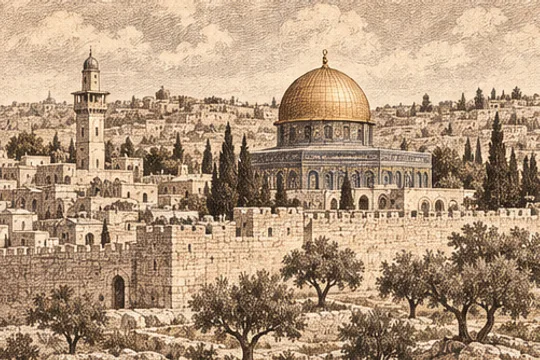
(Article 018 — 5 September 2014)
Contrary to what is usually thought, the first Western crusades against Muslims did not begin in the twelfth century, but much earlier, in the ninth. Their purpose was to drive Muslims out of Spain and Portugal. In 711 Muslims set foot in Spain under Tariq ibn Ziyad and founded the Islamic civilization of al-Andalus there. The first attempts to expel them began in the ninth century and, as is well known, were completed in 1492. Islamic rule in those lands came to an end.
History books record nine military campaigns as the Crusades, intended to bring Jerusalem under Christian rule. Taking lands held sacred by Christians, recovering Jerusalem and increasing papal revenues were all important aims. The First Crusade took place from 1095 to 1099 in pursuit of these ideals. On 15 July 1099 Jerusalem fell to the Crusaders and all the Muslims and Jews living in the city were killed. The city remained the capital of the Holy Kingdom of Jerusalem for eighty-eight years, until Saladin took it back in 1187.
The Second Crusade took place in 1147–49 after the atabeg of Mosul took Edessa in 1144 and ended the County of Edessa. Emperor Conrad III of Germany and King Louis VII of France led their armies into Anatolia. They met the resistance of the Seljuk armies and returned to Europe.
The Third Crusade took place in 1189–92 after Saladin took Jerusalem in 1187. The German emperor Frederick Barbarossa entered Anatolia with a hundred thousand men. King Philip II of France and King Richard the Lionheart of England reached Acre by the Mediterranean and took the city. Richard made several attempts to capture Jerusalem but could not take it from the Muslims.
The Fourth Crusade took place from 1202 to 1204. Pope Innocent III called all Europe to join a campaign to recover Jerusalem, and command of the assembled army went to Boniface of Italy. The Latin armies turned toward Istanbul instead of Jerusalem and occupied Constantinople. The city suffered the greatest devastation in its history. The Crusaders began by looting homes. The chronicler Geoffrey of Villehardouin, one of the early French lyric poets, witnessed the plunder and wrote, “The soldiers forgot the meaning of the cross stitched onto their clothes and set about butchery and arson. Houses were set ablaze, palaces and public buildings were stripped bare. Men were killed, women raped, and even the least valuable things were looted, down to the peasants’ shirts.”
Once the buildings had been stripped bare, it was the turn of Hagia Sophia, the greatest place of worship of the age. It was not merely plundered; it was the scene of utter disgrace. The soldiers entered the church with mules and a French prostitute. The looting took only a few minutes. They loaded the mules with wall coverings, objects believed to have belonged to Jesus’s apostles or to Mary, one of the holy nails said to have been used to crucify Jesus, the crown of thorns, gold and silver crosses and whatever was made of precious metal. Priests who had hidden in the church were disembowelled and nuns were raped. Catholic soldiers who were too late for the plunder began breaking pieces off the columns, said to have healing properties and to relieve kidney and chest pain. When the mules collapsed under their loads and could not move, they were cut to pieces with swords. Once everything in the church had been carried away, it was time to make merry. The French prostitute the soldiers had brought with them climbed into the pulpit from which the Orthodox patriarch had preached only days earlier, and began singing bawdy songs and dancing lewdly. The soldiers meanwhile were busy drinking barrels of wine. The Eastern Romans never forgot the disaster of 1204. That brutality was the reason that as the Turks advanced in later centuries, instead of seeking help from the Catholic world they said, “We would prefer a Muslim turban to a cardinal’s hat in Hagia Sophia.” The Latin Empire that had been founded ruled from 1204 to 1261. In 1261 Michael VIII Palaiologos retook Constantinople, brought the Latin state to an end and restored the Eastern Roman Empire.
The Fifth Crusade followed a call in 1213 by Pope Innocent III, who believed the keys to Jerusalem lay in Egypt. The Crusader army advanced toward Cairo. Near Mansoura, however, the rising Nile stranded them on higher ground and they surrendered.
The Sixth Crusade took place in 1228–29. On 18 February 1229, the Ayyubids and Crusaders signed a ten-year peace treaty. Under it, Jerusalem, Bethlehem, Nazareth, Jaffa and Sidon were left under the rule of the Holy Kingdom of Jerusalem. In 1244, Khwarazmian Tatars sacked Jerusalem. They massacred the Christian population and expelled the Jews. The city passed back into Ayyubid hands in 1247.
The Seventh Crusade, in 1248–54, was led by King Louis IX of France. After taking Damietta in Egypt, Louis marched on Cairo but was defeated and taken prisoner. The French king paid a ransom and was released.
Jerusalem then fell to the Mamluks in 1250. The Eighth Crusade, in 1268–70, was again organized by Louis IX of France. The king and half his army died in an outbreak of plague. The Ninth Crusade, the last, took place in 1271–72. Prince Edward, the future king of England, led an expedition to Acre, the seat of the Holy Kingdom of Jerusalem, against the Mamluk sultan Baybars. The expedition failed and was the last the Crusaders mounted in the Middle East. Jerusalem, under Mamluk rule since 1250, was incorporated into Ottoman territory by Sultan Selim I in 1517.
The unnamed Tenth Crusade…
Now to the Tenth Crusade, which does not appear on the list but ended in a resounding Christian victory. It was waged against the Ottoman Empire between 1914 and 1918, exactly 643 years after the last crusade. Britain, France, Italy, Russia, Greece and a number of other states took part. Their aim was to drive the Muslim Turks off European soil altogether. And they succeeded. The Turks were driven from all European territory except Thrace. Jerusalem fell to the British. The dream of Richard the Lionheart came true six and a half centuries later. The Turks lost all their lands in the Middle East and were confined to a tiny territory.
The West’s second objective is to clear the holy city of Jerusalem of Muslim Arabs altogether. Its legionnaire in this endeavour is Israel. Israel’s role in the region is to deny Muslims peace and tranquillity and keep creating problems. When oil runs out in the Middle East and priorities change, Israel will no longer matter either. On that day the authority the Western countries have recklessly given Israel to “attack as much as you can and kill as many as you can” will end, Israel will be isolated and the Holy Kingdom of Jerusalem will be restored.
The Vatican has stood behind every crusade from the first one in 1094 to the present. It is in no hurry. It waited patiently for 781 years to expel the Muslims from al-Andalus and has waited a thousand years to take Jerusalem. The pope is Jesus’s shadow and plenipotentiary on earth, his caliph, in other words. It is that office that plans all these long-term projects. Remember the Islamic caliphate whose legal existence our Republican intellectuals swept away at a stroke with Law No. 243 on 3 March 1924? The papacy is its counterpart in the Christian world.
Secularism, defined as keeping religious and state affairs apart, also originated at the Vatican. The republican leadership could not imagine what the Caliphate might bring Türkiye in the future, but the Western world, led by Britain, foresaw that the Islamic Caliphate would give Türkiye an important role.
In 1924, İsmet İnönü, Şükrü Bey and Mahmut Esat Bozkurt met at Ankara’s railway station to work on the Constitution. They went further still, going so far as to say, “Let us put Christianity in the Constitution as the state religion so that Westerners will not be our enemies.” Were they alone? There was also Abdullah Cevdet, who argued that “civilization had come right to our doorstep during the Battle of Çanakkale, but the Turks resisted it.” The founder of the Society of Friends of England, whom some called “Adüvvullah Cevdet,” meaning “Cevdet, enemy of God,” even said, “We need to bring in breeding men from Europe and America to improve and strengthen the Turkish race.”
Sadly, there is no leading state carrying the banner of Islam today. Nor is there an institution to mediate between Muslim countries or communities, take a position, reconcile them or stand up to them when necessary. After the Turkish Islamic caliphate ended, the British tried to foster Egypt as leader of the Muslim world and some Egyptian religious scholars as caliphs, but they failed. The entire Arab world is ablaze today. Iraq, Syria, Egypt, Saudi Arabia, Yemen, Libya, Sudan and the rest are busy tearing at one another. There are no two Muslim countries in close friendship. All have quarrels with one another and all are enemies. This is precisely when the Turkish Islamic caliphate is needed. The office of caliph has enormous power to end conflicts, secure regional peace, lead the world’s Muslims, restore Islam’s standing and begin and sustain dialogue between civilizations. To that end, the Republic of Turkey should repeal the provision abolishing the caliphate as soon as possible and proclaim the oldest living man of the Ottoman dynasty caliph. The TURKISH CALIPH who takes office at Hagia Sophia, donning the robe and bearing the sword of the caliphate, will command extraordinary authority among Muslims. Sectarian disputes and regional conflicts will then come to an end. The person stepping in to resolve these problems will, after all, be the shadow of the Prophet on earth. In the face of that authority no one will be able to stir or act on their own. Re-establishing the caliphate is one of the basic conditions for a strong Turkey in its region. Otherwise the region will remain in turmoil for years, millions will continue to die, people will lose their homes, lands and countries, and the region will decline step by step.
After the unnamed Tenth Crusade, General Edmund Allenby, the commander of the British armies who entered Jerusalem on 11 December 1917, kicked Saladin’s tomb and said, “Get up, Saladin. We are back.” By “we are back,” he meant the first arrival of the English king Richard the Lionheart, who took part in the Third Crusade in 1189 and failed. The real reason the First World War broke out was not the killing of the Austrian prince or anything of the sort. The aim was to launch a crusade against the Ottoman state, and that is what happened. The Ottomans suffered the greatest losses in the war and vanished from the stage of history.
With that background, let me illustrate how important Jerusalem is to the Turks with a recollection of a visit there in 1972 by the late İlhan Bardakçı, who died in Frankfurt in 2004.
“Location: Jerusalem. Place: Al-Aqsa Mosque. Date: Friday, 21 May 1972. My journalist friend, the late Said Terzioğlu, and I are touring this blessed site with guides from the Israeli Foreign Ministry.
Walk a little through Jerusalem’s covered bazaar, dodging the hanging trays of the robed coffee sellers who dart about like the wind, and a gate will bring you out in front of Al-Aqsa Mosque, the place of the miraculous Ascension and our first direction of prayer. Right there is the first courtyard, still known by the name we gave it: ‘the courtyard of twelve thousand candlesticks.’ When Selim I brought Jerusalem into the state on Tuesday, 30 December 1517, it had grown dark. He prayed the night prayer in that courtyard, together with the whole army. They lit the candlesticks, twelve thousand of them. That is where the name comes from. Walk up the broad steps, eight or ten of them, and you reach the second courtyard, where the sacred mosque sits as though cross-legged.
I saw him at the top of those steps. Almost two metres tall, with a strange garment hanging on his skeletal body. An overcoat? No, a greatcoat, a raincoat, a kaftan? None of those. Something like that. And on his head, a fur cap, a skullcap, a fez? None of them. He stood there ramrod straight. I looked at his face and shuddered. It was like poor soil just after harvest. Hundreds of thousands of lines and wrinkles, and what remained of a weather-beaten skin.
Beside me was Yusuf, a department head at the Israeli Foreign Ministry. He was a former citizen of ours, from Istanbul. ‘Who is that man?’ I asked. He shrugged indifferently. ‘I don’t know,’ he said. ‘Just a holy fool. They say he’s been here for years, for as long as I can remember. Rooted to the spot. Look, he’s still there. He asks no one anything. He looks at no one and sees no one.’
Was it a pull of kinship? I still do not know how it happened or why. I went over to him. In Turkish I said, ‘Peace be upon you, father.’
Behind his heavy lids he opened his dull eyes a slit, as though a razor had drawn a line. His face tensed. He answered me in our dear Anatolian Turkish:
‘And upon you be peace, son…’
I froze. I took his hands and kissed them again and again…
‘Who are you, father?’ I asked.
He told me, and I shall tell you. But first you must know that as our beloved Ottoman state was collapsing, we left Jerusalem after 401 years, three months and six days of rule. It was Sunday, 9 December 1917. There was no way to hold the city. The army had been routed and was withdrawing, and the state was on the brink of extinction. We left a rear-guard company there so the city would not be plundered before the British entered. By custom, a victorious army taking a city does not treat defeated soldiers who are keeping order as prisoners of war.
As I said, he told me. Let me finish the story.
‘I was,’ he said, ‘in the rear-guard company left here on the day we lost Jerusalem…’ He went quiet. Then he fired off these words like rounds he had fed into the chamber of his weapon:
‘I am Corporal Hasan, commander of the 11th Heavy Machine Gun Platoon, 8th Company, 36th Battalion, 20th Corps, left here that day…’
My God. I looked at him. His head above his shoulders, taut as a minaret balcony, was like a standard one could kiss.
I reached for his hands once more. He murmured in a voice like thunder:
‘I have something to entrust to you, son. I’ve kept it for years. Will you deliver it?’
‘Of course,’ I said. ‘Go ahead…’
He spoke:
‘If your journey home takes you to the district of Tokat, find my commander, Senior Captain Musa Efendi, who entrusted this place to me. Kiss his hands for me. Tell him…’
Then he thundered like the machine gun of the platoon he commanded:
‘Tell him not to worry. Tell him that Corporal Hasan of Iğdır, commander of the 11th Machine Gun Platoon, has been at his post since that day, in the very place you left him. All present and accounted for, commander, he says…’
That is what I wrote. Then he straightened up again and turned to stone. I looked once more. Behind those closed eyes he seemed like a frontier sentry of our four-thousand-year-old army, the Hearth of the Prophet. He was watching the horizon, still at his post. For fifty-five full years we had ignorantly forgotten him, yet he had not turned against his state.” Source: Zafer magazine, issue 345.
Under Article 1 of Law No. 243 on the abolition of the caliphate and the expulsion of the Ottoman dynasty from the territories of the Republic of Turkey, the current caliph of Islam is Ahmet Davutoğlu, prime minister of the Republic of Turkey. How so?
The first article of the law concerns abolition of the caliphate. Under it, the office is now vested in the government and in the prime minister of the Republic of Turkey as its representative. Here is the wording of the article.
“ARTICLE ONE. The caliph has been deposed. The office of caliph is abolished because the caliphate is already inherent in the meaning and concept of the government and the republic.”
The word mündemiç, of Arabic origin, means “contained in” or “vested in.”
As is well known, the first four caliphs of Islam were chosen by election, whereas later caliphs came from the Umayyad, Abbasid, Fatimid, Mamluk and Ottoman dynasties. The Republic of Turkey is governed by a government that comes to office by election. Law No. 243, alluding to the election of the caliph, emphasized that the government too is elected, and stated that the powers of the caliphate belong to the government. A caliph chosen by descent was therefore no longer necessary.
Translated from the Turkish original. Türkçe