
The Grand Bazaar: money’s nail-studded cradle…
24 May 2017 · Personal website
(Article 167 – 24 May 2017)
The Grand Bazaar is a closed box in which billions of dollars change hands in shops no bigger than a few square metres.
It also goes by the name of Tahtakale, as though the people of Kilis and the Syriacs of Mardin were sheltering there behind an invisible wall.
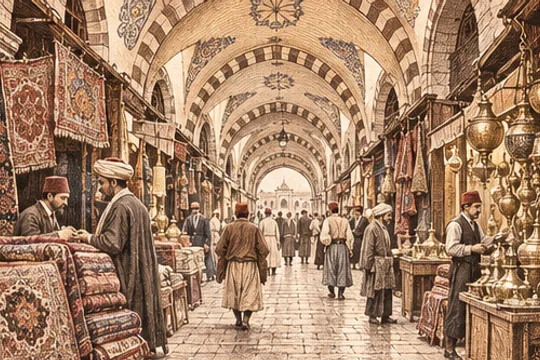
The Grand Bazaar, which draws visitors from Turkey and abroad, has held a special place throughout almost every period of its history. Built on Istanbul’s oldest settlement, it is the world’s oldest, largest, and most visited shopping centre. It has kept its distinctive architecture for centuries despite the destructive forces of fire, earthquakes, and floods.
In Ottoman times, textiles and woven goods, gold, and jewellery brought from Eastern countries were traded, displayed, and kept here. The bazaar held a special place in Ottoman social and cultural life and became the heart of the imperial economy in the first years after the conquest.
Over the centuries the bazaar has been a subject for travellers, writers, and painters from Turkey and abroad, and has enchanted practically everyone who visited it. Its mysterious scent and historic atmosphere cast a spell on people.
The English writer Julie Pardoe visited in 1835 and said of this one-of-a-kind bazaar in her memoirs: “Among the crafts that catch the eye in the Grand Bazaar are tea and coffee cups edged in gold, fine necklaces worked in many styles for the young women of the harem, ornaments for noblemen’s caps, harnesses for the Arabian horses ridden by pashas, gold rings, and stars. And the arms market? In under five minutes a person can be armed from head to foot with weapons from any age or nation. Antique shields, implements that look as though they were made for the state, helmets of every shape and size, and armour that has lost its lustre… Here one can see close-woven silks worked in gold and silver thread, fine muslins embroidered in silk, tobacco pouches that seem to have taken years of labour, and coverings with verses embroidered along the edges.”
Nicolas de Nicolay, who visited the bedesten in the second half of the sixteenth century, wrote in his notes: “It has four gates and many passages. On either side are shops full of rare and precious goods, jewels and ornaments, and furs. Furs sell very cheaply. Sometimes a long ermine robe can be had for 80 to 100 ducats. In fact one could not buy it elsewhere for four or five times that. The bedesten also has all sorts of fabrics worked in gold and silver, fine morocco leather, belts set with turquoise, shields, and daggers. It is open every day until noon except Friday.”
A document from 1304 AH (1888) lists two bedestens, 4,399 shops, 2,195 rooms or cells, a bathhouse, 497 cupboards, 12 treasury rooms, one congregational mosque, 10 small mosques, two ablution fountains, a public water kiosk, 16 fountains, three wells with pumps, a tomb, 73 arcades, 24 commercial inns, and a school in this ancient complex. Small wonder it made such an impression on visitors from Turkey and abroad.
The area was called the Grand Bazaar in those years because it was unroofed. It has seen many fires and earthquakes since it was founded, yet has never lost its architectural character. An earthquake destroyed much of the bazaar in 1477. Another struck in 1510, and a fire five years later burned many shops.
The bazaar’s bad luck did not end there. Fires in 1546 and 1565 reduced many shops to ashes. The succession of fires continued in 1618, 1645, 1652, 1658, 1660, and 1750, destroying parts of the Grand Bazaar.
This complex of buildings was roofed over in 1760, turning the Grand Bazaar into the Covered Bazaar. Originally each shop had a single arch and entrance. Today, a single arch can house two or three shops, sometimes four or five.
Wealthy people and merchants in the Grand Bazaar at the time rented safes, vaults, and cupboards to store their jewels and precious gold and silver objects. In his Book of Travels, Evliya Çelebi records that those who ran the cupboards, which still exist, were called haceği, meaning master or merchant. They were so honest and trustworthy that nobody ever touched even open cupboards containing treasures from Egypt.
The streets and lanes of the Grand Bazaar remind us practically every day of the many trades that have disappeared. Among the people once at work here were velvet, brocade, satin, and striped-silk makers, silk robe makers, makers of perfumed goods and cotton thread, bath-wrap and twill makers, carpet makers, coarse woollen cloth makers, pouch makers, dyers, mallet makers, gold dealers, jewellers, silversmiths, miniature painters, gilders, scrap-metal dealers, carvers, flint-striker makers, inlayers, embossers, engravers, gold-leaf makers, calligraphers, antiquarian booksellers, illuminators, knife and scissors makers, goldsmiths, helmet makers, gunsmiths, sword makers, pen-rest and cushion makers, antique dealers, shoemakers, leatherworkers, embroiderers, shawl makers, broadcloth and lining makers, makers of small caps, gold-thread embroiderers, mother-of-pearl inlayers, cup-holder makers, repairers, smelters, spoon makers, ivory carvers, mirror makers, prayer-bead makers, and sellers of herbs and perfumes, and many more…
The Grand Bazaar, with its distinctive mystique, has inspired writers and poets in almost every period. See how Orhan Veli Kanık describes the bazaar of 1949 in these lines:
“You know how unworn linen smells
In rooms full of chests.
That is how your shop smells too.
You don’t know my elder sister.
Had she lived, she’d have been a bride in Hürriyet.
This bridal tinsel was hers,
And this is her veil.
And the women in these windows?
This one all in blue,
This one in a green dress…
Do they stand like that at night too?
And that stark white shirt?
Hasn’t it a story of its own?
Don’t just say Grand Bazaar and pass by.
A covered bazaar,
A closed box.”
Orhan Veli saw the bazaar as a “closed box” in the 1940s. If he had seen the scale of today’s Grand Bazaar, one of the world’s largest trading centres, I think he would have seen it differently.
The Grand Bazaar, poor and drab beside the Beyoğlu department stores that sold European goods, underwent its real structural change after the Second World War. As the population and the volume of trade grew, the bazaar’s dim, deserted streets began to fill, and its dark lanes lit up. Migration from the countryside gathered pace. Istanbul’s population grew and the bazaar felt the effects too. The Wealth Tax drove Armenians, Greeks, and Jews, who had held the gold and foreign-exchange trades and many other crafts, out of commercial life. Tens of thousands of people, most of them from outside Istanbul, began to take over those trades.
We Turks are unaware of the riches of our own country, don’t visit museums, and have no respect for history or historic objects. When a European tourist says “Old Bazaar,” can we sense how much they admire the history and art we do not even take an interest in?
On your travels abroad, you have probably noticed that tourists who do not even know where Turkey is say “Old Bazaar” more often than “Turkey” or “Istanbul.”
For a visitor from abroad, there is no finer place to shop in historic surroundings.
In Turkey the gold and foreign-exchange trades remained illicit until 1989, and the only centre where imported precious metals such as gold and silver, and pearls, diamonds, and jewellery truly changed hands was the Grand Bazaar. With its own trading methods, terminology, rules, and systems, and billions of dollars in turnover, the Grand Bazaar market is attracting more and more attention.
The gold sold to workshops and jewellers in the market once known as Tahtakale and now called the Grand Bazaar is measured in tonnes. There was no official gold market, so workshop owners, manufacturers, jewellers, money changers, and wholesalers gathered at the corner of Ağa Sokak. They would stand for hours, shouting and buying and selling gold and currency with cordless phones in their hands.
It was a sorry sight to see gold and currency brokers shuttling between the gate of Çuhacı Han and the Kılıççılar Gate, sometimes thrown out by the bazaar police.
At Çuhacı Han, Varakçı Han, the Sandal Bedesten, the Inner Bedesten, and other premises inside and outside the bazaar, many gold and foreign-exchange dealers do billions of dollars’ worth of business a year in almost airless shops a few square metres in size, with empty displays and paper or curtains drawn across their windows.
Smuggling in eastern and southeastern Anatolia came to an end with the 1980 military coup, forcing people with few ways of earning a living to move to big cities such as Istanbul, İzmir, and Ankara. The people from Kilis who became a force in the Grand Bazaar’s currency and gold markets were among those who migrated then.
Over the years the market developed a language and terminology of its own. In the bazaar’s gold market, 24-carat pure gold goes by names such as Has, Beykoz, Orijinal, Külçe, Kağıtlı, 995, and Merkez. Foreign currencies have names of their own. The US dollar is Tam or Yeşil, the German mark Çeyrek or Papaz (for the 500- and 1,000-mark notes), sterling Kraliçe, the Dutch guilder Gül, the Saudi riyal Hacı, the Iraqi dinar Hurma, the French franc Çarşaf, the Swiss franc Sivis, and the Austrian schilling Şilte.
The running battles between the police and the gold and currency brokers at the corner of Ağa Sokak and Çuhacı Han marked an era. The bazaar police would sometimes lock them up, beat and curse them, hit them with truncheons, or drive them out of the Kılıççılar Gate. Before long the Yeşildirek police would drive them back in. Shuttling from a metre on one side of the gate to a metre on the other, they did billions of dollars in business under those conditions, nearly half of Turkey’s 1991 budget in its years of scarcity and hardship.
The 1970s, 1980s, and 1990s were the golden years of the Grand Bazaar, when shopkeepers and traders lived up to their names. Being a merchant here carried real standing. You couldn’t just decide to open a shop, and even if you opened one you couldn’t necessarily keep it going. First you had to be a person of character, and a very decent one at that. The slightest misstep was enough to get you swept out of the market. Millions of dollars’ worth of gold and foreign currency were bought and sold on a single word, and no one went back on their word no matter how things turned out. Shops changed hands by word of mouth. Nobody knew what an estate agent was.
When the merchants of those days passed each other in the street, they paid one another the greatest respect. Reputation was the greatest wealth.
I maintain that the commercial successes of the Grand Bazaar merchants ought to be taught in universities. If gold and foreign currency can be traded easily in Turkey today, the people of Kilis deserve much of the credit. My late uncle was an important figure in this market. Uğur Sağlam, known as “Camkinoz,” was a walking computer with tremendous foresight and a keen eye for risk. He hadn’t even finished primary school, yet he had the Grand Bazaar currency market at his fingertips. He could spend the money in his right pocket for a whole month and, on the thirtieth day, list every sum he had spent and balance the account to the last kuruş. He forgot nothing and had an astonishing photographic memory. If you asked about his education, he would say, “I graduated from the University of the Grand Bazaar.” My late father Erdoğan Sağlam was another respected figure in the market. He took great care over every purchase and sale, acted cautiously, and thought forty times before acting once. He cared nothing for show and lived modestly. He was someone people went to for advice.
Mention the Grand Bazaar and its merchants, and how could I forget Suphi Aşıcıoğlu, who made the streets tremble when he walked? Nor can I leave out the commercial geniuses Adnan Bıyıkbeyi and Ceyhan Bektaş. Emin Görpe, Yusuf Şerefoğlu, Korkmaz Zelzele, Tevfik Uygur, and Aziz Bağbekleyen were remarkable people too. May God have mercy on them.
I must also mention Necati Çakır of Kilis, a model of loyalty who is still at the Grand Bazaar today.
I have known so many remarkable jewellers, money changers, gold reclaimers, refiners, diamond dealers, currency traders, silversmiths, and exchange brokers. In any other market you would be hard pressed to find even one of their discarded nail clippings, let alone their equal.
I cannot thank my late uncle Uğur Sağlam and my late father Erdoğan Sağlam enough for letting me become part of this market and for all I learned from them. May God bless them both a thousand times over.
Dr. Mehmet Hakan Sağlam
Translated from the Turkish original. Türkçe