
If Jerusalem becomes the capital, Hagia Sophia becomes a mosque and Erdoğan becomes caliph…
6 December 2017 · Personal website
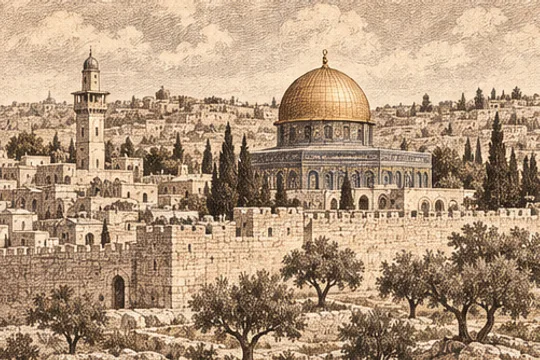
(Article 193 — 6 December 2017)
Reports that US President Donald Trump would move his country’s embassy from Tel Aviv to Jerusalem on 6 December have galvanised the Muslim world. Such a step by the United States could set off a chain of events with no end in sight.
The status of Jerusalem is one of the most contentious issues between Israel and the Palestinians. Israel occupied East Jerusalem during the Six-Day War of 1967. It remains under occupation. Israel calls the whole of Jerusalem its indivisible capital. The Palestinians want East Jerusalem to be the capital of their future state. Neither claim, however, has won international acceptance.
President Erdoğan addressed the issue at yesterday’s meeting of his party’s parliamentary group. “Jerusalem is a red line for Muslims. If such a step is taken, we will act immediately and convene a summit of the leaders of the Organisation of Islamic Cooperation in Istanbul within five or ten days. Indeed, it could go as far as breaking off our diplomatic relations with Israel.”
President and AK Party chairman Recep Tayyip Erdoğan also spoke about the Zarrab case in America. The US had a plan directed against Turkey, he said. “This trial is a diversion, a game of ‘look over there at the acrobat!’ They want to kill many birds with one stone. The case in America is a conspiracy against Turkey. Something is happening in America akin to our own 28 February period. A group left over from the previous administration appears to be pursuing a policy towards our country contrary to the wishes of the Trump administration.”
We can read those words of Erdoğan’s as saying that the United States and Turkey are already, in effect, at war.
We have now seen how empty the words “friendship”, “alliance” and “strategic partnership” can be.
How, then, should we respond to this American decision, bound as it is to provoke outrage across the Muslim world?
If I were Erdoğan, I would first convene the Organisation of Islamic Cooperation at Yıldız Palace in Istanbul. I would put the election of a caliph for the Muslim world first on the agenda and don Sultan Selim I’s caliphal robe. I would call on millions to join me, walk with the leaders of the Muslim countries to Hagia Sophia and there perform the Friday prayer, flinging the Treaty of Lausanne back in the West’s face.
If Jerusalem becomes Israel’s capital, no signatory to Lausanne should feel secure.
Those who covet Jerusalem today will set their sights on Mecca and Medina tomorrow. Then they will want Istanbul.
If Jerusalem falls, Damascus and Aleppo fall, Beirut falls, Mosul and Kirkuk fall.
The West’s plans to carve up Yemen, Libya, Tunisia, Algeria, Saudi Arabia, Iraq, Iran, Syria, Pakistan, Lebanon and other Muslim lands would come to pass one by one.
We must make Western countries feel the same anxiety Muslim countries feel about their future.
Without Jerusalem there is no Lausanne. Without Lausanne there is no Greece, no Cyprus, no Dodecanese, no Egypt, Syria, Iraq, Kuwait, UAE, Saudi Arabia, Yemen, Libya, Sarajevo, Albania, Serbia or Bulgaria.
Indeed, the list of countries that would not exist without Lausanne is a long one.
Does anyone know how many states emerged from the ruins of the Ottoman Empire? Sixty-four, no fewer.
Of the 196 states recognised today at the United Nations, we once governed sixty-four.
For those who are curious, here are the countries the Ottomans governed and how long they remained under our sovereignty.
1. Turkey
2. Bulgaria (545 years)
3. Greece (400 years)
4. Serbia (539 years)
5. Montenegro (539 years)
6. Bosnia and Herzegovina (539 years)
7. Croatia (539 years)
8. Macedonia (539 years)
9. Slovenia (250 years)
10. Romania (490 years)
11. Slovakia (20 years) — Uyvar
12. Hungary (160 years)
13. Moldova (490 years)
14. Ukraine (308 years)
15. Azerbaijan (25 years)
16. Georgia (400 years)
17. Armenia (20 years)
18. Southern Cyprus (293 years)
19. Northern Cyprus (293 years)
Southern Russia (291 years)
21. Poland (25 years) — Lehistan
Southeastern Italy (20 years)
23. Albania (435 years)
24. Belarus (25 years) — protectorate
25. Lithuania (25 years) — protectorate
26. Latvia (25 years) — protectorate
27. Kosovo (539 years)
28. Vojvodina (166 years) — Banat
29. Iraq (402 years)
30. Syria (402 years)
31. Israel (402 years)
32. Palestine (402 years)
33. Jordan (402 years)
34. Saudi Arabia (399 years)
35. Yemen (401 years)
36. Oman (400 years)
37. United Arab Emirates (400 years)
38. Qatar (400 years)
39. Bahrain (400 years)
40. Kuwait (381 years)
41. Western Iran (30 years)
42. Lebanon (402 years)
43. Egypt (397 years)
44. Libya (394 years)
45. Tunisia (308 years)
46. Algeria (313 years)
47. Sudan (397 years) — Nubia
48. Eritrea (350 years) — Abyssinia
49. Djibouti (350 years)
50. Somalia (350 years) — Zeila
51. Kenyan coast (350 years)
52. Tanzanian coast (250 years)
53. Northern Chad (313 years) — Resade
54. Niger (300 years) — Kawar
55. Northern Mozambique (150 years)
56. Morocco (50 years) — protectorate
57. Western Sahara (50 years) — protectorate
58. Mauritania (50 years) — protectorate
59. Mali (300 years) — Ghat
60. Senegal (300 years)
61. The Gambia (300 years)
62. Guinea-Bissau (300 years)
63. Guinea (300 years)
64. Ethiopia (350 years) — Abyssinia
Professor Aleksandr Dugin is an influential figure in shaping Russian foreign policy. He played a critical part in resolving the Turkish–Russian crisis over the downed aircraft, practically shuttling between the two countries. The reports he delivered directly to Putin shaped the future of their relations. It was he who warned Turkey before 15 July of a pro-American coup by FETÖ. After the attempt he gave Turkey his full support and became one of the architects of the rapprochement.
In Dugin’s words: “Russia isn’t simply suggesting that Turkey join existing institutions such as the Shanghai Cooperation Organisation. Turkey can of course join them, but our proposal goes further. We propose that Turkey, Russia and Iran together form a triangle. This would be an entirely new organisation. We might call it the Eurasian Triangle. It is a model for a military, political and strategic alliance.”
Those words of Dugin’s are the clearest indication of why Western countries have gone on the offensive against Turkey together.
Turn and look west. How many countries could rival Turkey militarily, politically or economically?
Europe is living through the weakest, most helpless century in its history. It is hard to tell whether it even counts as a presence. Say “the West” and almost everyone thinks only of the United States.
We are, in fact, witnessing history in these very days.
A new world order is taking shape.
It will have two poles. On one side, a Western world led by the United States and growing steadily weaker. On the other, an Eastern world comprising Turkey, Russia, Iran and China.
NATO will pass into history. The European Union will collapse.
This new alignment is the real reason why America and its lackeys, alarmed at the East’s growing strength, are attacking Turkey like hungry hyenas.
History is being written anew in this part of the world. With the Trans-Asian Railway, a modern Silk Road is taking shape on land and at sea. On the new rail route from China to London no country is more pivotal than Turkey.
Countries that stand with Turkey, Russia and China will grow richer while the rest grow poorer.
Just as they did five hundred years ago, goods from China, Kyrgyzstan, Uzbekistan, Turkmenistan, Russia, Iran, Azerbaijan, Georgia, Turkey and all the other lands along the way will stream into Europe, this time on the Trans-Asian Railway over the Yavuz Sultan Selim Bridge. Freight costs and journey times will fall to a minimum. Far Eastern goods that take two or three months to reach European ports by cargo or container ship will be carried to the heart of Europe within just two weeks.
When this largely completed railway corridor is fully operational, transit time between China and Turkey will drop from thirty days to ten. Products that currently take two months by sea from Beijing to Turkey will reach Istanbul in seven or eight days. The overland distance will also shrink by three thousand kilometres.
Marmaray, the Yavuz Sultan Selim Bridge and the Baku–Tbilisi–Kars and Edirne railway projects make up the middle corridor of the modern Silk Road. It is projects like these that underlie the West’s anxiety and fear.
The Cape of Good Hope, discovered by Bartolomeu Dias in 1488 and instrumental in the impoverishment of Eastern lands, is losing its importance.
Once the new Silk Road comes into service, shipping and container companies, insurers, customs businesses and port operators across Europe will go under. Factories will close and an army of unemployed people will emerge in continental Europe.
On the maritime leg of the new Silk Road, the Persian Gulf and the Red Sea are especially important. Over the last few years Turkey has taken significant steps to secure logistics on both waters, establishing military bases in Qatar on the Gulf and in Somalia on the Red Sea. These bases matter greatly both for maritime security in Africa and the Middle East and, as the Qatar crisis showed, for the security of countries in the region itself.
Happily, history has come full circle after a hundred years.
For the first time since 1918, when the Ottomans were forced to withdraw from the Middle East and Africa, a Muslim country is once again in a position to provide security in these lands.
When I set all these developments side by side, this is the conclusion I think the West has drawn: if it wants another hundred years of exploiting the Middle East and Africa, carving little states out of existing ones and enslaving Muslims, it sees Erdoğan’s death as a prerequisite.
Erdoğan and Turkey are the last stronghold.
If Erdoğan falls, Turkey falls.
If Turkey falls, the Kaaba falls. Mecca and Medina, Jerusalem, Aleppo and Damascus, Beirut, Sanaa and Cairo fall.
That is why, as the saying goes, the waters may sleep but the enemy never does.
That is why the PKK, HDP, YPG, JPG and DHKP-C on one side, and FETÖ and the CHP, which has become its political arm, on the other, keep attacking.
That is why countries that support terrorism, including the United States, Germany, Belgium, the Netherlands, Austria, France, Britain and Sweden, have openly taken a stand against Turkey.
Yet none of that matters in the least.
God is our protector.
With God there is no cause for sorrow…
Dr. Mehmet Hakan Sağlam
Translated from the Turkish original. Türkçe