
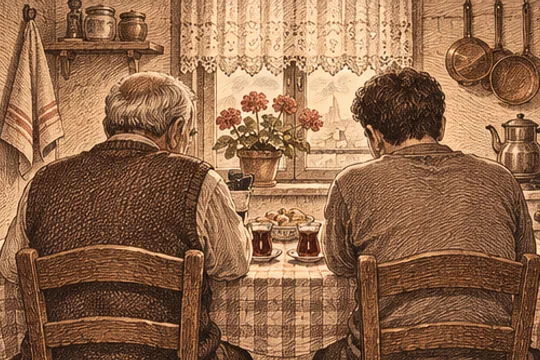
What does my father make of the central bank governor?
25 January 2015 · Tarafsız Haber
In my previous article I discussed the economic policies pursued by the United States and other countries affected by the Great Depression of 1929, and how the ideas of Keynes and Friedman were applied in practice.
So whom should we take as our model in Turkey? Should we emphasise Keynesian policies that allow the state to channel resources into the economy and create jobs when necessary, or should we opt for monetarist policies that leave the whole burden to the central bank and dismiss investment and jobs as a waste of time, as though fighting inflation were all that mattered? Time and place matter to whether the policies put forward by Keynes and Friedman succeed. What works in one period may fail in another time or place. In today’s interconnected world, with vastly expanded means of communication, interventionist or monetary measures alone cannot succeed. Monetary and fiscal policies must be coordinated.
The “high interest rates” President Erdoğan brings up at virtually every opportunity are a problem for all businesspeople and industrialists operating in Turkey. And, of course, for every Turkish citizen who lives here and pays by credit card. It takes real courage to invest or spend with lending rates at 12–13 per cent. Some say the central bank’s interest-rate policy is quite sound. They argue that foreign capital will leave Turkey if rates fall. A reduction may initially help the economy, but the resulting outflow of foreign capital will shrink the volume of credit and push rates back up. Isn’t that exactly what the monetarists explain? In their view interest rates are determined by the supply of and demand for credit, rather than for money. Thus expanding the money supply cannot lower rates and spur investment. The extra money may increase output without affecting prices in the short term, but in the long term it only causes inflation and does not increase output.
Seen from that angle, the argument sounds persuasive and the central bank governor’s actions look right. Others view it solely as politics and take it upon themselves to defend and protect the governor out of hostility to Erdoğan.
How are we to make new investments, create more jobs and increase exports at high rates? Some have an answer ready: “The government should leave the central bank alone. The bank is pursuing a highly successful policy on inflation. If you interfere, everything will be thrown into disarray. If the government wants to reduce interest rates, let it give investors an incentive or subsidy. It amounts to the same thing.” Suppose the government wants rates of around 4 per cent and the central bank’s benchmark is 7 per cent. On this view the state ought to give people who borrow to invest a 3 per cent subsidy, bringing their rate to 4 per cent without a central bank cut.
But high rates themselves are only part of what the government and the president are protesting. The central bank’s high-rate policy makes the Treasury of the Republic of Turkey one of the treasuries now paying the highest interest on domestic government debt securities. Treasury figures put Turkey’s outstanding domestic debt in the third quarter of 2014 at 438 billion lira. Each one-percentage-point rise in interest rates costs the Turkish Treasury 4.38 billion lira a year, equivalent to $1.9 billion. Just before the Gezi events, interest rates reached a low unprecedented in the history of the Republic of Turkey, at 4.61 per cent.
Gezi abruptly reversed the favourable climate. As political risk grew, rates began to climb quickly, first towards 8 per cent and then to around 12 per cent with the judicial coup of 17/25 December. Taking domestic public debt alone, that rise of about 7.5 percentage points cost the Treasury an extra 49 billion lira over a year and a half, or around $23 billion.
What does 49 billion lira, or $23 billion, mean? Think what could have been done with the money the central bank’s high-interest policy took out of the public purse. The new Presidential Palace, for example, which the opposition leaders and the Parallel State Structure (PDY) have talked about incessantly for almost a year, cost 1.35 billion lira in total. We could have built another just like it in each of thirty-nine Turkish provinces, not only in Ankara. We could have built eleven more Yavuz Sultan Selim bridges at 4.5 billion lira apiece. The high-speed railway between Ankara and Istanbul cost 7.2 billion lira, so we could have built seven more like it. And the Marmaray project, Turkey’s pride, which links Asia and Europe beneath the sea, cost just 8 billion lira. With what went into the rentiers’ pockets we could have built six more Marmarays under the Bosphorus.
Bribery is a filthy thing that repels almost every society. My father, Erdoğan Sağlam, is an esteemed and respected merchant of the Grand Bazaar. He started out as a blacksmith, went into the glassware trade, and later dealt in gold and foreign currency. He spent about 40 years as a money changer before he retired. He raised and trained me, too. Together we lived through the chaos and economic and political upheaval of the 1970s, the Özal years in the 1980s when Turkey struggled to break out of its shell in practically every sphere, above all the economy, the 1990s when terrorism and crisis dominated everything, and the 2000s when you never knew what tomorrow would bring. Over those years there was hardly an event in Turkey we did not hear about or see, a crisis we did not live through, or a kind of person we did not meet.
The Grand Bazaar is the “Nail-Studded Cradle of Money.” In the 1970s, 1980s, 1990s, and even the early 2000s, gold and foreign currency could not be bought and sold as easily as they are now. Banks didn’t offer such a range of services. You couldn’t sit down at a computer and transfer foreign currency abroad. The Grand Bazaar has a mystique of its own, a commercial life unlike anywhere else, and thousands upon thousands of shopkeepers and craftspeople working in harmony like the organs of a body. Without exaggeration, each could outdo not once but a thousand times many a professor teaching at the world’s leading economics faculties and many a so-called economic expert. In shops of just a few square metres, $50 to $60 billion in gold and foreign currency changes hands in a single year.
The Grand Bazaar is a “closed box.” It is also known as Tahtakale, a place where people from Kilis keep themselves behind an invisible wall…
The Grand Bazaar, which draws many visitors from Turkey and abroad, held a special place in the social and economic life of the Ottoman state in almost every period of its history. This marketplace extends across a wide area in Istanbul’s oldest settlement and is one of the rare buildings to have retained its distinctive architecture for centuries despite the destructive forces of fire, earthquakes, and floods.
In the Ottoman Empire, clothing of all kinds and gold and silver jewellery brought from East, West, and elsewhere were traded, displayed, and stored in this bazaar. Besides its special place in Ottoman social and cultural life, the Grand Bazaar became the heart of the imperial economy in the first years after the conquest. Over time it became a subject for travellers, writers, and painters from Turkey and abroad, and won the admiration of practically everyone who visited it. The bazaar has a mysterious scent and an air of secrecy that enchant people and make them fall in love with it.
The English writer Julie Pardoe visited in 1835 and said of this one-of-a-kind bazaar in her memoirs: “Among the crafts that catch the eye in the Grand Bazaar are tea and coffee cups edged in gold, fine necklaces worked in many styles for the young women of the harem, ornaments for noblemen’s caps, harnesses for the Arabian horses ridden by pashas, gold rings, and stars. And the arms market? In under five minutes a person can be armed from head to foot with weapons from any age or nation. Antique shields, implements that look as though they were made for the state, helmets of every shape and size, and armour that has lost its lustre… Here one can see close-woven silks worked in gold and silver thread, fine muslins embroidered in silk, tobacco pouches that seem to have taken years of labour, and coverings with verses embroidered along the edges.”
Nicolas de Nicolay, who visited the bedesten in the second half of the sixteenth century, wrote in his notes: “It has four gates and many passages. On either side are shops full of rare and precious goods, jewels and ornaments, and furs. Furs sell very cheaply. Sometimes a long ermine robe can be had for 80 to 100 ducats. In fact one could not buy it elsewhere for four or five times that. The bedesten also has all sorts of fabrics worked in gold and silver, fine morocco leather, belts set with turquoise, shields, and daggers. It is open every day until noon except Friday.”
A document from 1304 AH (1888) lists two bedestens, 4,399 shops, 2,195 rooms or cells, a bathhouse, 497 cupboards, 12 treasury rooms, one congregational mosque, 10 small mosques, two ablution fountains, a public water kiosk, 16 fountains, three wells with pumps, a tomb, 73 arcades, 24 commercial inns, and a school in the Grand Bazaar. Small wonder it attracted such interest at home and abroad.
The area was called the Grand Bazaar in those years because it was unroofed. It has seen many fires and earthquakes, large and small, since it was founded, yet has never lost its architectural or commercial character. An earthquake destroyed much of the bazaar in 1477. Another struck in 1510, and a fire five years later burned many shops. Its bad luck didn’t end there. Fires in 1546 and 1565 burned many of its shops. More fires followed in 1618, 1645, 1652, 1658, 1660, and 1750, each destroying part of the Grand Bazaar.
The shops were roofed over in 1760, turning the Grand Bazaar into the Covered Bazaar. Originally each shop had a single arch and entrance. Today, a single arch can house two or three shops, sometimes four or five.
In Ottoman times the Grand Bazaar served as Istanbul’s bank. Wealthy people and merchants rented safes, vaults, and cupboards to store their jewels and precious gold and silver objects. In his Book of Travels, Evliya Çelebi records that those who ran the cupboards, which still exist, were called haceği, meaning master or merchant. They were so honest that nobody ever touched even open cupboards containing treasures from Egypt.
Many trades survive only in the names of the Grand Bazaar’s streets and lanes. Among the people once at work in the Grand Bazaar complex were velvet, brocade, satin, and striped-silk makers, silk robe makers, makers of perfumed goods and cotton thread, bath-wrap and twill makers, carpet makers, coarse woollen cloth makers, pouch makers, dyers, mallet makers, gold dealers, jewellers, silversmiths, miniature painters, gilders, scrap-metal dealers, carvers, flint-striker makers, inlayers, embossers, engravers, gold-leaf makers, calligraphers, antiquarian booksellers, illuminators, knife and scissors makers, goldsmiths, helmet makers, gunsmiths, sword makers, pen-rest and cushion makers, antique dealers, shoemakers, leatherworkers, embroiderers, shawl makers, broadcloth and lining makers, makers of small caps, gold-thread embroiderers, mother-of-pearl inlayers, cup-holder makers, repairers, smelters, spoon makers, ivory carvers, mirror makers, prayer-bead makers, and sellers of herbs and perfumes.
With its distinctive atmosphere and mystique, the Grand Bazaar inspired writers and poets of the Republic too. Orhan Veli Kanık described the bazaar of 1949 in these lines:
You know how unworn linen smells
In rooms full of chests.
That is how your shop smells too.
You don’t know my elder sister.
Had she lived, she’d have been a bride in Hürriyet.
This bridal tinsel was hers,
And this is her veil.
And the women in these windows?
This one all in blue,
This one in a green dress…
Do they stand like that at night too?
And that stark white shirt?
Hasn’t it a story of its own?
Don’t just say Grand Bazaar and pass by.
A covered bazaar,
A closed box.
Orhan Veli called the bazaar a “closed box” in the 1940s. Had he seen the scale and bustle of today’s Grand Bazaar, one of the world’s largest commercial complexes, I think he would have written even better poems. Until the Second World War, most of its lanes were empty and quiet. The bazaar looked rather poor and drab beside the Beyoğlu department stores selling European goods. Its real structural change came after the war. As the economy improved, its dim, deserted streets gradually filled up and its dark lanes began to light up. Migration from the countryside gathered pace. Istanbul’s population grew and the bazaar felt the effects too. The Wealth Tax drove Armenians, Greeks, and Jews, who had held the gold and foreign-exchange trades and many other crafts, out of commercial life. Tens of thousands of people, most of them from outside Istanbul, began to take over those trades.
We Turks often don’t know our country’s riches, don’t visit museums, and have little respect for history or historic objects. Can we sense what admiration for our history and art lies behind a European tourist saying “Old Bazaar”? Many of us, I think, have found abroad that a European or American tourist who doesn’t even know where Turkey is has heard “Old Bazaar” more often than “Turkey” or “Istanbul.”
Foreign visitors see the Grand Bazaar as the most “Orientalist” place to shop in historic surroundings. For our own people, it’s just somewhere to walk around when it rains. In Turkey the gold and foreign-exchange trades remained illicit until 1989, and the only centre where imported precious metals such as gold and silver, and pearls, diamonds, and jewellery truly changed hands was the Grand Bazaar. With its own trading methods, terminology, rules, and systems and billions of dollars in annual turnover, the bazaar is also the world’s most important university of business and economics.
With no official gold market, workshop owners, manufacturers, jewellers, money changers, and wholesalers gather at the corner of Ağa Sokak to buy and sell some 250 to 300 tonnes of gold a year while standing in the street. At Çuhacı Han, Varakçı Han, the Sandal Bedesten, the Inner Bedesten, and other premises inside and outside the bazaar, many gold and foreign-exchange dealers do billions of dollars’ worth of business a year in almost airless shops a few square metres in size, with empty displays and paper or curtains drawn across their windows.
Smuggling in southeastern Anatolia came to an end with the 1980 military coup, forcing people with few ways of earning a living to move to big cities such as Istanbul, İzmir, and Ankara. The people from Kilis who became a force in the Grand Bazaar’s currency and gold markets were among those who migrated then.
In the bazaar’s gold market, 24-carat pure gold goes by names such as Has, Beykoz, Orijinal, Külçe, Kağıtlı, 995, and Merkez. Foreign currencies have names of their own. The US dollar is Tam or Yeşil, the German mark Çeyrek or Papaz, sterling Kraliçe, the Dutch guilder Gül, the Saudi riyal Hacı, the Iraqi dinar Hurma, the French franc Çarşaf, the Swiss franc Sivis, and the Austrian schilling Şilte. Among the brokers you can hear nearly any language, from Albanian and Arabic to Turkish and Armenian, Hebrew, and Syriac.
The running battles between police and the gold and currency brokers at the corner of Ağa Sokak and Çuhacı Han marked an era. With nowhere else to gather, traders met in these squares and shouted so loudly when buying and selling that they made a terrible racket. The bazaar police sometimes locked them up, beat them, cursed them, hit them with truncheons, or drove them out of the Kılıççılar Gate. A quarter of an hour or twenty minutes later, the Yeşildirek police would drive them back in. Shuttling from a metre on one side of the gate to a metre on the other, they did billions of dollars in business under those conditions, equivalent to practically half of Turkey’s state budget in the 1980s and 1990s.
In the mid-eighties my father told me something important about “bribery” that I’ve kept in mind ever since. One day he sat me down and said, “Son, there are two kinds of bribery. One is ordinary bribery: you give someone money and they do what you want. The other is organised, collective bribery. The first is a sin and carries a heavy penalty. If a public official is bribed with so much as one lira, both the person who pays and the person who takes it are tried and go to prison. Organised, collective bribery is never a crime.”
I was surprised and asked, “How does that work, Dad?” He explained: “You know how politicians like Demirel or Ecevit go out into the squares and say they’ll raise the floor price for barley, wheat, hazelnuts, and pistachios, then hand out money? That falls into the category of organised, collective bribery, and there is no penalty for it. The money was given openly to a section of society or to the public at large, rather than slipped to one person in secret. There’s no punishment for that.”
What the central bank governor and the Money Market Committee are doing today by keeping interest rates high and funnelling money to rentiers, or bloodsucking leeches, is exactly what my father called “organised, collective bribery.” Of the taxes collected from 77 million Turkish citizens, $23 billion is doled out to a mere thousand people as a collective bribe, making the rich richer. Everyone remembers the Old Turkey that could barely pay wages from the early 1990s until the AKP took power in 2002. Almost 85 percent of state revenue was used to pay interest on domestic and foreign debt under the heading of transfer payments. About 1.5 million people held Treasury bills. With the state borrowing at rates as high as 60 to 65 percent, about $50 billion flowed from the treasury to rentiers. In the Republic’s most troubled years, about 1,499,000 people shared 10 percent of those $50 billion. The other 90 percent went to a Turkish elite of just one thousand. Given the population at the time, around $45 billion of the taxes paid by 65 million people went to a thousand as a “collective bribe.” These elites, known as White Turks, were given handouts and sang the praises of the incompetent, second-rate, thieving, and unscrupulous politicians and officials of the day, even commissioning documentaries about their “success.”
When the state needs funding, nothing is more natural than obtaining it at a reasonable price, meaning interest. In similar borrowing operations, other countries pay an average of 1.5 to 2.0 percent. It is unacceptable for the Central Bank of the Republic of Turkey to pay 7.75 percent, when it was 12 percent until two months ago. That rate amounts to an abuse of powers and duties entrusted by the public, the securing of financial benefit, bribery, and the enrichment of certain people without cause.
The contest between the Old Turkey and the New Turkey stems largely from these financial losses. The era of lending to the state at 60, 70, 80, or even nearly 400 percent interest is over. The AKP government brought rates down from 60 percent to 4.61 percent in May 2013 and paid off its debt to the IMF. The last time Turkish history saw interest that low was in 1854 under Sultan Abdülmecid, at 3.5 percent. If you’re wondering who the thousand elites were who plundered the Turkish Treasury until the AKP came to power, look at TÜSİAD and you will see quite a few of them. But who gave these leeches the means and opportunity to suck some $600 billion out of the state over the years? Look at the central bank and you’ll see.
Had Turkey not achieved political and economic stability between 2002 and 2014, the state would have continued to borrow and pay interest. Perhaps many times more than had been paid before would have gone into those rentiers’ pockets. The industrialists, businessmen, and owners of media outlets, banks, and holding companies of the Old Turkey cannot stomach seeing the $600 billion that should have gone into their pockets evaporate.
They are furious that Erdoğan made them miss out on such a fortune. They have tried everything to remove him from power, put him in prison, and even eliminate him, and they will keep trying. The party closure cases, the arbitrary obstruction of the government and its actions by constitutional institutions of tutelage such as the Court of Cassation, the Council of State, the Constitutional Court, and the High Council of Judges and Prosecutors, the dozens or hundreds of assassination attempts, many kept from the public, the Gezi protests, and the judicial coup of 17 and 25 December all aimed to finish Erdoğan.
Isn’t the fact that the $600 billion that would have gone to the White Turks stayed in the Treasury enough of a reason, in their eyes, to kill Erdoğan?
Looking at it from that angle, even I feel tempted to say, “President Erdoğan has tripped up so many rich people that they must think he’s got off lightly!”
You probably understand by now how my father sees central bank governor Erdem Başçı. My father forged iron over a red-hot fire for years, packed glass and porcelain, and worked as a jeweller and money changer. Through all of it he never ate a single forbidden morsel, never let a penny of interest touch his wealth, and never cheated anyone of their due.
In 2001 my father suffered a serious brain haemorrhage related to high blood sugar, and he now has trouble speaking. Do you know the first question he asks me every time I visit? “Where is Erdoğan today?”
Politicians, political scientists, think tanks, and secret services worldwide are putting their heads together today over one question: “How does Recep Tayyip Erdoğan win so many elections in a row?” Of course each wants the answer for different reasons. For foreign politicians, learning the secret of winning reelection at home would be like discovering the elixir of immortality. Secret services want to defeat Erdoğan so they can return to a weak and powerless Old Turkey. White Turks want to remove him so they can return to the days of making sweet, easy money. Institutions like the High Council of Judges and Prosecutors, the Court of Cassation, the Council of State, the Constitutional Court, and the central bank are angry that someone like Erdoğan managed to throw a spanner in the works of their power.
Isn’t the answer hidden in the sincere, heartfelt question my father asks every time I visit: “Where is Erdoğan today?”
Erdoğan does not swill whisky in the waterside mansions of the White Turks like politicians of old, go to Las Vegas or Budapest to gamble in luxury hotel casinos, or treat the people who vote for him like sheep. He breaks his fast in a shanty home and stands by people in the most remote hamlet of Hakkâri and by the destitute in Somalia, Djibouti, Nigeria, Sudan, Syria, Egypt, and Palestine.
Translated from the Turkish original. Türkçe