
Neither the name of haytalya nor the taste of macun sweets remains…
20 March 2017 · Personal website
(Article 141 – 20 March 2017)
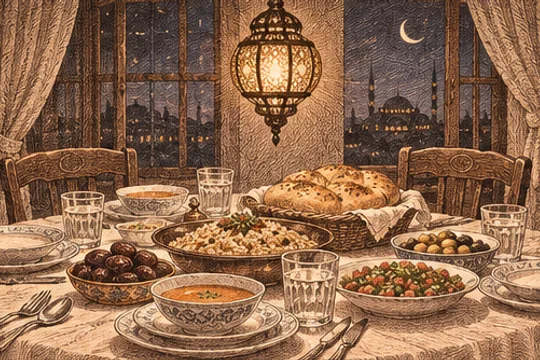
Have you ever lost something you loved? Have you ever felt things slip through your fingers, never to return, or seen something as close as your own breath suddenly recede a long, long way? Have you ever realised just how much the things you thought unimportant actually mattered? Or how lovely it is to share a meal around one table, talk about this and that, ask after one another, recall the past and catch up on what has happened since?
Do any of you remember the warmth of tırnak flatbread, the smell of cheese, the taste of cracked olives sprinkled with thyme, of bread dipped in olive oil and zahter, or of eggs from the village cooked in butter? Never mind all those. Does anyone even remember the eggy smell of a tea glass that had got egg on it?
Does anyone remember people setting out for work in horse-drawn carts hours before mid-morning, picking grapes or olives in the bitter chill and sitting down to breakfast at sunrise after two or three hours’ work? Does anyone remember how hard it was to earn one’s bread and how, in the whole country, only civil servants had steady jobs and incomes?
Did any of you see the frothy juice run from grapes gathered in the vineyards and crushed under bare feet? Did you smell that wonderful aroma as the juice boiled in great copper cauldrons on its way to becoming fruit leather, or watch strings of hazelnuts, almonds, walnuts and pistachios dry in the shade after being dipped in thickened grape must?
We forgot! Sadly, we forgot so much.
The fifties, sixties, seventies and eighties were hard years. Hard is hardly the word for it. Want and poverty were everywhere. Not everyone could eat meat. Those who could bought only enough for that day’s meal. A kilo or two from the butcher, like today? Out of the question. Two or three hundred grams, just enough for a taste. Chicken was expensive and hadn’t yet become commonplace. Serving it to special guests was quite the mark of “standing”.
A civil servant was the state itself. Never mind throwing a Molotov cocktail at a police officer. Even tearing a button off a neighbourhood watchman’s uniform could land you in prison for six months. The district governor, the district finance chief and the head of the tax office owned the district, as far as anyone was concerned.
The word “forbidden” was never open to question. People obeyed prohibitions, and no one ever asked why anything was “forbidden”. The prevailing attitude was that the state surely had its reasons.
Even crime and the characters of those who committed it were different. A man who committed murder went straight to the police station, turned himself in, confessed, stood trial, went to prison and served out his sentence with his head held high.
In those same years, simply saying words like “democracy” and “freedom” in public was enough to get you taken into custody and placed under arrest. “Violating the demonstrations law” was a very, very serious offence. A murderer would be treated humanely, but people tried and sentenced for their “thoughts and ideas” were never regarded as decent citizens. They were treated like lepers.
Don’t the things we experienced a mere ten or fifteen years ago show how much technological progress has simplified our lives? By simplicity I mean the monotony, listlessness, drabness and dissatisfaction technology has injected into our lives, rather than the benefits it has given us.
We used to take up pen and paper and write to friends and family at the drop of a hat, on holidays and festive occasions. In our letters we sent kisses to the hands and eyes of each person in turn, and never left a single relative unmentioned lest one uncle get cross or another feel slighted.
We never forgot to slip in a black-and-white photograph, full of feeling, the kind that still speaks to you when you look at it today. We addressed the envelope with great care, made the trip to the post office without a second thought, and paid ten kuruş for a stamp. Each was as lovely as a little painting. We gave it an eager lick, stuck it neatly to the envelope and handed it over the counter. The clerk inspected it gravely and put it on the scales if he had any doubt. If all was in order, he brought the round postmark down on it with all his might.
Then what happened? First came the automatic franking machines. Those inseparable lovers, stamp and envelope, were parted for good. Once a stamp had clung to its envelope in all its beauty, lending the plain white paper a grace and meaning all its own. Now there was only a machine mark in red ink, utterly devoid of character.
Meaningless colour pictures took the place of black-and-white photographs. Most are tucked away in digital memory and deleted three days later. The second great blow came with the typewriter and the computer. The beautiful handwriting that laid bare a person’s inner world gave way to ugly, insubstantial rows of mechanical lettering. By the way, does anyone know what an inkwell and a reed pen are?
Just as we were about to say enough was enough, electronic messages entered our lives. There’s no feeling in them, no laughter, no weeping. You can’t let a tear fall where it will show, blurring the ink to say, “I’m shedding tears for you.” You can’t singe a corner of the letter to show your beloved how much you miss them. And as for asking after someone’s health, forget it.
So much has changed in our lives. We go on living, but nobody even notices. We marvelled at how comfortable lifts were and forgot our neighbours on the floors in between. We marvelled at television and forgot the magic of the open-air cinemas: the light summer breeze, cracking sunflower seeds as we watched, all crying together at the saddest scene and booing the villain.
We forgot queuing at a payphone to call a sweetheart with a token good for three minutes. We forgot whittling a pencil, getting a shoe patched, keeping a handkerchief in our pocket, boiling mint and lemon for a stomach ache, doing homework by a paraffin lamp, roasting chestnuts on a tin woodstove, spreading Sana margarine on bread and dipping it in sugar.
We also forgot the old crank telephones, booking a call at the post office, waiting days to speak to someone and rushing to the telephone when the young woman at the exchange called, “I’m putting you through!”, by which time you’d forgotten where you’d meant to ring.
No one even remembers the candyfloss vendors who roamed the streets, the simit sellers with their sesame kahke rings, or the rooster-shaped sweets. These days haytalya is known as bici bici, and who outside Kilis, Adana and Mersin has heard of it? Most people don’t even know what fresh chickpeas or sugar cane look like.
How many remember the trolleybuses with their twin horns on the Ortaköy–Eminönü route? Or the conductors on the municipal buses who took your fare, tore off a ticket according to how far you were going and counted out your change to the last kuruş? How many students are left who, too hard up for the fare, drew themselves a counterfeit ticket on cheap straw paper with coloured pencils?
None, none, none!
Because the ticket is digital now, and so is the contraption we put in the conductor’s place.
The family greengrocer has gone, and so has the family butcher. Into the supermarket you go: look, choose, buy. In Güneşli I saw a neighbourhood grocer with a very apt name: Karagün Market — the Hard Times Grocery. Those old grocers really were friends in hard times. In every grocer’s ledger of goods bought on credit were a thousand and one stories, and just as many friendships and bonds of trust. Today, if you haven’t a lira in your pocket, can you walk into any supermarket and come away with so much as a loaf of bread?
And who remembers those evenings when the whole family went visiting together? We would go round to our relatives’ homes. There was no television, of course. We talked for hours. Once television came along the visits grew fewer. Even on the ones we felt obliged to make, the people fell silent and the televisions did the talking!
Then it all got worse: the internet age began. Nowadays, after a meal in a household of four, everyone retreats to a corner and they message one another on and on.
They’ve built a tunnel beneath the Bosphorus. A splendid thing, isn’t it?
But what will become of the Bosphorus ferries? One day they, too, will disappear, like the paddle steamers to the Princes’ Islands that live on only in Sezen Aksu’s songs. And if we can lay our hands on a single book or newspaper that hasn’t been digitised, perhaps we’ll feel moved to look up what those Bosphorus ferries were like.
In his incomparable poem “To the Martyrs of Çanakkale”, Mehmet Akif Ersoy described the twentieth century like this:
“Ah, that twentieth century, that noble creature,
Whose every darling is as wretched as can be,
Stood for months vomiting in the Turkish soldier’s face,
Shamelessly spilling all the secrets in its belly.
Had the mask not torn, that face would still beguile us…
That whore they call civilisation is shameless, truly.”
Here we are in the twenty-first century. Look what technology has given us! Has the mask torn yet and shown the face beneath?
Or is what we are living through now only a tiny fraction of what we will experience later?
You can’t help exclaiming, “My God!”
Please, set aside one day for yourself. Take your camera and walk through the city you live in, street by street, photographing it as you go. Don’t try to arrange it with anyone else. Everybody will find some excuse and throw your plans off.
There are so many things you can see today that you’ll soon go looking for in vain. Photograph everything you see, and date the pictures so you can pass them on to future generations.
I picture Kilis as it was in my childhood. How much we have lost! There was the 500-year-old Arasta Bazaar, demolished on the pretext of building a road. My late grandfather’s blacksmith’s shop, the one with the double doors in Nacar Market, fell to the same demolition. Of the stone houses that had stood for centuries, very few survive.
Sadly, the Republic’s intellectuals acted quite barbarously towards historic buildings. Lovely works left to us by the Seljuks and the Ottomans disappeared under the deceitful slogan “Roads are civilisation.” What is civilisation: the historic monuments built on our soil, or roads of black asphalt?
That is what I’d call confusing wheat with chaff.
There used to be a joy and an excitement about the holidays. There were no ready-made clothes. Turkey didn’t have a textile industry yet. Clothes Europeans had donated to churches somehow found their way into Kilis as contraband and were sold there. That’s where the expression “jacket smuggling” came from. In those years my mother, a tailor by trade, used fabrics of all kinds to make clothes for my siblings and me. I remember it vividly. I was the only child, or at most one of a handful in the entire neighbourhood, who got to wear something new. Most of my friends wore patched clothes and shoes and spent the holiday like any ordinary day. As I said at the start, those were hard years.
On the morning of the holiday, Mother dressed us in our best, lined us up at attention and had us kiss our late father’s hand. Some people now think “kissing hands” is out of date, but it mattered a great deal to us. My late father and Uncle Uğur gave us the most holiday money. In the seventies the largest sum was a hundred lira. The smallest came from Uncle Niyazi, who has also passed away. He gave ten lira at most. So with our childish calculations we took care to visit the most generous people first whenever we could.
Reciprocity mattered at the holidays. A “visit” called for a return visit. If we went to see someone, they were sure to come and see us. And the things we talked about! Yesterday and today, places near and far, this, that and everything in between. There wasn’t a soul we didn’t mention.
There were “holiday fairgrounds”, too. In the neighbourhood squares there were amusements of all kinds for children, and that was where we spent the holiday money we’d collected. Mehmet Akif Ersoy wrote a poem called “The Holiday”:
“Balloon sellers, roly-poly dolls and pinwheels,
Rooster-shaped sweets and toys that chirp and tweet.
A merry-go-round to your right, a sedan chair to your left,
Handcarts galore before you, a pair of swing ropes overhead.”
We saw and lived through all of that. We knew the man with the floating balloons, the roly-poly dolls, the wooden toy camels and the colourful pinwheels. Sadly, children these days have never even heard of merry-go-rounds, sedan chairs and pomegranate carts. Who knows what haytalya tastes like, or what macun candy is?
There isn’t a trace of any of it left.
Gone are the holidays and holiday treats, the greetings and the kissing of hands. Gone is the habit of asking after one another. Gone are the visits and the return visits.
May God spare us anything worse.
Dr Mehmet Hakan Sağlam
Translated from the Turkish original. Türkçe