
On the lack of foresight
6 August 2014 · Personal website
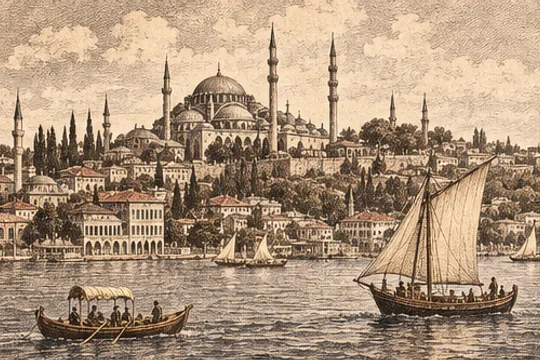
At the beginning of 2008, a friend of mine told me that a rector and senior officials from a prominent university in America would be visiting Turkey, and he suggested that he could arrange for me to meet with them.
We enjoyed a meal and conversation with our guests at the rooftop restaurant of a hotel in Yenikapı, accompanied by a stunning view of the Bosphorus. The guests were high-level executives from Virginia Commonwealth University (VCU). One of the guests began by saying, “After a long period, the government has finally managed to establish political and economic stability in Turkey,” and then stated that VCU was interested in collaborating with a university in Turkey. When I asked, “What kind of collaboration are you envisioning?”, he told me that VCU had a campus in Qatar, and that the Qatari emir had donated $50 million to their university to fund the construction of that campus. It was clear that they were looking to monetize their brand value. I clearly stated that they should not confuse Qatar with Turkey and the Turkish people, that Turkey would hold a very important position in this region in the near future, and that if they wanted to do business here, they would need to pay. They were very surprised.
In those years, Turkey had begun to clear away the 100 years of neglect and stagnation that had enveloped it, and to start making its voice heard, both in the Middle East and around the world. During the meal, I also shared my predictions about the future with them. Following 9/11, a growing Islamophobia in Western societies, I expressed the concern that this would increasingly isolate the United States, along with other Western countries, leading to new reactions driven by fear and anxiety. Specifically, I noted that Muslim Arabs wishing to travel to America or England for educational or travel purposes would increasingly begin to prefer Turkey – a country they perceive as closer – due to difficulties obtaining visas or experiencing Islamophobia.
As I began speaking, a few guests reacted to this prediction, and I drew their attention as they explained their reasons, noting everything related to Turkey. After dinner, I went online and researched VCU’s campus in Qatar. It turned out that this was only a department within the art faculty they had established in Qatar. The students were carefully cutting colored paper with scissors, seemingly engaged in some kind of “artistic activity.”
Years have passed since then. Just two days ago, my path led me to Richmond, which is the center of VCU. I was expecting a larger city, but instead, I found a town of around 200,000 people. It has only one main street, and along it, you find businesses of all kinds. However, it’s interesting to note that almost half of these businesses are currently closed. VCU buildings dominate the city – you see their faculties, dormitories, and administrative offices everywhere. We entered the beautiful arts faculty building on the main street; there was only one security guard inside. He mentioned that fewer students were coming compared to before, and that many buildings in the city were now empty, attributing this loneliness to the vacation season.
The situation in Richmond, in fact, reflects a broader issue facing countries like the United States and England at the moment. These countries, which used to welcome wealthy Arabs with open arms, are now granting visas while ensuring that those who receive them will live in the afterlife on Earth. Simply obtaining a visa isn’t the real problem; the issue exists at the customs gates. Muslims wishing to visit these countries are being subjected to absurd questions, requests for documentation, and phone calls – and then, when everything seems to be settled, they are told, “We’re sorry, we can’t bring you to our country.” As a result, it’s becoming increasingly unlikely to see many Arabs in the US and the UK. This trend will continue and eventually disappear. Islamic fears, it seems, didn't reach such extreme levels even during the Crusades. On both sides, there was a growing sense of isolation and separation, with civilizations not “coming together,” but rather “polarizing.”
In 2008, I observed that the issues I raised were manifesting not only in Richmond, but also across Western countries. The city feels increasingly isolated. Due to a decline in student enrollment, departments that were previously profitable and accepting students are now being closed, one by one. Essentially, VCU has begun to lose its brand value because it hasn't accurately predicted its future. This year, VCU has had to let go of the jobs of 800 faculty members. This is becoming the most significant problem for many universities in America over the next 50 years: it’s becoming increasingly expensive and reliant on tuition fees. While there are thousands of universities in the country, only a very small number – like MIT, Harvard, Stanford, Berkeley, and Cornell – are truly successful in producing science and technology.
The situation at American universities is very similar to our own. The only difference is that in America, ten universities are operating, while we have all of them working, and none of them are. However, we should celebrate those ten American universities – the ones that truly “make America” in terms of science and technology.
We had the opportunity to visit the public campuses of Harvard and MIT (Massachusetts Institute of Technology) in Boston. Tourists can walk through the hallways, which include research laboratories, and use the university’s facilities, such as restrooms and internet access. But, we were allowed to enter the university building – something that would never happen!
MIT’s laboratories are a truly significant center for producing space and aviation technologies. So, when it comes to confidentiality in any matter, that secrecy is entirely maintained here. My initial impression of MIT was a sense that information only holds value when it’s shared. At least, that’s how I understood it. You really feel the science and technology – a sense of being immersed in it – at MIT. But at VCU, there was a distinct lack of that feeling.
VCU’s executives clearly made a mistake – they failed to recognize that Turkey began to change after 2002, and even in 2008, the reality was evident. Turkey is growing, shedding its old limitations, and breaking free. The fundamental problem with Turkey is an outdated mindset, old ways of thinking, a lack of vision, and an inability to adapt. The very structures that cannot adapt to this change, like the VCU example, will inevitably disappear.
I am also a member of the faculty. I have always questioned the inefficiency and lack of scientific output of universities in Turkey. I’ve come across many academics who, after obtaining a title and a position, produce nothing. About six years ago, while sitting with my friend and colleague, Cemil Ertem, I said, “Cemil, let’s go to a university and see what’s happening.” That’s when we decided and set out on this path. After a five-year effort, our university gained legal status last year and was established in Ankara as “T.C. Ankara Teknoloji University.” When people ask me why we established this university, I tell them I was influenced by the words of the famous American mob leader, Al Capone: “When I was a child, I used to pray every night before going to bed, and whenever it came to my mind, to ask God to give me a bicycle.” One day, I realized that God didn't work this way. The next day, I went and bought myself a new bicycle, and every evening, before going to sleep, I prayed for God to forgive my sins.
I respond to those who ask, “What does it have to do with anything?” by saying, “I’ve seen so many absurd things in academic life that I realized there was no fixing them, so I decided to establish a university.”
Dr. Mehmet Hakan Sağlam
Translated from the Turkish original. Türkçe