
Orlando, the Conqueror’s Constantinople, and the herd of donkeys in Turkey…
20 December 2014 · Tarafsız Haber
Orlando is sweltering, and the humidity is stifling. Its buildings, scattered across wide stretches of land, remind me of Antalya. The climate is more like Mersin’s. You simply cannot go to bed without the air conditioning on. As in practically every American city there are rivers and water sources enough and to spare. On top of that there are the sudden downpours this humidity brings. When it rains, it really rains, as if a natural disaster had struck. If that much rain fell back home, we could plant a stone and a man would spring from the earth. Since I got here I’ve found myself remonstrating with the Creator. “My God,” I keep saying, “you must have your reasons, but what would it cost you to send a tenth of this rain our way?” Our poor Anatolian peasant sows his field, then goes out to pray and implore the Creator. Here they knock back drinks morning and night and bring in two harvests a year, there’s so much water.
Architecturally, Orlando is very different from American cities like Boston or Philadelphia. Most of the buildings have a single storey, or two or three at most. Practically wherever you go in the city, there is a shopping centre every three or four kilometres. I wouldn’t call them gigantic. Plenty of our shopping centres back home are bigger. What sets these apart is that most are outlets for well-known brands. The prices are rock-bottom and you can find just about anything. Some centres stay open twenty-four hours a day.
Orlando is a sort of holiday retreat for Americans. Like our own Kumburgaz and Selimpaşa, it sees its population multiply in summer. But what really puts the city on the map is Disneyland, of course. Every year millions of tourists from around the world pour into this capital of entertainment. Everywhere in the city you can find places of all kinds built around Disney cartoon characters. Everything here is planned around Disney: the hotel shuttle buses, the road signs, the places to eat and drink, the hotels themselves and so on. Take Disneyland out of Orlando and there would be no economic life left to speak of. Within three days the city would be a deserted oasis where not a bird flies overhead or a caravan passes by. In Orlando, as in every other American city, the amount of history is “zero”. I cannot imagine what they would do with even one ten-thousandth of the history we have, never mind one per cent.
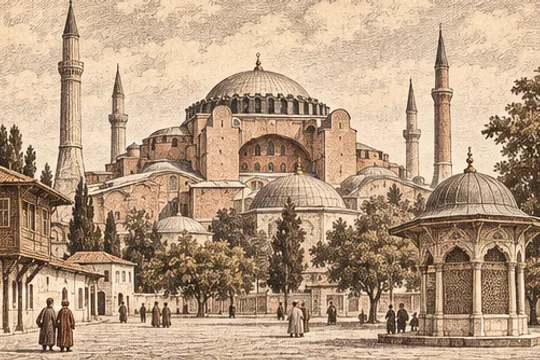
In 1453 Sultan Mehmed the Conqueror takes Istanbul. The very first thing he does is grant a tax exemption to the Genoese merchants trading in the city. Mehmed knew perfectly well that trade was what kept a city alive above all else. The Cape of Good Hope had yet to be discovered. The matchless spices of the Far East came by caravan from India and China along what we call the Silk Road to the ports of Izmir, Istanbul and Caffa. From there Venetian and Genoese merchants carried them to Europe. The Ottomans wanted that transit trade to continue, as they collected substantial tax revenue at guarded passes, markets and ports along the Silk Road. In 1488 something unexpected happened. The Portuguese explorer Bartolomeu Dias discovered a point at the southern end of Africa that no Western mariner had ever rounded. We call it Ümit Burnu, Westerners call it the Cape of Good Hope, and the Portuguese called it the Cape of Storms, Cabo das Tormentas. With this discovery world trade suddenly shifted away from the Silk Road and Anatolia and out onto the open seas. The Silk Road, with its history stretching back thousands of years, never regained its old importance. The countries, cities and towns along it, their peoples and civilisations, their merchants, grew poorer and poorer and in the decades that followed disappeared from the stage of history.
Our scoundrels of historians, oblivious to the world, divide the life of the Ottoman state into three periods, foundation, rise and decline, and date the beginning of decline to the Treaty of Karlowitz in 1699. They are too stupid and witless to see that economics cannot be separated from politics or from the power of the state. If the economy is strong, the state is strong. If it is weak, the state is nothing. Ottoman decline actually began with the discovery of the Cape of Good Hope. After that the rules changed, and power and money began to pass to the societies that possessed ships fit for ocean voyages. Great quantities of goods could be carried quickly by sea from Eastern ports to Europe, where banking and insurance developed as a result. Under Mehmed the Conqueror, one Venetian gold ducat was worth 12 Ottoman akçes (the first Ottoman gold coin was struck on Mehmed’s orders in 1477 at Serres and Constantinople). Under Bayezid II, who was in power when the cape was discovered, a ducat came to be worth 60 akçes. One factor in the depreciation of the silver akçe against the Venetian ducat, the dollar of its day, was the seigniorage revenue that Mehmed’s political power and authority had secured. But the chief cause was the appearance of the first lasting deficits in the Ottoman state budget, as the balance of foreign trade deteriorated and dozens of taxes on the Silk Road trade disappeared. Fortunately, the Ottomans, by pursuing a policy of provisioning the domestic market, managed to eliminate foreign trade deficits until 1838, when the Treaty of Balta Limanı was signed.
Republican-era historians, accustomed to inventing periods of history to suit themselves, have failed to mention a single one of these matters in their stacks of books, several metres high and mostly plagiarised. Most of our historians try to practise their profession without knowing Ottoman Turkish, a language all our own that our people used for a thousand years. They even have their meaningless title of “Professor” carved on their gravestones. How can one keep one’s temper with this “herd of donkeys” who pronounce the Roman Empire’s capital, Constantinople, as “Istanbul” and call the Roman Empire that Mehmed consigned to history the “Byzantine Empire”? “Well, you see, the Greeks call Istanbul Constantinople, so for political reasons it would be better if we said Istanbul.” Just listen to that pack of ignoramuses! To begin with, the state Mehmed overthrew was the Roman Empire, and the city he took was Constantinople, the city no one had been able to conquer. Say it, write it, illustrate it, explain it proudly and with honour. there is no division of Ottoman history into foundation, rise and decline, any more than there ever was a state called the Byzantine Empire.
Yes, there is not a trace of history in Orlando, but they manage to draw millions here in pursuit of cartoon characters. We have inherited thousands of years of history and civilisation, yet we do not appreciate what we have. Constantinople was home to the Roman Empire for centuries, yet you cannot find a single Roman tavern, restaurant, house, bath or market in it. Our first task should be to correct this “Byzantine Empire” error in the history books. We must drop foolish arguments about what Greece might or might not do. Who is Greece, a country we could drown in our spit, to harm Turkey and take this ancient Turkish city from us? For years the Republic’s timid, ineffectual excuses for leaders destroyed this nation’s self-confidence and trampled it underfoot. While the world burned, while blood flowed all around us, while Israel fought the Arabs and massacred Palestinians, while the French occupied Syria and the British occupied Mosul, Kirkuk, Baghdad and Basra, every last one of our traitorous rulers, none deserving the name of statesman, invoked the platitude “Peace at home, peace in the world”, created a world of his own in Ankara and lived a life of pleasure and ease.
Melih Gökçek has launched a project in Ankara modelled on Disneyland in Orlando. The idea is to turn Ankara, long identified with state bureaucracy, government buildings and official solemnity, into a major centre of entertainment, and put a little smile on people’s faces. But as on every other issue, certain die-hard naysayers, professional bodies, parties and associations filed suit after suit and brought the project to a halt. We should put the visionless fools who took the case to the Council of State on a plane, along with the judges who granted those idiots’ application and stopped the project, and show them the Disney parks of Paris and Orlando. Let them see for themselves how a project like this provides employment and a living for millions. Let them see the millions of tourists who come pouring into the country, one after another, from every corner of the world.
The fact is that these people, who object to everything and for years have failed to move Turkey a single step forward, have not inherited so much as a millionth of the outlook and vision of Mehmed, who conquered Constantinople in 1453.
Consider Mehmed, who in 1453 granted Venetian and Genoese merchants tax exemptions and made Constantinople a great trading centre. Then consider the mentality that 493 years later, in 1946, introduced the Wealth Tax, seized its own citizens’ property, put an end to their trading lives and sent them to Aşkale in Erzurum to work in the stone quarries. Is that not the clearest illustration of my point?
Translated from the Turkish original. Türkçe