
The last stronghold in the Middle East
26 August 2014 · Personal website
(Article 012, 26 August 2014)
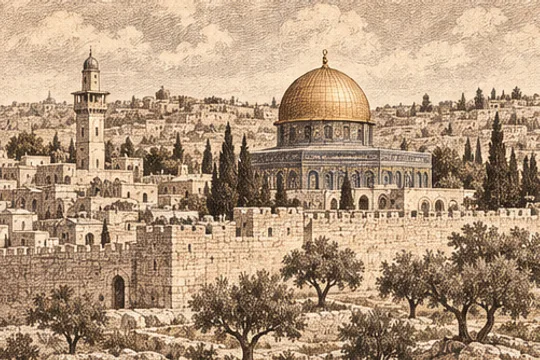
Jerusalem and Palestine…
Is there a single Muslim who hears those two names without feeling a pang of grief or sorrow?
The killing of civilians, including women and children, the bombing of buildings and the strikes on schools and hospitals in Palestine barely matter to many people. The attacks and deaths have become so familiar that most news agencies no longer even see a need to relay reports from this part of the world to their audiences. Sadly, the massacres that followed the founding of Israel have never stopped.
Palestinians complain more about the indifference of Muslims around the world than about napalm and phosphorus bombs. Turkey is the only country that speaks out about Israeli oppression, in the author’s view.
The process that led to the establishment of Israel began when Theodor Herzl convened the First Zionist Congress in Switzerland in 1897. Britain and almost all the other Western powers supported the idea of establishing a state of Israel in Palestine. In the years leading to the Second World War, the campaign of persecution and extermination against Jews, Roma and others deemed not to be “Aryan” in Germany went largely unheeded in the West for a long time. Across Europe, hostility towards Jews and Roma went back to the Middle Ages. The author argues that the United States and the European powers failed to speak out against Hitler’s mass murder and genocide of the Jews because, he argues, a Europe without Jews suited their interests as well.
After coming to power in 1933 as leader of the National Socialist Party, Hitler pursued policies intolerant of difference. His right-wing nationalist and racist policies unleashed an unprecedented wave of fascism. Some Western intellectuals backed Hitler because of his stance against the Soviet Union. Adolf Hitler, one of history’s greatest dictators, was even nominated for the Nobel Peace Prize in 1939. Time went further, naming him its Man of the Year for 1938 and putting him on the cover.
When Theodor Herzl convened the three-day First Zionist Congress in Basel, Switzerland, on 27 August 1897, more than two hundred delegates attended. The congress laid the foundations of the World Zionist Organization and made Herzl its president. It defined the aims of the Zionist movement, the means required to achieve them and the executive body that would put those means to use. Three days after the congress ended, Herzl wrote in his diary: “At Basel I founded a Jewish state. If I were to say this aloud today, the whole world would erupt in laughter. But in five years, perhaps, and certainly in fifty, everyone will understand that this was so.”
Herzl is said to have visited Istanbul five times between 1896 and 1902 to persuade Abdülhamid II to permit Jewish settlement in Palestine. Before coming to Istanbul, he made preparations and described the borders of the state he envisaged: “It must extend from the mountains of Cappadocia in the north to the Suez Canal in the south. It must be the Palestine of David and Solomon.” These were, in the author’s account, the boundaries of Palestine described in the Bible.
Herzl also conveyed an offer to ease the Ottoman government’s financial difficulties in exchange for land. Abdülhamid replied through the Polish count Philipp de Newlinsky: “If Mr Herzl is your friend as you are mine, advise him to take no further step in this matter. I cannot sell even a handspan of land. This country belongs to my people, not to me. My people won this empire by shedding their blood in war and made it fertile with their blood. Before this land is torn from us, we will water it with our blood again. My Syrian and Palestinian regiments fell one by one at Plevna. They gave their lives on the battlefield without a single man returning. The Turkish Empire does not belong to me. It belongs to the Turkish nation. I cannot give away any part of it. Let the Jews keep their millions. When my empire is partitioned, they may take Palestine without paying anything. But only our corpses can be divided. I cannot allow surgery on a living body.”
Abdülhamid II went further, introducing measures to prevent Jewish settlement in Palestine and laws to bar Jews from buying land there. Herzl held two more unsuccessful meetings with him on 19 May 1901 and 4 July 1902. He recorded in his memoirs: “For Zionism to achieve its aim, we must wait for the Ottoman Empire to disintegrate.”
Britain, which was receptive to the Zionist ideal, entered the nineteenth century as the greatest colonial power. After Herzl’s death, Chaim Weizmann took charge of links between Britain and the Zionist movement. The Conservative leader Arthur Balfour, Winston Churchill, Lloyd George and Herbert Samuel, also a member of Parliament, were Weizmann’s closest friends. Samuel said he supported giving Syria to France under the secret 1916 Sykes–Picot Agreement between Britain and France on the principle that “a future Jewish state should have a European state for a neighbour instead of the Turkish state.”
On 18 July 1917, Lord Rothschild, president of Britain’s Zionist associations, submitted a signed letter to Foreign Secretary Arthur Balfour with three principal proposals. Palestine should become a Jewish homeland, Jews should be able to immigrate there without restrictions, and Jews should be allowed to govern themselves there.
On 2 November 1917, Balfour sent Lord Rothschild a reply that went down in history as the Balfour Declaration. It stated that Britain looked favourably on the establishment of a national home for the Jewish people in Palestine. The letter read as follows.
Foreign Office, 2 November 1917
Dear Lord Rothschild,
On behalf of His Majesty’s Government, I am pleased to inform you that the following declaration of sympathy with Jewish Zionist aspirations has been submitted to and approved by the Cabinet. His Majesty’s Government views favourably the establishment in Palestine of a national home for the Jewish people and will do all it can to help achieve this aim, on the understanding that nothing is to be done that might prejudice the civil and religious rights of Palestine’s existing non-Jewish communities or the rights and political status enjoyed by Jews in any other country. I would be grateful if you would bring this declaration to the attention of the Zionist Federation. Yours sincerely.
The British occupied Jerusalem a month after the declaration was issued. In 1917, the year of the Balfour Declaration, Palestine had 570,000 Muslim, 74,000 Christian and 75,000 Jewish inhabitants. Jewish immigration to Palestine accelerated after the declaration.
While Jews lived with greater tolerance and freedom of worship in Muslim countries, they faced severe repression in Europe. Antisemitism in medieval Europe, especially in the west, led to expulsions from England in 1290, France in 1392, Spain in 1492 and Portugal in 1497. Some Jews had to conceal their faith and pretend to embrace Christianity. The author puts the number of Jews killed in Spain in the late fifteenth century at 100,000. Some of those expelled sought refuge in the Netherlands, but most migrated to the Ottoman Empire, while Jews expelled from Germany settled in Poland.
Towards the end of the century [the century number is missing in the recovered text], European nationalism fuelled antisemitism across the continent. Hostility to Jews intensified sharply in societies where it had long existed. Even in Russia, which the author considers the country least affected by European nationalist movements and which was home to three million Jews, they were treated as second-class citizens.
The assassination of the Russian tsar in 1881 intensified hatred and hostility towards Jews. It drove them to emigrate to other countries in large numbers. After Hitler came to power and the genocide of the Jews began, Palestine’s Jewish population grew rapidly. In the 1880s there were 35,000 Jews in Palestine. That number doubled during the First World War and the years that followed. In the ten years after British mandatory rule was established, about 100,000 Jewish immigrants entered Palestine. The Jewish share of the population rose from around 10 percent to around 17 percent.
The wave of antisemitism that flared up in Germany in the 1930s spread to Italy, Poland, Austria, Romania, Hungary and Czechoslovakia. Growing antisemitism in Europe prompted Jews around the world to act. The Eighteenth World Zionist Congress, meeting in Prague, passed resolutions on settling Jewish refugees in Palestine.
Under British rule, the demographic balance shifted in favour of the Jewish population. In 1922, according to the account, the Jewish Agency was established, allowing Jews in Palestine to engage with other states internationally. Hebrew was also recognised as an official language alongside English and Arabic. Meanwhile, armed clashes began between Arabs and Jews. Over the thirty years that Britain ruled Palestine, first as an occupying power and then under the mandate, its policy was full of contradictions.
Between 1882 and 1903, about 35,000 Jews from Eastern Europe, mainly from the Russian Empire, migrated to Palestine. The article also states that after the 1897 Basel Congress, 40,000 Jews were brought from Russia to Palestine in a systematic, organised migration. In Russia, pressure on Jews increased in the wake of the Bolshevik Revolution of 1917, and 37,000 Jews migrated to Palestine as a result. Between 1924 and 1929, 48,000 Jews from Poland, Hungary and the United States settled there. Between 1929 and 1939, with the Nazis coming to power in Germany and European countries closing their doors to Jews, Palestine’s Jewish population rose from 175,000 to 475,000.
In 1947, on the initiative of Britain and the United States, a draft resolution was put to a vote at the United Nations. The decision was to allocate 56 percent of Palestine’s territory to the Jewish population of 650,000 and 44 percent to the Palestinian population of 1.3 million. More importantly, Jerusalem was to be placed under an international regime. The article describes 14 May 1948 as the date the United Nations approved Israel’s independence. The desire to found a state that Herzl had recorded in his notebook shortly after the meeting he convened in Basel on 27 August 1897 was thus fulfilled fifty-one years later.
After the establishment of Israel, half a million Jews migrated to Palestine from Eastern Europe and Arab countries. During this migration, 49,000 Jews from Yemen, 114,000 from Iraq and 30,000 from Iran were flown to Israel. Ethiopian Jews were brought to the country in two separate operations in 1985 and 1991.
Fighting between Palestinian Arabs and Jews began well before the Second World War. From 1936 to 1939, protests took place under the leadership of the Mufti of Jerusalem against increased Jewish immigration. The article says British troops opened fire on demonstrators and killed five thousand Arabs.
On 22 July 1946, members of the Jewish organisation Irgun bombed the King David Hotel in Jerusalem. Ninety-one people died, forty-one of them Arabs. Irgun’s activities did not end there. Villages were raided to frighten Arabs into leaving. Children and elderly people were killed in the raid on Deir Yassin, near Jerusalem, which the article dates to 9–11 April 1948. Later that year, on 9–18 July, came the Lydda massacre. The author groups it with attacks at al-Tira, Tantura and Haifa and describes hundreds of civilian deaths and sixty thousand people being forced off their land.
On 29 October 1948, the massacre at Safsaf took place. Seventy villagers were killed by indiscriminate fire, according to the article. On the same day, an attack on the village of al-Dawayima near Hebron killed between eighty and one hundred Palestinians. On 12 October 1953, a group led by Ariel Sharon raided Qibya in the West Bank. Sixty-seven people were killed and seventy-five wounded, according to the figures given here.
Fear began to spread throughout Palestine. The Kafr Qasim massacre took place on 29 October 1956, killing forty-nine civilians, including women and children. The article dates the attack on the West Bank village of Samu to November 1956. It says the village was devastated and eighteen Palestinians were killed. On 15 February 1968, Israeli warplanes are said to have destroyed more than fifteen Palestinian villages near the Jordan River with napalm, killing eighty-six people. On 12 February 1970 a factory at Abu Zaabal near the Egyptian border was targeted, and seventy workers were killed.
Israeli attacks were not confined to Palestine. In the author’s view, Egypt and other Arab countries were also attacked from time to time to instil fear of Israel across the Middle East. On 8 April 1970 a school in an area the source calls Sha’a, eighty kilometres from Cairo, was bombed, killing forty-six children. On 8 September 1972, Syria was targeted: seven villages were bombed and two hundred people killed. The article gives 19 February 1973 as the date a Libyan passenger aircraft carrying 107 passengers was shot down and portrays it as a warning to Muammar Gaddafi for defying Israel. It says that no passengers or crew survived. On 20 July 1981, according to the account, Beirut’s airport was targeted and three hundred civilians died.
On 16 September 1982, Israeli forces occupying Lebanon and Lebanese Christian Phalangist militiamen under Ariel Sharon’s oversight and protection attacked the Sabra and Shatila camps where Palestinian refugees lived, in the author’s account. It puts the number of unarmed and defenceless Palestinians killed at 2,750 and says only 328 bodies could be identified. On 8 October 1990, Israeli soldiers opened fire during clashes between Palestinians and Jewish groups that, according to the author, wanted to demolish al-Aqsa Mosque and build what he calls the so-called Temple of Solomon in its place. The article gives the toll as thirty Palestinians killed and eight hundred wounded.
During the First Intifada of 1987–93, the mass Palestinian uprising against Israeli occupation, Palestinians threw stones at heavily armed Israeli soldiers. The soldiers opened fire, and more than a thousand people were killed.
On 25 February 1994, during Ramadan, the American-born Israeli settler Baruch Goldstein killed twenty-nine Palestinians worshipping in the Ibrahimi Mosque and wounded 125.
On 18 April 1996, in an Israeli army attack on what the article describes as a refugee camp at Qana in Lebanon, 109 Palestinians, most of them women and children, were killed. In an attack on the Jenin refugee camp in the West Bank between 3 and 15 April 2002, the article gives the death toll as 1,300 civilians.
Israeli attacks were not confined to the camps. They also targeted leaders of Hamas and the Palestine Liberation Organization, whom the author describes as fighting for Palestinian freedom. On 22 March 2004, Sheikh Ahmed Yassin, a founder of Hamas, was assassinated by fire from Israeli helicopters. On 17 April, Abdel Aziz al-Rantisi, the most prominent Hamas leader after Yassin, was also killed. In March 2004, Israeli forces entered the Nuseirat and Bureij refugee camps in Gaza and killed fourteen civilians, including four children.
On 11 November 2004, Palestine Liberation Organization leader Yasser Arafat died. The author alleges that he was poisoned. In the operation in the Gaza Strip from 28 February to 3 March 2008, at least 117 Palestinians were killed, 200 were wounded and the homes of around 800 Palestinians were damaged. On 14 April 2008, Ibrahim Abu Ilba, the leader of the military wing of the Democratic Front for the Liberation of Palestine, was killed in an Israeli attack.
On 27 December 2008, citing rocket attacks against it, Israel struck a police headquarters during a graduation ceremony, killing 140 police officers, including senior Hamas security officials, and launched Operation Cast Lead in the Gaza Strip. Sixty warplanes took part. More than two hundred Palestinians died in the first hours alone. The article puts the toll of the air and ground attacks and bombardment in January 2009 at 1,600 Palestinians killed, including many women and children, and more than 6,000 injured and left homeless. On 1 January 2009, senior Hamas leader Nizar Rayan was killed when his home was bombed. On 15 January, Hamas government interior minister Said Siam was killed in an Israeli missile strike along with his son, his brother and members of his family.
On 31 May 2010 the attacks extended to Turkey, in the author’s account. The Israeli navy boarded the Gaza Freedom Flotilla in international waters. The flotilla had set sail under the slogan “Our course is Palestine, our cargo is humanitarian aid.” Nine Turkish aid volunteers aboard the Mavi Marmara were killed and more than fifty volunteers wounded. In September 2011, eighteen Palestinians died in a week of Israeli airstrikes on the Gaza Strip. In November 2012, the article says, Israeli air and ground attacks on Gaza killed 341 people. It gives the toll from Israeli airstrikes in July 2014 as 202 dead and 1,400 wounded.
The attacks in Palestine continue unabated. With every attack, Israel advances and expands its territory. The map referred to in the original shows how Palestinian land shrank between 1947 and 2012 following Israeli attacks. The article says that Palestinians are left with a tiny strip likened to a refugee camp on the Mediterranean, which it calls the West Bank, and a few neighbourhoods of Jerusalem farther inland. [The source appears to conflate Gaza with the West Bank.]
Neither the United Nations nor the Western powers, the author argues, have spoken out against the extraordinary attacks Israel has carried out over the years.
Recep Tayyip Erdoğan, as prime minister of Turkey, was the only leader, in the author’s view, to criticise Israel’s attacks so publicly on the international stage. On 29 January 2009, Erdoğan joined UN Secretary-General Ban Ki-moon and Israeli President Shimon Peres at a Davos panel titled “Gaza: Peace in the Middle East.” Immediately after Peres sharply criticised Erdoğan and Turkey’s position on Gaza, Erdoğan asked to respond, but the moderator, David Ignatius, refused to give him the floor. Erdoğan spoke anyway: “Mr Peres spoke for twenty-five minutes. I spoke for only twelve. Peres raised his voice because he feels guilty. That is why he is shouting.” When Ignatius put a hand on Erdoğan’s arm to stop him speaking, Erdoğan shouted, “One minute… One minute.” Turning to Peres, he said, “You know very well how to kill people. You have prime ministers who shout from atop tanks. You are not letting me speak, and Davos is over for me.” He stood up and left the session.
The incident echoed around the world, and news outlets carried it as breaking news. When Erdoğan left Davos and returned to Turkey, hundreds of thousands greeted him at the airport. Arabs took to the streets as the incident unfolded, waving Turkish and Palestinian flags and chanting “Erdoğan, Erdoğan” until morning. In the author’s view, it was the first time a Muslim leader had stood up to Israel and embarrassed it on the international stage.
And this was the very country that, until then, had raised no objection to Israel’s actions and, in the author’s account, was the first Muslim country to recognise Israel when it was established in 1948.
Israel could not stomach Prime Minister Erdoğan’s outburst. The response from a country Israel regarded as a natural ally took it completely by surprise and left it suddenly isolated in the Middle East. The “One Minute” incident was the greatest turning point in international affairs in Turkey’s ninety-year history. It strengthened Turkey across much of the world, particularly in the Middle East, while leaving it exposed to attacks by Israel and its supporters. In the author’s view, the assault on the Mavi Marmara was an act of revenge by an Israel still furious over Davos. But Erdoğan stood firm and, the author says, forced Israel to apologise and pay compensation for the attack.
Erdoğan’s outburst fundamentally changed the way the world looked at Israel. Even Western countries are deeply troubled by what the author describes as Israel’s rash disregard for rights, justice and humanity. Protests against Israel can now take place in some countries, however muted they may be. After the incident, some Western parliaments recognised Palestine as an independent state. Those who write the history of Palestine will now divide it into two periods: “Before One Minute” and “After One Minute”…
While all this was happening and very young children were dying under phosphorus and napalm bombs, the author accuses Arabs themselves of being the only people who failed to condemn Israel or protest against it.
From Venezuela, fifteen thousand kilometres from Palestine, the country’s president responded to this Arab stance by saying, “Enough!” Saudi Arabia, Egypt, Kuwait, the United Arab Emirates, Qatar, Jordan, Algeria and the other Muslim countries did not speak out against the massacres, in the author’s view. Some Arab governments even blamed Palestine and tried to portray Hamas as a terrorist organisation. The author compares Hamas to the Kuvâ-yı Milliye, the Turkish National Forces that fought to recover occupied territory.
The Middle East today has no leader. Picture the region as it was twenty years ago: Hafez al-Assad in Syria, Saddam Hussein in Iraq, Gaddafi in Libya, Anwar Sadat in Egypt and King Hussein in Jordan. All were powerful, authoritarian leaders in their own way. Whatever their practices or their despotism, each had the power to bring millions of people in their country into the streets at a moment’s notice.
Western countries, the author argues, set Saddam Hussein and Khomeini against each other in the Iran–Iraq War and sold billions of dollars in arms to both sides. When the bloodiest war in the Middle East ended, they were bitterly disappointed. Their arms industries had to keep running somehow. They knew Saddam’s weak spot and, the author alleges, applauded as they encouraged him to enter Kuwait. The Iraqi army’s invasion of Kuwait in August 1990 marked a turning point in Middle Eastern history. Kuwait had given Iraq financial support during the Iran–Iraq War, and Saddam owed it fourteen billion dollars. When the occupation sent world oil prices soaring, the powers the author says had encouraged Saddam to enter Kuwait just three days earlier secured a UN resolution and formed an international coalition against Iraq. The First Gulf War began on 17 January 1991, led by the United States and Britain. Iraq was driven out of Kuwait, Saddam’s army was crushed, and Iraq was made to pay a huge indemnity.
Then came the attacks of 11 September 2001. Osama bin Laden’s militants struck the Pentagon and the World Trade Center with hijacked aircraft. It was the worst terrorist attack in US history. The article puts the death toll at more than three thousand Americans. The attacks popularised the ideas of American neoconservatives, and calls for war against Muslims rang out across the world. The author portrays the Second Gulf War, launched in 2003, as an attempt to finish what had been left undone. Iraq was occupied and in practice split into three areas: Shia, Kurdish and Sunni.
The Americans captured Saddam in the hideout where he had been concealed for some time. In the author’s account, he was tried by Shias and hanged by Kurdish executioners. He was not even allowed to complete the profession of faith as he was hanged, and Shia guards chanted, “Long live Muqtada al-Sadr.” Footage of the execution was immediately sent to the media and around the world, just as the author says happened in what he calls the judicial coup against Prime Minister Erdoğan on 17 and 25 December 2013. This remarkable exercise in social engineering swiftly bore fruit. In a diverse country like Iraq, which the author describes as predominantly Sunni, no one forgot that the Sunni leader Saddam Hussein was tried by Shias and hanged by Kurdish executioners. In the author’s view, Iraqi society was irrevocably divided on 30 December 2006, the day Saddam was executed.
With Saddam’s death, the Arab world lost what the author considers its most significant figure since Egypt’s legendary leader Gamal Abdel Nasser. Saddam’s removal in Iraq was followed by other operations in the years that followed.
Libya’s Muammar Gaddafi was also an important Arab leader. He too was killed in a degrading and shameful manner. Egypt’s Anwar Sadat was assassinated during a ceremony and succeeded by Hosni Mubarak, who lost power after thirty years following street protests. Mohamed Morsi succeeded him, but lasted only a year. Egypt’s first elected president was removed by a military coup after a year in office. His successor is Abdel Fattah el-Sisi, whom the author calls an American lackey. When Syria’s president Hafez al-Assad, one of the Middle East’s most fearsome dictators, died, his son Bashar al-Assad succeeded him. His position is now uncertain.
In today’s Middle East there is no trace of Hafez al-Assad, Anwar Sadat, Saddam or Gaddafi. Put all the leaders around today together and they would not amount to a quarter of one of the dictators of twenty years ago. In countries that look rich in oil from a distance, income inequality, social problems, poverty and inadequate infrastructure are extreme. Saudi Arabia, Iraq, Kuwait, the United Arab Emirates, Libya and Algeria sell billions of dollars’ worth of oil each year. The author alleges that the proceeds flow into their leaders’ Swiss bank accounts instead of public treasuries. Arab kings, sheikhs and princes with personal fortunes in the hundreds of billions live in a world they do not deserve while their people suffer poverty and hardship in silence.
Anyone who has had the chance to visit a village in Syria, Iraq, Saudi Arabia, Yemen, the United Arab Emirates, Libya or Algeria will see no difference between photographs of the region a century ago and those taken today. Arab leaders know their hold on power is temporary. The only authority they answer to, in the author’s view, is the “foreign powers” that put them there. Those who do not serve these powers are seized, put in cages and tried, whatever their name or title. Saddam, Gaddafi, Mubarak and Morsi are the clearest examples.
It is impossible to expect Arab leaders to react over Palestine or take a stand against Israel. The author argues that any leader who does so would lose his position that very day. From fifteen thousand kilometres away, Venezuela’s president criticised Arab governments, saying, “Enough already, make your voices heard.” There are things he does not understand. Outside tutelage is part of how power works in this region.
What about Turkey?
In Turkey, the counterparts to the dictators, emirs, sultans and kings serving foreign powers in the Arab world are what the author calls the institutions of constitutional tutelage, centred on the judiciary and the military. Everyone knows, he says, that in Turkey’s recent past chief prosecutors at the Court of Cassation used false reports gathered online to bring cases aimed at shutting down elected governing parties, that military officers plotted coups and issued ultimatums, that there were plans to arrest intelligence chief Hakan Fidan and Prime Minister Erdoğan for “treason,” and that what he calls the judicial coup of 17 and 25 December 2013 was intended to bring down the prime minister and the government.
Whatever anyone says, the author sees foreign powers and highly organised social engineering planned behind closed doors behind these events.
In a Middle East without leadership, Turkey is the strongest country still standing, and Erdoğan is the only leader they cannot put in an iron cage and put on trial.
Erdoğan is the last fortress in the Middle East.
If that fortress falls too, woe to Turkey and the Middle East!
Dr Mehmet Hakan Sağlam
Translated from the Turkish original. Türkçe