
When the oil runs out…
19 October 2014 · Personal website
(19 October 2014 — Tarafsız Haber)
I have seen almost every film about the Second World War, but only a few have stayed with me.
One I especially liked was Stalingrad, the German film from 1993. As you watch it, you feel in your bones how and under what conditions more than two million people died in just six months, or rather how they were knowingly sent to their deaths. You feel the cold of the Russian steppes, the resolve of people defending their country, the desperation of the civilians and what hunger can drive people to do.
The Battle of Stalingrad began on 23 August 1942 and ended barely six months later, on 2 February 1943. In that brief time the Germans lost 850,000 men and had 107,000 taken prisoner. Only 6,000 of those prisoners survived, and they did not get home until 1955. The Germans also lost 900 aircraft, 1,500 tanks and 6,000 artillery pieces. The Russian losses were staggering: 1,150,000 dead, 2,769 combat aircraft, 4,341 tanks and 15,728 artillery pieces.
The fighting at Stalingrad in 1942 and 1943 helped decide the outcome of the Second World War and shape the politics of the rest of the twentieth century. In the summer of 1942, German armies launched a major offensive against the Soviet Union, America’s wartime ally. Even with extraordinary logistical support, the German armies had to cover 1,600 kilometres to reach Stalingrad, an industrial centre on the Volga. Then something unexpected happened: the entire Russian nation resisted. With Russia’s unbearable cold adding to that resistance, the course of the war changed. The Russians defending Stalingrad were fighting several enemies at once: the Germans, the cold and the anti-communists fighting alongside the Germans.
The Germans were quite sure they would take the city. Their real objective was to seize a vital gateway to the oil fields of the Caucasus. Capturing a city named after Stalin would also have been a tremendous propaganda prize for Hitler. Stalin understood the German objective and ordered that the city be held at all costs, sending poorly trained Soviet soldiers into battle, many without weapons. The Soviet security services were authorized to kill soldiers who intended to flee the battlefield or retreat. Meanwhile, Soviet officials persuaded civilians to remain in the city and support the troops to the end. Among those who stayed to defend it was the famous sniper Vasily Zaitsev. He killed 225 soldiers during the Battle of Stalingrad, 11 of them German snipers.
The death toll at Stalingrad reached appalling proportions. Both Hitler and Stalin wanted the battle to go on until the last soldier was left. A total of 850,000 soldiers drawn from Germany, Romania, Italy and Hungary lost their lives fighting in the ranks of the German army. To those we must add the countless anti-communist Russian units that sided with the Germans in the hope of toppling the communist regime in the Soviet Union.
The Soviet Union suffered even greater losses. About 1,150,000 Soviet soldiers died in the fighting. Civilian deaths were staggering too. Before the siege, Stalingrad had a population of 500,000. By the end of the battle, it was down to 1,000. The extraordinary Soviet resistance upset Hitler’s calculations. Stalingrad was the farthest the German armies reached on the Eastern Front in the Second World War. The defeat went down as the greatest military disaster in German history. The Soviet people’s victory over the Germans was a turning point in the war. From then on, German expansion was checked, and the Soviet Union and the other Allied nations took heart from seeing that Germany could be defeated.
Another film I enjoyed, and one I suspect many people have seen, is The Pianist, a French, German and Polish co-production made in 2002. It, too, deals with the Second World War, telling the story of Władysław Szpilman, an accomplished Polish pianist, and what happened to him during the German occupation of his country. A Jew, Szpilman escapes deportation to the concentration camps by chance and goes into hiding on the outskirts of Warsaw. He struggles with hunger and illness and eats whatever he can find. With the help of a German officer named Wilm Hosenfeld, he manages to survive and is saved when Soviet troops enter Poland in 1945.
I think both films are well worth watching and strongly recommend them to anyone who has yet to see them. Both have things in common: death, blood, tears, hunger, misery, cities and lives levelled. When the Second World War ended in 1945, there were no buildings left standing in hundreds of European cities, among them Warsaw, Stalingrad and Berlin. Theatres, town halls, government buildings, homes, markets, museums and much else had been bombed, burned, demolished and laid waste. It took Europe a long time to shake off the effects of the war. The Axis countries, Germany, Japan, Italy, Hungary, Romania and Bulgaria, lost 12 million people, 8 million military and 4 million civilians. The Allies, the USSR, France, Britain, the United States, China, Poland, Yugoslavia, Canada, Australia, New Zealand, Greece, Czechoslovakia, South Africa, Norway, the Netherlands, Belgium and Brazil, lost 61 million people, 16 million military and 45 million civilians. The material losses are impossible to calculate.
Now come back to the present and look around us. Is the situation any different in Gaza and the West Bank, Aleppo, Hama, Homs, Raqqa and Damascus, Baghdad and hundreds of other cities and towns, Beirut, or the cities in Libya, Sudan and many other countries with histories spanning three to five thousand years? Ruined cities, buildings reduced to rubble, civilian neighbourhoods hit indiscriminately, people trapped under the wreckage, practices unthinkable even in the most barbarous societies, hospitals, schools, museums, mosques and shrines struck by bombs.
Have you noticed? We scarcely blink at scenes like this anymore. Thirty years ago, even a small incident anywhere in Asia, Europe or the Far East could make the news for days, and people scrambled to find out what had happened. Is it like that now? With the spread of the internet and other means of communication, we are bombarded with news. A bombing that killed seventy or eighty people three minutes ago becomes old news as soon as another story comes in three minutes later, and it loses the attention of the world. The bodies of hundreds of children pulled from the ruins of a school or hospital demolished by Israeli missiles in Gaza or by the Assad regime’s barrel bombs in Aleppo may be deemed far less newsworthy than Lady Gaga’s dress made out of steak.
Ten years ago the notion of the “consumer society” came up frequently in economics. Today it is used more often in media studies, in connection with the “consumption of news.” Things happen so fast and so often that no one can keep up with story after story. When the news cycle speeds up, a report of a bombing, suicide attack or atrocity in any country begins to sound like an ordinary item.
It is as if time is running backward in the Middle East today. Some cities now look no different from the ruins of Nineveh, Babylon, Uruk or Sippar that have come down to us across the centuries. What is there to compare between Baghdad today and the Baghdad of the eighth-century Abbasid caliph Harun al-Rashid, the setting of the Thousand and One Nights? In those days Baghdad was the beating heart of trade. It occupied the place that London, Amsterdam, New York and Istanbul do today. Merchants from Iran, China, India, Africa and Europe met in Baghdad, in Mesopotamia. Goods from across the Old World came to Baghdad and were sent on from there to the rest of the world. It was where Arab culture mingled with other cultures of the East. It was in this splendid city that Scheherazade told tales to the ruler she loved for a thousand and one nights. The Hanging Gardens of Babylon were also in Iraq. Had Baghdad been a two-house village, what could Scheherazade have found to tell her royal husband over a thousand and one nights?
Today this part of the world is counted among the least developed. Yet Mesopotamia was a cradle of civilization. Let us take a brief look at what happened here before the Common Era. In 9000 BCE, agriculture began in Mesopotamia and sheep and goats were domesticated. In 8000 BCE, the first settlements were established at Sagalassos in Anatolia. In 7000 BCE, pottery developed and cattle were domesticated. In 5400 BCE, the first irrigation systems were built and the plough and wheel were invented. In 5100 BCE, the first temples were built. In 4000 BCE, the Sumerians began using writing. In 3500 BCE, ships began to be used on the Nile. In 1200 BCE, Judaism emerged as a religion. In 1184 BCE, Troy in Anatolia fell. Around the same time, people in Anatolia and the Caucasus began smelting and working iron. Around 1000 BCE, pharaonic Egypt emerged as the world’s greatest power. In 600 BCE, Cyrus the Great conquered Babylon and founded the Persian Empire. In 333 BCE, Alexander the Great conquered Persia.
Developments in Mesopotamia continued into the Common Era. In the first century, Christianity emerged as a religion. In 391, Christians burned and destroyed the Library of Alexandria. In 395, the Roman Empire split into the Western and Eastern Roman Empires. In 610, the Prophet Muhammad began spreading Islam, the last of the revealed religions. In 756, the Arabs set foot in Spain and the Arab state of al-Andalus was founded. Abu Ja‘far Muhammad ibn Musa al-Khwarizmi, born in Khiva in Khwarazm in 780 and deceased in Baghdad in 850, emerged as the founder of modern mathematics, discovering the numeral zero and the unknown x. The first definitions of sine and cosine were given by al-Battani (858–929), and the first fundamentals of tangent and cotangent by Abu al-Wafa (940–998). Once Muslim scholars had established and developed most of the basic principles of mathematics, Western scholars drew on that knowledge and brought the discipline to its present level. They included Johann Müller (1436–1476), Cardano (1501–1596), Descartes (1596–1650), Newton (1642–1727), Leibniz (1646–1716), Maclaurin (1698–1748), J. Bernoulli (1654–1705), Boole (1815–1864), Poincaré (1854–1912) and Cantor (1845–1918). In 1071, the Seljuk Turks first set foot in Anatolia. The Ottoman state was founded in 1299. In 1347, a Genoese ship from Crimea reached the Italian port of Messina and brought plague to Europe. A third of Europe’s population died of plague, and in just three years the world’s population fell from 450 million to 350 million. In 1453, the Ottoman ruler Mehmed the Conqueror captured Constantinople and put an end to the Eastern Roman Empire. In 1492, Spain’s Catholics ended Arab rule there. Only the Ottoman state welcomed the Jews and Muslims who had escaped massacre in Spain and were fortunate enough to be expelled. That same year, Christopher Columbus discovered America. The French Revolution came in 1789. Innovations and discoveries followed one after another.
Across the East today, nothing remains of those brilliant days. Countries and peoples are at one another’s throats. Islam, presented as a religion of peace, has suffered serious damage to its standing among the peoples of the world because of images of brutal massacres by terrorist organizations such as ISIS. From Egypt to Libya, Sudan to Yemen and Iraq to Syria, the entire Middle East and North Africa look longingly to the past. For the last hundred years, an Arab civilization with such a powerful past has been caught in a vicious circle of helplessness. If asked what first comes to mind when you think of Africans or Arabs, you would probably say societies in conflict, war and violence. The Arab world must change its unhappy fate. A false prosperity built on oil is now in its final days. Spend a little time online and look at the hobbies of wealthy Arabs whose minds have been numbed by excess wealth, to the point that they have lost their judgment. You will find people of no breeding taking leopards, panthers or lions out in their latest-model cars like pet dogs, collecting cars in every colour, and never hesitating for a moment to spend the wealth God gave them on worldly pleasures.
The Middle East, now a focus of attention for wealthy countries such as Britain, the United States, Germany and France, looks likely to lose its geostrategic importance in the near future. The main reason developed countries with a great appetite for energy care so much about the region is the high quality and relatively low cost of Middle Eastern oil. Rising production costs, shrinking oil reserves and an increasingly diverse supply of alternative energy sources look likely to weaken the region’s leading role in the global energy market.
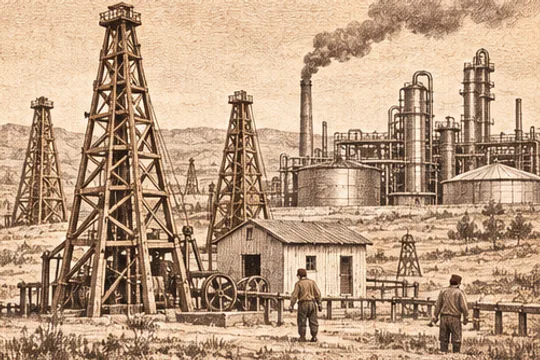
The Middle East’s present strategic importance comes from its comparative advantages in oil production. First, the region’s oil is the cheapest in the world to produce. It lies beneath flat deserts and does not have to be extracted from beneath an ocean or from difficult deposits such as those in the Amazon. In 2008, the cost of producing a barrel of oil in the Middle East and North Africa ranged from $6 to $28, compared with $39 elsewhere in the world. Second, Middle Eastern oil is known as “light sweet” crude and is easier to refine than, for example, Venezuela’s “heavy” crude. Third, the region’s giant oil producers benefit from economies of scale. Even today the Middle East holds more than half the world’s known oil reserves and accounts for one third of its production. The final advantage is that the states of the Middle East rest on a delicate international balance. Buyers and producing countries alike take for granted that the developed countries would never allow a serious disruption to oil production.
The first industrial demand for oil arose in 1886, when Karl Benz invented the internal combustion engine that ran on refined petroleum. In a short time, the transport of people and goods switched from steam, coal and animals to petroleum products. The Middle East’s comparative advantage in energy production and the world’s appetite for oil peaked in 1974. In response to the oil embargoes and supply cuts of 1974–79, Western countries mounted a successful energy conservation effort. Energy sources are now far more varied, with nuclear power and renewables such as wind, solar and bioenergy among the most prominent.
In 2010, oil’s share of US energy demand fell to its lowest level since 1951. The arrival of hybrid electric vehicles on the market suggests that demand for petroleum fuels will gradually decline, even though the transition is still in its infancy. The Middle East’s comparative advantage in oil production is waning. Some fields have been producing oil uninterrupted for 80 years and their reserves are being rapidly depleted. A substantial share of Saudi Arabia’s fields is showing signs of nearing the end of its productive life. Thirteen of the world’s twenty largest oil fields are in the Middle East. All of them produced oil between 1928 and 1968, and declining reserves make extraction increasingly difficult and costly. When oil prices soared in the 1970s, the rest of the world invested in production and energy conservation. The Middle East’s share of oil production fell below 19 percent, its lowest level since 1953. In the future, the Middle East will become a minor global player. According to figures from the International Atomic Energy Agency, the world has 7.9 trillion barrels of potentially recoverable oil, more than 90 percent of it outside the Middle East. Once resources outside the region are developed commercially, its output will be overshadowed by Canada, the United States and Venezuela. If that happens, the oil-producing states of the Middle East will become dispensable.
Since 1945, the United States has worked to ensure that no country gains sole control of Middle Eastern oil. It was for that reason that, throughout the Cold War, America supported the anti-communist monarchies and autocracies of Saudi Arabia, Kuwait and Bahrain. Since 1950 it has sold Saudi Arabia a total of $81.6 billion in arms. In the 1980s it backed Iraq against Iran. It then fought Iraq in 1990–91 to support Kuwait and Saudi Arabia. Following the attacks of 11 September 2001, it strengthened its position in the region by adding Kuwait, Bahrain and Morocco to the group of non-NATO allies that already included Egypt, Israel and Jordan. In 2003 it invaded Iraq.
The “oil wealth” of many oil-producing countries, Saudi Arabia foremost among them, will run out in the near future.
Where, then, will the wealthy Arabs of the Middle East who keep tigers and panthers find their daily bread? We will wait and see.
Translated from the Turkish original. Türkçe