
Saladin’s descendants addicted to necrophilia
8 October 2014 · Personal website
(Article 028 – 8 October 2014)
A city no one can agree on, called Kubanlı by the Turkmens, Kobani by the Kurds, Ayn al-Arab by the Arabs and now Ayn al-Islam by ISIS.
Kobani has been one of the biggest issues in Turkey for the past month.
It is a small Turkmen, Kurdish and Arab town on the Syrian side of the border, directly across from Suruç. When resistance to the Syrian regime first began, the PYD forces led by Salih Muslim kept out of the Free Syrian Army (FSA) formed by the Syrian opposition. They went further, working with Bashar al-Assad and fighting the FSA. In other words, Salih Muslim took the bait Assad threw him and brought about what is happening in Kobani today with his own hands. This hapless fellow, following the principle “Let it be small, as long as it’s mine”, got carried away with the idea of setting up a little autonomous principality of his own. When ISIS stepped up its attacks and took Kobani’s eastern neighbourhoods, he rushed to Turkey and pleaded for help: “I’ve made a mess of things. I’ll kiss your hands and feet.” By then it was too late. Months of fighting around Kobani drove some 200,000 refugees into Turkey, killed thousands and drove people from their homes. Responsibility for letting things go this far lies solely with Salih Muslim and the PYD. Had they stood alongside the Free Syrian Army and built up some momentum together in northern Syria, Assad’s regime might not even have survived this long. As it was, the FSA had to fight Assad on one side and the PYD on the other, squandering much of what they might have achieved together.
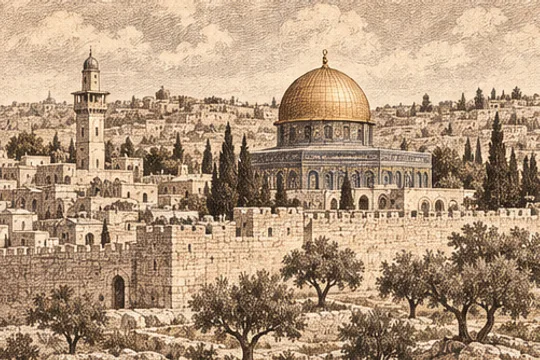
Let us put these events aside for a moment and talk about Saladin, the conqueror of Jerusalem. Saladin entered the service of the Zengids, who ruled Mosul and were subordinate to the Anatolian Seljuk state, became governor of Baalbek and took part in regional wars. He achieved his first major success in the Egyptian campaign of 1162. On 2 January 1169 he routed the Crusaders and forced them to withdraw from Egypt. On 23 March 1169 the Fatimid caliph al-Adid appointed him vizier of Egypt with the title al-Malik al-Nasir and also made him the Mosul atabegate’s emir of Syria. He banned Shiism in Egypt and declared the Shafi‘i school the official school of law. In 1172 he put an end to the symbolic presence of the Fatimid caliph, whose authority he did not recognise and with whom he could not agree, and ordered that Friday sermons be delivered in the name of the Abbasid caliph al-Mustadi. With the death of Nur al-Din Zengi, the state Saladin had founded became fully independent (13 April 1175). Saladin grew more powerful, extending his rule into Sudan, Syria, the Hejaz, Yemen and neighbouring lands, though he never used the title “sultan”. In October 1187 he captured Jerusalem after a month-long siege. He treated the Christian population with great tolerance and had religious sites repaired, foremost among them the Al-Aqsa Mosque. He retired to Damascus and died there. By his character and his policy of conciliation, Saladin earned respect both in Muslim countries and in the Christian countries he had fought for years. As a ruler sincerely devoted to Islam, he never compromised its precepts. He worked to establish Sunnism in place of the Shiism that the Fatimids had tried to instil in Egypt’s people. He had not been brought up as a warrior, but through his intelligence and faith he led his armies to important victories. In the consensus of historians, his gifts went beyond those of a great warrior. He was an incomparable statesman and negotiator.
It seems that none of the Kurdish intellectuals and politicians living in what is now Turkey and Syria got a share of Saladin’s political acumen. It is hard to believe that these people are descended from a commander as noble, just and great as Saladin. Ask anyone who understands what the HDP and PKK members demonstrating over Kobani are trying to achieve to take a step forward, and you are unlikely to see anyone move. In Istanbul, Ankara, Bursa and many other cities, particularly Diyarbakır and Hakkâri, people are protesting ISIS attacks on Kobani, throwing Molotov cocktails, setting municipal buses on fire and damaging shops and businesses. What are these demonstrations meant to achieve? Was it Turkey that created ISIS, put American, Russian and Chinese weapons in its hands, gave it logistical support, built it up and turned a blind eye to its slaughter?
What are politicians like these trying to achieve? There is the HDP’s Aysel Tuğluk, who threw a stone at a Turkish soldier carrying on his back people who had fled Kobani for their lives to take refuge in Turkey. There is Sırrı Süreyya Önder, who gave the Gezi protesters his unstinting support, Gülten Kışanak, who confronted a Turkish soldier with the words “your state”, and the CHP’s Mahmut Tanal, who tries to insert himself into practically every public disturbance. If Turkey refused entry to people fleeing Kobani, left them starving across the border, ignored them, stood by while ISIS killed them or handed these defenceless people over to ISIS, we might sympathise with these protests. But none of that has happened. Over the past four years Turkey has taken care of nearly two million refugees from Syria and met all their needs. Spending on refugees has now reached a sum many Western countries would struggle to cover. The whole world has sent Turkey just $150 million in aid, while Turkey’s own spending has reached $4 billion.
The most important question to ask the HDP and PKK members protesting the ISIS attacks on Kobani in Istanbul, Ankara, Diyarbakır and our other big cities is this: “Why, then, did you vote against the motion in the Grand National Assembly that authorised the government to conduct operations abroad?” The Kurdish people must accept that politicians this hypocritical cannot build their future. For days vandals have burned and wrecked parts of our cities, ignoring the aid the Republic of Turkey has given Syrian refugees without distinction of race, religion, language or sect, and showing how shameless they are. Meanwhile the HDP plays to the gallery and takes pleasure in escalating the clashes. There is only one aim: to derail the peace process. These politicians know that once the fighting among brothers in Turkey ends, they will have no role or sway. Kurdish politicians who have hidden behind PKK terror and profited from the deaths of young Kurds know all too well that the Peace and Brotherhood Project will end their political careers. These necrophiliacs, who stir up trouble at the funerals of Kurdish youngsters killed in the mountains and take pleasure in further deaths, have been so disturbed by peace and prosperity reaching the region that they saw Kobani as their salvation. Although Abdullah Öcalan has spoken constructively about holding fast to peace, a section of the PKK and HDP sadly has no desire at all for the process to continue. But this too shall pass. Everyone will be left with what they have done. The Kurdish people will eventually see the truth and stand with their state. As for the mainstream and parallel media and their hired pens, who have suddenly gone back into Gezi mode over the Kobani protests and recklessly egged the public on to revolt, there is nothing left to say. Ebubekir Efendi fell in love with the daughter of a Greek priest in Silistra, and when the priest asked him to become a Christian he replied, “Can a man who’s been Kâni for forty years suddenly become Yanni?” In much the same way, even if heaven and earth came together, these hired pens would never change.
Turkey has taken responsibility for the Syrian crisis to a degree no other country would. Turkey is the foremost among those who want it resolved as soon as possible. The problems of the Middle East cannot be solved with so-called Kurdish leaders like these, nor can any strategy be built with them. They think shallowly, try to get through the day and have made a habit of looking at the small picture. They pine for the feudal arrangements of two hundred years ago and try to set up tribal states of their own. They cannot get past their obsession with “Let it be small, as long as it’s mine” and embrace “Let it be big and belong to us all”. They make a principle of being puppets of Middle Eastern dictators like Bashar al-Assad and cannot tell friend from foe. These politicians bow and scrape to whoever comes or goes. Nothing they say carries weight or can be trusted.
During the Kobani protests curfews were declared in five provinces and twenty-five people lost their lives. No one can atone for that. Politicians such as Salih Muslim, Aysel Tuğluk, Gülten Kışanak, Sırrı Süreyya Önder and Mahmut Tanal, far from grieving for the young people killed, actually take pleasure in it. What kind of politician could rejoice in chaos, disorder, blood and tears, wish for their own people to die and hope to profit from the destruction of public and private property? When the self-styled fighters of the PYD, YPG and PKK saw how a savage terrorist organisation like ISIS executed its victims, they fled to Turkey as fast as their legs would carry them. ISIS’s deeds proved the saying that “even war has its own code of honour”. What would happen to these Nero-like PKK members, who think nothing of throwing stones at police and soldiers and damaging buildings and vehicles with Molotov cocktails, if they did the same thing in another country? Shouldn’t the real place for those demonstrating in Turkey on the pretext of Kobani be Syria, and Kobani in particular? If even one in ten of those involved in street demonstrations and causing disturbances almost daily went to fight in Kobani, ISIS would cease to exist.
Kobani is on the verge of falling. Turkish tanks are positioned in the border area. For the moment, however, both Prime Minister Davutoğlu and President Erdoğan are determined to stay out of Syria. The reason is that Bashar al-Assad has been left outside the scope of the fight against ISIS. Turkey does not want to join in unless a no-fly zone and a safe zone are declared and the Assad administration is included in the scope of the fight. Turkey is quite right to make these demands. They are sensible ways to ensure that once an area is cleared of the ISIS threat, Assad or another organisation he pushes onto the scene does not fill the vacuum. Everyone knows there can be no lasting peace in this part of the world until Assad and, more importantly, the Syrian Baath are gone.
Translated from the Turkish original. Türkçe