
Allenby, who kicked Saladin’s cenotaph, rise from your grave and see what has become of your country…
16 September 2014 · Tarafsız Haber
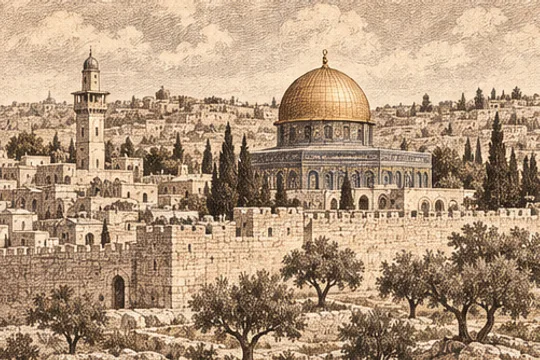
Jerusalem, 11 December 1917…
As the Ottoman state collapses, we leave Jerusalem on Sunday, 9 December 1917, after 401 years, three months and six days of rule. There is no way of holding it anyway. The army has broken and is retreating. On 11 December 1917 General Edmund Allenby, commander of the British armies, enters Jerusalem after defeating the Ottoman army. He kicks Saladin’s tomb and says, “Rise, Saladin. We’re back.” When he says “we’re back”, he is surely referring to the first coming of King Richard the Lionheart of England, who joined the Third Crusade in 1189 and failed.
Istanbul, 8 February 1919…
Immediately after the Armistice of Mudros, the Allied powers took de facto control of Istanbul on 13 November 1918 under the terms of the armistice. The second and harsher wave of occupation on 16 March 1920 was an outright show of intimidation. British soldiers raided the Şehzadebaşı military band barracks, bayoneted soldiers, occupied government offices and arrested several deputies of the Ottoman Chamber of Deputies, sending them into exile on Malta. The occupying officers and soldiers poured out centuries of pent-up hatred. The conduct of the French general Franchet d’Espèrey in particular deeply wounded Istanbul’s Muslim inhabitants. Yet the Ottoman state had always protected the French and for years considered them old friends. France had shown its true face when Napoleon occupied Egypt, as Ottoman power waned at the beginning of the nineteenth century. General d’Espèrey made a showy entrance into Istanbul on 8 February 1919. He arranged a victory parade from the Galata quay to Beyoğlu. He rode a “white” horse without reins, led by two Black men holding it by the head. He moved along with his procession, greeting those around him like an emperor of ancient Rome. He rode a white horse like Mehmed the Conqueror in allusion to Istanbul’s conquest, as if to say, “The Romans are back.” He said he wanted to reside in Dolmabahçe Palace and told the sultan to leave it, then went on his way. Amid cheers from Istanbul’s non-Muslim inhabitants, he proceeded to the French embassy in Beyoğlu.
Bursa, July 1920…
Greek soldiers have entered Bursa. At their head is Sophoklis Venizelos, a reserve officer and the son of Venizelos. In the Ottomans’ first capital, it is as if history has turned back six hundred years. It is a day in Ramadan, and the calls to prayer seem to sob over the captive city. The photographer from Athens, whom Sophoklis has been awaiting for days, has finally arrived. With the photographer and a squad of soldiers, Sophoklis heads for the tomb of Osman Gazi, founder of the Ottoman state. They find the door locked. Venizelos’s soldiers charge the door as if storming a fortress tower. They break down the wooden door and enter. Unsure what to do, they point their rifles with fixed bayonets at the entrance, as if someone might appear at any moment. Osman Gazi’s cenotaph, with the turban at its head, looks so dignified and imposing that they cannot help but recoil. Under their astonished gaze Sophoklis approaches the cenotaph. Raising his spurred boots, he kicks it three times in succession. The photographer, wearing a stiff grin, wonders what to do. The mysterious silence of the tomb’s unearthly air seems to have taken hold of their heartbeats. Sophoklis draws his sword and swings it as if lunging at an imaginary enemy, shouting: “Great Osman! We’ve destroyed the state you founded. I’ve come to kill you.” After wandering around the tomb for a while swinging his sword, he strikes the pose of a victorious commander. He rests one foot on the cenotaph, leans on his sword and tells the photographer, “Go on, take a souvenir of Bursa…” Sophoklis sends the photograph of his Don Quixote pose to Athens, with these lines on the back: “Our armies are in control of Bursa. Osman, the founder of the Ottoman state, is beneath my feet. I have avenged Byzantium.”
Three incidents, one in Jerusalem, one in Istanbul and one in Bursa. There is no difference among the three. They all left deep wounds in our souls, and none has been forgotten. Lands lost in succession, shrinking borders, betrayals, disappointments, losses of life and property, and so much more. We lost millions of square kilometres of land one after another. As we withdrew from Europe, Asia and Africa, we left millions of our people behind. And what a parting it was. Every vein in our body was torn out, strand by strand. Even after ninety years, Albania, Greece, Bulgaria, Romania, Hungary, Crimea, Georgia, Egypt, Sudan, Tunisia, Libya, Algeria, Yemen, Mecca, Medina, Aleppo, Palestine, Jerusalem, Beirut, Damascus, Basra, Mosul and Kirkuk are still our homeland. Who knows? Those lands of our homeland, now on loan to others, may return to their rightful owner tomorrow or even sooner. We shall wait and see.
A recent speech by Prime Minister Ahmet Davutoğlu escaped most people’s notice. He said that “in 2023 the Republic of Turkey will be a WORLD POWER”. If a Turkish prime minister had spoken like this fifteen or twenty years ago, there would have been an uproar in Europe about “the Turks dreaming of an empire”. Yet today no one so much as reacts. Indifference has nothing to do with it. They too have begun to accept that it will happen.
Meanwhile, some very interesting things are happening in the West. A new Europe is being born. The pot is boiling ever harder in Belgium, Spain, Italy and Britain. These countries are marching steadily towards disintegration. Calls for secession are gathering force in countries we least expected, and countries famed as “the cradle of democracy” are at a loss as to what to do. Europe’s longest-standing demand for secession is surely that of the Catalans in Spain. On 11 September 1714 Bourbon armies entered Catalonia and took Barcelona. That is why each year on that date, at 17:14, thousands of Catalans fill the streets, sing their national anthem and wave Catalan flags to make their voices heard. One way or another, Catalonia could break away from Spain at any moment. The Basque region will follow, and then other autonomous regions.
Belgium is a federation of three regions: Wallonia, Flanders and Brussels. In the early general election of 13 June 2010, a party advocating a split topped the polls for the first time after a surge in support. The Flemish Alliance took 28 per cent of the vote in wealthy Flanders, home to 60 per cent of the population, finishing ten points ahead of its nearest rival, the Christian Democrats. In French-speaking Wallonia, home to roughly 40 per cent of the population, the Socialists (PS) took 38 per cent. Elio Di Rupo, leader of the Walloon Socialists, was tasked with forming a government after the election. Unable to make headway because the regional governments wanted greater autonomy, he tendered his resignation in September. The country went without a government for about six months. The Belgian king then pressed the Flemish and Walloon parties to compromise and tasked the Flemish Alliance leader, De Wever, with forming a government. The Walloon parties rejected De Wever’s compromise document on the grounds that it laid the groundwork for Belgium’s breakup. Belgium’s structure leaves it dependent on coalition governments, and the growing demands for secession have raised more questions about its future. The Flemish and Walloons differ in language, economics and politics. In the early twentieth century, Wallonia industrialised while Flanders remained agricultural, giving the Walloons the political upper hand as well. The Flemish increasingly found themselves marginalised in their own country. French was required to take part in government, and those who spoke only Flemish were treated as second-class citizens. In the past fifty years, however, Flanders’ economy has grown thanks to coal and steel while Wallonia has gone into sharp decline. Economic and political dominance shifted to the Flemish. The country stands ready to break apart at any moment.
Scotland, however, provided the real surprise. Scotland will hold an independence referendum on 18 September 2014. The people will either vote to continue a 307-year union or say “enough” and establish their own state. British Prime Minister David Cameron visited Scotland before the referendum and made an emotional appeal to Scots to preserve the three-century-old union. Cameron called Great Britain a precious and very special country, and said that Scotland, England, Wales and Northern Ireland together had a system that met all their needs. He also warned that if the union were dissolved in a popular vote it would be gone for good. Queen Elizabeth II is keeping quiet for now, and there is not much she can do anyway. What people are really debating is the role Scotland would play in international affairs if it separated from England. For instance, would Scotland, now in the European Union and NATO alongside England, remain a member after independence? The Scots have no wish to leave either organisation.
The Scottish referendum matters not only to Scots but to Wales and Northern Ireland, which make up Great Britain alongside them. Even if Wales is not in that camp, Northern Ireland, which has fought for independence for nearly a century, will surely follow Scotland. While serving as the Special Organisation’s chief for the Arabian Peninsula, Kuşçubaşı Eşref commanded advance units in the Suez Canal campaign in 1916. As a Special Organisation unit was fighting at Khaybar, Eşref was wounded and captured. He is said to have told Lawrence after his capture: “Lawrence, you think you have won. But nothing is over yet. We’ll cause such trouble for your government that you won’t be able to put an end to it even if you try for two centuries.” Kuşçubaşı’s words are taken as evidence that the Special Organisation organised and supported the IRA, the Irish Republican Army. Just one century has passed, not two, and now the bells of secession are tolling for the last remnants of the empire on which the sun never set.
Yes, now it is our turn to strike the cenotaph. Let the kings and queens of England and reptiles like Cromwell, Lawrence of Arabia and Lloyd George rise from their graves and see what has become of the mighty British Empire.
The effects of Scotland’s independence referendum will reach beyond Great Britain. First to follow will be the Catalans and Basques in Spain, the Flemish and Walloons in Belgium and South Tyrol in Italy. After that, many ethnic groups across Europe will demand referendums of their own.
Hard times await the Western countries that broke up the Ottoman state in the twentieth century and drew a host of new states with compass and set square. May God keep their troubles coming, I say…
Translated from the Turkish original. Türkçe