
Now it’s Hagia Sophia’s turn, and time to make Istanbul the capital…
10 July 2018 · Personal website
(Article 238 — 10 July 2018)
In 2015 the Hürriyet columnist Ertuğrul Özkök wrote a piece objecting to the recitation of the Qur’an in Hagia Sophia. He wrote, “For God’s sake, is this becoming of a modern Muslim living in the twenty-first century? There are 80,000 mosques in your country. You can pray five times a day in all 80,000. Yet you have set your sights on one of the holiest places in the Orthodox world. Easter, the holiest day for Orthodox Christians, coincides this year with the week marking the Prophet’s birth. What do you do instead of using the occasion to send a message of mutual respect and tolerance with a gracious gesture? With a kind of Eastern cunning that makes your heart sink, you put on an exhibition in Hagia Sophia the day before Easter and have the Qur’an recited there for the first time in eighty-five years. You imagine you are sending someone a message.”
Who is troubled by the call to prayer, the recitation of the Qur’an or a prayer? The only people who could take offence are followers of another religion, people who believe in neither religion nor God, infidels, godless men, scoundrels, people of bad blood and charlatans who betray their country.
I have said this repeatedly and will say it again. In the Republic of Turkey, let us please bury the dead according to their beliefs. If people are atheists, unbelievers, godless men with no scripture, scoundrels, traitors or whatever other scourge you care to name, their bodies should not even be brought into a mosque courtyard.
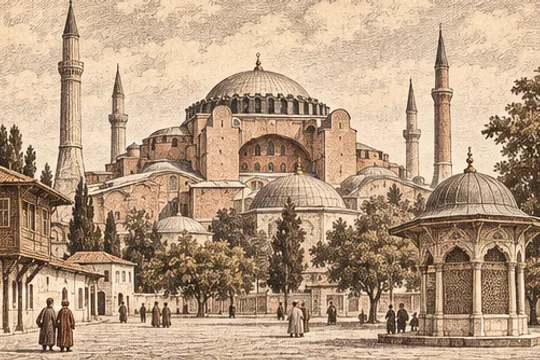
The Hagia Sophia Mosque was the Turks’ most important source of prestige and standing in the Islamic world and a symbol of their supremacy over the West. Built as the imperial church in this exceptional capital of the Eastern Roman Empire, it stood in rivalry with the Vatican’s St Peter’s and was the prize of which would-be conquerors of the city dreamed for centuries.
The Prophet Muhammad, peace and blessings be upon him, said, “Constantinople will surely be conquered. What a fine commander its conqueror will be, and what fine soldiers his soldiers will be!” In fact, the subject of the hadith was Hagia Sophia itself, not Constantinople. Constantinople is a city of magnificent beauty where Europe and Asia meet. Yet there is only one building that makes it Constantinople. Take it away and there is nothing left of Istanbul. For centuries Hagia Sophia, with all its beauty and splendour, was the place where millions of Orthodox Christians bowed before God. To the Prophet Muhammad and to those who made it their mission to spread Islam throughout the world as it was then known, Hagia Sophia was their “Red Apple,” the prize they sought. If it fell, Christianity’s greatest stronghold in the East would fall with it, and Islam would have a chance to spread into the heart of Europe. Is that not exactly what happened when Mehmed the Conqueror took Constantinople?
Hagia Sophia mattered greatly to Muslims and to the Catholic world alike. Catholic control of the city and of Hagia Sophia would have made the Vatican Church the world’s greatest centre of faith. Today the Vatican presumes to judge Turkey over the Armenian genocide. Yet in the Fourth Crusade, from 1202 to 1204, its knights, who knew no bounds to their brutality, did more harm to this city than anyone else. Pope Innocent III called all Europe to join a campaign to recover Jerusalem, and command of the assembled army went to Boniface of Italy. The Latin armies turned toward Istanbul instead of Jerusalem and occupied Constantinople. The city suffered the greatest devastation in its history. The crusaders began by looting homes. The chronicler Geoffrey of Villehardouin, one of the early French lyric poets, witnessed the plunder and wrote, “The soldiers forgot the meaning of the cross stitched onto their clothes and set about butchery and arson. Houses were set ablaze, palaces and public buildings were stripped bare. Men were killed, women raped, and even the least valuable things were looted, down to the peasants’ shirts.”
Once the buildings had been stripped bare, it was the turn of Hagia Sophia, the greatest place of worship of the age. It was not merely plundered; it was the scene of utter disgrace. The soldiers entered the church with mules and a French prostitute. The looting took only a few minutes. They loaded the mules with wall coverings, objects believed to have belonged to Jesus’s apostles or to Mary, one of the holy nails said to have been used to crucify Jesus, the crown of thorns, gold and silver crosses and whatever was made of precious metal. Priests who had hidden in the church were disembowelled and nuns were raped. Catholic soldiers who were too late for the plunder began breaking pieces off the columns, said to have healing properties and to relieve kidney and chest pain. When the mules collapsed under their loads and could not move, they were cut to pieces with swords. Once everything in the church had been carried away, it was time to make merry. The French prostitute the soldiers had brought with them climbed into the pulpit from which the Orthodox patriarch had preached only days earlier, and began singing bawdy songs and dancing lewdly. The soldiers meanwhile were busy drinking barrels of wine.
The Eastern Romans never forgot the disaster of 1204. That brutality was the reason that as the Turks advanced in later centuries, instead of seeking help from the Catholic world they said, “We would rather see a Muslim turban in Hagia Sophia than a cardinal’s hat.” The Latin Empire ruled Istanbul from 1204 to 1261. In 1261 Michael VIII Palaiologos retook Constantinople, brought the Latin state to an end and restored the Eastern Roman Empire.
The rest is well known. Mehmed the Conqueror took the city in 1453, turned Hagia Sophia into a mosque and personally declared that the lives, property and freedom of worship of Istanbul’s Orthodox population were under his protection. Orthodox Christians lived in peace and prosperity for centuries after the conquest.
Now to the tenth crusade, which does not appear on the list of crusades but ended in a resounding Christian victory. It was waged against the Ottoman Empire from 1914 to 1918, exactly 643 years after the last crusade. Britain, France, Italy, Russia, Greece and a number of other states took part. The aim was to sweep the Muslim Turks off European soil altogether.
And they succeeded.
The Turks were driven from all European territory except Thrace. Jerusalem fell to the British. The dream of Richard the Lionheart came true six and a half centuries later. The Turks lost all their lands in the Middle East and were confined to a tiny territory.
The West’s second objective is to remove all Muslim Arabs from Jerusalem and restore the Holy Kingdom of Jerusalem.
The Vatican has stood behind every crusade from the first one in 1094 to the present. It is in no hurry. It waited patiently for 781 years to expel the Muslims from al-Andalus and has waited a thousand years to take Jerusalem.
The pope is Jesus’s shadow and plenipotentiary on earth, his caliph, in other words. It is that office that plans all these long-term projects. Remember the Islamic caliphate whose legal existence our Republican intellectuals swept away at a stroke with Law No. 243 on 3 March 1924? The papacy is its counterpart in the Christian world.
Secularism, defined as keeping religious and state affairs apart, also originated at the Vatican. The republican leadership could not imagine what the Caliphate might bring Türkiye in the future, but the Western world, led by Britain, foresaw that the Islamic Caliphate would give Türkiye an important role.
In 1924, İsmet İnönü, Şükrü Bey and Mahmut Esat Bozkurt met at Ankara’s railway station to work on the Constitution. They went further still, going so far as to say, “Let us put Christianity in the Constitution as the state religion so that Westerners will not be our enemies.” Were they alone? There was also Abdullah Cevdet, who argued that “civilization had come right to our doorstep during the Battle of Çanakkale, but the Turks resisted it.” The founder of the Society of Friends of England, whom some called “Adüvvullah Cevdet,” meaning “Cevdet, enemy of God,” even said, “We need to bring in breeding men from Europe and America to improve and strengthen the Turkish race.”
What difference is there, then, between what Ertuğrul Özkök said and what İsmet İnönü, Şükrü Bey, Mahmut Esat Bozkurt and Abdullah Cevdet, the enemy of God, said? The same mentality ninety years ago and the same mentality today.
With no caliphate, there is today no institution to mediate disputes between Muslim countries or communities, take a position, reconcile them or stand firm when necessary.
The Arab world today is ablaze. Iraq, Syria, Egypt, Saudi Arabia, Yemen, Libya, Sudan and the rest are busy tearing at one another. There are hardly two Muslim countries in close friendship. Each has a quarrel with the others, and each sees the others as enemies.
This is precisely when a Turkish Islamic caliphate is needed. The office of caliph has enormous power to end conflicts, secure regional peace, lead the world’s Muslims, restore Islam’s standing and begin and sustain dialogue between civilizations. The Islamic caliph who takes office at Hagia Sophia, donning the robe and bearing the sword of the caliphate, will command an extraordinary degree of authority among Muslims. Sectarian disputes and regional conflicts will then come to an end. The person stepping in to resolve these problems will, after all, be the shadow of the Prophet on earth. In the face of that authority, no one will be able to stir or act on their own. Re-establishing the caliphate is one of the basic conditions for a strong Turkey in its region. Otherwise, the region will remain in turmoil for years, millions will continue to die, people will lose their homes, lands and countries, and the region will decline step by step.
Turkey signed the Treaty of Lausanne on 24 July 1923, but Britain did not sign it for a year. That was because the Grand National Assembly had not abolished the caliphate. Britain signed only on 16 July 1924, four months after the Assembly abolished the office on 3 March 1924. The Republican leadership, with no vision or grasp of the future, thus abolished the caliphate after it had been in Turkish hands for 407 years. The Turks were cut off entirely from the Muslim world and the Middle East. The office remained vacant from then on, though in Moro and Aceh the sermon is still delivered in the name of the Ottoman caliph today.
In an article in issue 29 of Büyük Doğu, the late Necip Fazıl Kısakürek wrote that “during the Lausanne negotiations the Western and Turkish delegations held talks and reached agreements kept secret from the public. They agreed that Türkiye’s Islamic identity would be erased, its people turned away from Islam and its government given a secular form outside Islamic rules. In return for these concessions, the European powers recognised Türkiye’s independence.”
Founded in Söğüt in 1299 and soon spread over three continents, the Turkish Empire disintegrated in a very short time. Until 1908 its lands covered millions of square kilometres. Abdülhamid II’s deposition in a coup in 1909 and the Unionists’ rise to power brought that great state down in just six years. They took it into the Balkan Wars in 1912 and the First World War in 1914. By the end of those four years they had managed to confine us within the lands we live in today. These men of Union and Progress founded and governed the Republic we have today. What happened next? First, on 24 July 1923, Lausanne was signed, and Ottoman lands were parcelled out as though by a spendthrift heir. Millions of square kilometres of Ottoman territory were handed out indiscriminately at Lausanne, and no fewer than sixty-four states came out of lands that had been ours.
On 13 October 1923, just three months after Lausanne was signed, one of the most shameful episodes in Turkish history took place. Istanbul, the city mentioned in the Prophet’s hadith, was stripped of its status as capital, and Ankara was designated capital of the new Turkish state.
Then in 1924 the caliphate was abolished and a blow was dealt to the central institution of Islam. In 1935 Hagia Sophia Mosque was turned into a museum by a fraudulent decree. One by one, the traces of Turkish identity were erased from Istanbul. In the end we went back to the day before Mehmed the Conqueror took Istanbul. On 28 May 1453 Istanbul was not the Turkish capital, Hagia Sophia was a church and there was no such office as the caliphate.
What happened in the years that followed?
As the Turks were gradually led away from Islam, acts of incredible destruction of history served that purpose. In the single-party era most of Istanbul’s mosques and prayer halls were advertised for sale in newspapers, sold, torn down and replaced with other things. Some became taverns, some nightclubs and others stables. In the capital of Ottoman sultans who called themselves protectors of Mecca and Medina, the sacred buildings of Islam disappeared one by one. Who perpetrated all this disgrace? The traitors among us and those besotted with the West. We have a dark past in which opening nightclubs, bars and gambling houses and frequenting those places was considered a mark of modernity.
On 9 July 2018 the Republic of Turkey entered a new phase.
This state, the heir to the Ottoman Empire, has after almost a hundred years thrown off the monstrosity of a “democratic parliamentary system” invented by the British, which brought these lands nothing but chaos, crisis and instability. It has returned to its original form.
Recep Tayyip Erdoğan, president of the Republic of Turkey, has taken the reins of the state like a Göktürk khagan, a Seljuk sultan or an Ottoman sovereign.
As the saying goes, the brave rise where they fell. We must reconnect this ancient state with its roots.
What are those roots?
Our first priority should be to make Istanbul the capital again. It was there on 29 May 1453 that Mehmed the Conqueror won the city by his sword and consigned the Eastern Roman Empire to the pages of history.
The second step is to turn Hagia Sophia, the symbol of the conquest, back into a mosque and open it for worship.
The third and most important step is to restore the caliphate, which will bring peace to the Islamic world. Christianity’s equivalent is the Vatican, whose existence no one questions today. Abolishing the Islamic caliphate removed Islam’s central institution and left it without leadership or oversight. Abolition directly serves the interests of many Western countries, with the Vatican foremost among them.
Taking account of their influence in India and their other Muslim colonies, the British adopted the abolition of the Ottoman Islamic caliphate as state policy. Today we can see plainly the impasse that its abolition created throughout the Muslim world, particularly in the Middle East.
Those who accuse Iran of “exporting an Islamic revolution” say nothing about the Vatican’s missionary work to spread Christianity.
Do you know what would happen if someone today wanted to end the Vatican’s religious status? Even Protestant Britain would be among the first to object. It knows very well that the collapse of the Catholic Church would make hundreds of new denominations spring up and alter the balance of power in Europe and the world in the medium and long term. It would act accordingly.
The Republican leadership failed to understand the importance of the caliphate or the harm its absence would cause in later years.
Abolition left the Muslim world without a head. The Arab states founded in the Middle East with the backing of Britain and Mustafa Kemal were cut off from one another. This lack of leadership deepened sectarian divisions and made enemies of different religious groups.
The caliphate is the most important institution of Muslims the world over. It would strengthen the New Republic of Turkey and raise its prestige across the world. The new Turkish Islamic caliph would be as symbolic as the British queen in England or the pope in the Vatican. Yet no one should underestimate the political and regional power the office would give Turkey. Through the caliphate, Turkey would become the symbolic leader of a Muslim world thirsting for rights and justice. Its influence and strength would grow in the United Nations and other international organizations. Bodies with no standing in the world, such as the Islamic Development Organization or the Islamic Conference, would be reshaped under Turkish leadership.
Can you imagine a New Turkey that holds the caliphate and has brought Mosul, Kirkuk, Damascus and Aleppo back under its authority?
Do you know what would happen if Istanbul were made the capital and Hagia Sophia Mosque opened for worship on another anniversary of the conquest?
That day the sky would weep. Our Prophet and 116 Muslim caliphs would stand in the first row. Sultan Mehmed the Conqueror, who gave this sacred city to Islam and the Turks, and all the other Ottoman sultans would prostrate themselves a thousand times, in tears and ecstasy.
On that day the earth would shake. Every soldier who fell for Islam in Aleppo, Egypt, Damascus, Jerusalem, Diyarbakır, Crimea, Tbilisi, Sarajevo, Athens, al-Andalus and all the other lands where Islam set foot would stand in ranks in Hagia Sophia in a white shroud.
That day Muslims around the world would give thanks to God. From Sultanahmet to Topkapı, there would be no room in Istanbul’s streets for one more prayer rug.
That day the abject provisions of Lausanne that wounded Turkish honour would be swept away one by one, and a fully independent “New Turkish Empire” would be founded.
Has the time not come to open Hagia Sophia and make Istanbul the capital?
God willing, we shall see those days too…
You may say that CHP members and rabid leftists might object. But if they have even a shred of affection and respect for Mustafa Kemal, they ought to be the strongest supporters of this change.
Why?
The reason is written in the deed of endowment of Hagia Sophia.
When Mehmed the Conqueror made the noble Hagia Sophia Mosque a waqf, he had a deed drawn up and a curse written into it.
“Whoever, on the strength of distorted interpretations or false pretexts amounting to no more than superstition and hearsay, changes any term of this waqf or alters any of its laws or rules, strives to alter or annul it, or seeks to abolish it or divert it from its purpose and aim, commits a grave wrong. So does whoever seeks to replace one of its principal charitable institutions with another or to challenge any part of the waqf, or assists or gives guidance in such changes or objections. The same applies to anyone who sets out to dispose of the waqf contrary to the sacred law, for instance by issuing a decree, patent, scroll or written order contrary to the law and the deed, or by demanding a fee for the right of trusteeship, a fee for the right of transfer or anything similar. In short, whoever carries out any such invalid act, or enters it in written records and registers that are entirely invalid and folds these unjust transactions into accounts that are a tissue of lies, has openly committed a grave forbidden act and incurred sin. May the curse of God, the angels and all people be upon them. May they remain in Hell forever, may their torment never be lightened, and may they never receive mercy. Whoever changes these terms after hearing and seeing them, the burden and sin shall be upon those who change them. Surely God hears and knows all things.”
My appeal to the soldiers of Mustafa Kemal who call themselves CHP supporters is this: save from their suffering the people who will be tormented in Hell for changing the status of Hagia Sophia in breach of the deed.
Then again, can we expect such consideration from people so witless that they have no qualms about working with the HDP, PKK and Gülen organization and resorting to every kind of betrayal to bring down Erdoğan?
That is another question…
Dr Mehmet Hakan Sağlam
Translated from the Turkish original. Türkçe