
Loan-shark banks, phoney economists and small-minded intellectuals…
20 November 2016 · Personal website
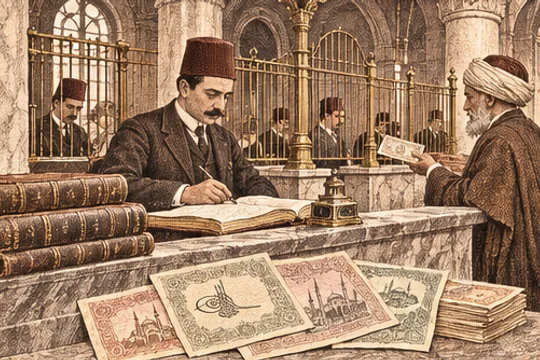
(Article 113 – 20 November 2016)
Whenever the president makes a statement about the economy, certain circles that see it as their duty to criticize Erdoğan immediately perk up and go on the attack. Some two-bit “economists” who have never bought or sold so much as a lemon and fancy themselves Turkey’s Keynes or Marshall start spouting nonsense in every direction, armed with the economics they don’t know. I say “spouting nonsense” because there is nothing else to call what they say. Unfortunately, we are dealing with unscrupulous politics, an unscrupulous press, and a crowd of so-called intellectuals who lack both stature and integrity.
These self-proclaimed great economists talk about monetary expansion and contraction in Europe and America. They imagine that tinkering with interest rates will bring the economy into some sort of balance and argue that European economies will recover as the euro loses value. They are stuck on the international trade model developed by Eli Heckscher and Bertil Ohlin. You know that “stupid theorem” invoked after 1980 in many countries, Turkey included, which holds that letting the national currency lose value against foreign currencies boosts exports, but works only in countries rich in raw materials? That is the one.
That was the theory behind the move from 70 to 1.35 million Turkish lira to the US dollar between 1980 and 2002, when Turkey’s exports rose from $3.5 billion to $35 billion. In other words, the lira lost ground against the dollar by a factor of 20,000, while Turkey’s exports grew only tenfold. Between 2002 and 2014, however, under an export model based on increasing production, the dollar went from 1.35 to 2.50 lira, and our exports readily rose from $35 billion to $160 billion. In other words, the lira depreciated against the US dollar by just 85 percent, while our exports grew by roughly 400 percent.
The Heckscher–Ohlin model is a mere “fairy tale” for countries that depend on imported raw materials. Only a fool would say that a weaker euro against the US dollar will boost eurozone exports. European economies must import even the natural gas that keeps their factories running, let alone the raw materials those factories use. If you can name another manufacturing country in the entire European Union besides Germany, Britain, and France, please let me know. How could those economies increase exports the way the Heckscher–Ohlin model describes, especially with China exporting practically everything under the sun to Europe and the rest of the world?
About a year ago I visited my dear friend Ahmet Kökler at the Grand Bazaar. Another guest came into his office and asked him what would become of the country and the government. Ahmet asked him, “Do you pay all the taxes you owe?” When the man said no, Ahmet replied, “Then there is no discussing affairs of state with you.” He immediately followed up with a second question: “Do you distribute your zakat in full?” The guest again said no. “Then there is no discussing matters of religion with you either,” Ahmet said, and closed the subject on the spot.
Turkey is unfortunately full of contradictions. There are tens if not hundreds of thousands of economists, but not one who can come up with a theory. Economics students take a course in the history of economic thought in their first year. It gives an overview of practically every theory and practice, from mercantilism to monetarism. Each school of thought, however, gets two or three pages, four at most. Everyone knows the Keynesian view that the state must intervene to get a stalled economy moving again or lift it out of stagnation and recession, but nobody knows the details of Roosevelt’s remarkable New Deal programs. In short, we are surrounded by “economists” who know nothing.
Just before US economic figures are released, people crowd onto television to chatter about what will happen if Yellen raises interest rates and what will happen if she lowers them. If they know so much, shouldn’t they be devising an economic model suited to Turkey instead of holding up Western economic policies and shooting their mouths off?
I maintain that if you put all the economists of the Republic together and multiplied them by 100, they would not be worth the fingernail of Mehmet Cavit, one of the last Ottoman ministers of finance. People who think that putting “Professor” before their name makes them Keynes or Friedman, yet know nothing of economics, should ask themselves why not a single Turk figures in the history of world economics.
Had the Ottoman Empire’s financial authorities been made up of such idiots, a state that lasted 623 years would probably have vanished in six. When the Ottoman state was founded, there was neither mercantilism nor liberalism. Keynes and Friedman had yet to be born. So what distinguished Ottoman economic policy? Aren’t you curious? For those who are, one short sentence explains it all: “Sustain the people so the state may endure.”
The social, political, legal, and economic life of the Ottoman Empire was built on this principle. “Sustain the people so the state may endure” was the guiding point of reference for every official in the Ottoman administration.
The sultan says, “Let us make a decision we will not have to reverse.” The qadi says, “Let us impose a sentence that can be carried out.” The finance official says, “Let us set a tax that people can pay.” The founder of a charitable endowment says, “Let me establish an endowment that will serve people for centuries and stand in perpetuity.”
You will find no practice in Ottoman public life that fails to take people into account. People were “entrusted by God” to those who governed. People were also at the center of the provisionist economic policy the Ottomans practiced for around four centuries. Under that policy, all goods and services produced in the country were made available first for the use and welfare of its people. If the country produced two million tonnes of cotton and the guilds and the population together needed two million tonnes, none of that year’s cotton could be exported. If demand was one and a half million tonnes, however, the excess 500,000 tonnes could be exported. The Ottomans scrupulously applied this policy to almost every kind of good for centuries. Their officials knew very well that doing otherwise would bring domestic shortages and scarcity, and that those in turn would push up the general price level.
Provisionist economic policy kept Ottoman inflation low, allowed the general price level to rise moderately, and kept living standards stable for about 450 years. Until when? Until the signing of the Treaty of Balta Limanı, when the Ottoman economy began to become closely intertwined with Western economies. That is how cumulative inflation in the Ottoman economy came to 300 percent over four and a half to five centuries, compared with 100 million percent in the Republic’s 90 years.
The “high interest rates” that President Erdoğan raises at almost every opportunity are a problem shared by businesspeople, manufacturers, and everyone in Turkey who carries a credit card. Investing and spending with borrowing rates reaching 12 to 13 percent takes real nerve. Some say the central bank’s interest-rate policy is sound and that lowering rates would drive foreign capital out of Turkey. In their view, a cut would help the economy initially, but once capital began to leave, the fall in the volume of credit would push rates back up. Isn’t that precisely the monetarist argument? According to monetarists, interest rates are determined by the supply and demand for credit, rather than the supply and demand for money. Increasing the money supply thus cannot lower interest rates and spur investment. Extra money put into circulation for that purpose might boost production without affecting prices in the short run. In the long run, it produces only inflation, without raising output.
Seen from that angle, the argument seems persuasive and the central bank’s policy sound. Others look at it purely in political terms and take it upon themselves to defend and shield the central bank out of hostility to Erdoğan.
Yet high interest rates in themselves are only part of what the government and the president have been protesting. As a result of the central bank’s high-rate policy, Turkey currently pays some of the highest interest rates in the world on domestic government debt securities.
According to Treasury figures, each one-percentage-point increase in interest rates costs the Turkish Treasury an additional 6 billion lira a year, or about $2 billion. Just before the Gezi protests, rates had fallen to an unprecedented low of 4.61 percent in the history of the Republic of Turkey. The protests abruptly reversed the favorable mood in the country. As political risk increased, rates began rising rapidly, first to around 8 percent, and then to around 12 percent with what I call the judicial and police coup of 17 and 25 December 2013. Taking only outstanding domestic public debt into account, this increase of roughly 7.5 percentage points cost the Turkish Treasury an additional 49 billion lira in a year and a half, equivalent to about $23 billion.
So what does that $23 billion mean?
Think what could have been done with the money paid out of the state treasury because of the central bank’s high-interest-rate policy. The presidential complex that opposition leaders and the FETÖ organization keep bringing up, for instance, cost a total of 1.35 billion lira. We could have built a copy of that palace in each of 39 other provinces in Turkey. We could have built 11 more Yavuz Sultan Selim bridges, at 4.5 billion lira apiece. At 7.2 billion lira for the Ankara–Istanbul high-speed railway, we could have built seven more lines like it. The Marmaray project, Turkey’s pride and joy, which links Asia and Europe beneath the sea, cost only 8 billion lira. With the money that went into rentiers’ pockets, we could have built six more Marmarays beneath the Bosphorus.
I don’t want to get too caught up in this, but I would remind the economists who collect salaries in the tens of thousands of dollars and hold forth on the Turkish economy while guzzling whisky and rakı over fish on the Bosphorus of a proverb: “Speak if you know, so they take you for a scholar. Keep quiet if you don’t, so they take you for a man of substance.”
It is plain to see where those famous Turkish economists have ended up today after their relentless attacks on then-prime minister Erdoğan for refusing to renew the stand-by agreement with the IMF.
Officials of TÜSİAD, the 600-member association accustomed to bringing down governments in the old Turkey with their public statements, issued a statement yesterday: “We are worried about 2017!”
They are worried about the sudden rise in the dollar and the exchange-rate risks it brought with it. TÜSİAD officials seem quick to worry whenever their own interests are touched. Nearly every member of this elite owns a bank or a financial institution and practices what can fairly be called usury more than banking. The sudden swing in exchange rates has sent their foreign debt soaring. Those who failed to anticipate Trump’s election and positioned themselves for Clinton are now jumping around like monkeys with smelling salts up their backsides. There is nothing to be done. Trade is half profit and half risk. They can set the losses against what they have earned so far.
Now to Turkey itself. In the medium and long term, we can bring the exchange rate down so that it cannot rear its head again.
So how do we do it?
Let me explain briefly.
Turkey must find a way to put the emphasis on production and exports based on branding, advanced technology, and software.
There are tens of thousands of exporting companies in Turkey, yet our exports are stuck at $160 billion and simply cannot seem to grow. This stems from our conventional approach to production and exports. We are like a car doing 70 kilometers an hour in the right-hand lane of a motorway. We need to switch lanes and change course.
Here are a few foreign companies we have all heard of, together with their annual sales:
Walmart (US): $482 billion
Volkswagen (Germany): $237 billion
Apple (US): $234 billion
BP (Britain): $233 billion
Samsung (South Korea): $177 billion
General Motors (US): $152 billion
Just two examples, Apple and Samsung, are enough to show that Turkey needs to rethink and redraw its industrialization and export policies from the ground up.
With close to 65,000 exporters, all we manage to export is $160 billion, while the US company Apple alone posts $234 billion in sales, nearly one and a half times Turkey’s figure.
Turkey needs young, fresh, quick minds who can develop innovative projects and know the ins and outs of domestic and international trade.
I can tell you what will happen without them: the president’s target of $500 billion in exports will remain a dream, and we will go on beating water in a mortar.
Translated from the Turkish original. Türkçe