
Tolstoy’s Pahom and my father…
18 June 2017 · Personal website
(Article 174 — 18 June 2017)
Today is Father’s Day.
For the first time in my life I’m celebrating it without my father. Or, to be more honest, I can’t celebrate it.
I turned on the television. In the very first news report I saw small children clinging to their fathers’ graves and weeping, in a sea of graves turned red by the Turkish flags planted on them. I saw little children left fatherless at the very start of life, women left widowed, mothers and fathers left without their children, and grandfathers and grandmothers who had lost a grandchild.
I saw people speaking to their martyred loved ones in their graves, weeping, telling them their troubles, trying to put into words how awful, how hard, how needless, how painful and how sad it is to be without a father.
Once again I understood the worth of the life we are free to live, and the price paid for it by all those Ahmets, Mehmets, Alis and Ayşes who died as martyrs for this paradise of a homeland so that we might sleep peacefully in our homes.
Yesterday Süleyman Tapsız, the governor of Karaman, sent me a piece of writing. It touched me so much that I want to share part of it with you.
In Tolstoy’s book “What Men Live By”, we are told the sad, cautionary tale of Pahom the farmer. Pahom is an ordinary farmer who keeps to himself, but he dreams of a richer life. He hears that, somewhere far away, a generous chief gives away land for nothing. Eager to get more land, he makes the long journey to see him. The chief is indeed a generous man, and gives everyone as much land as they want. “All the ground you can cover on foot between sunrise and sunset will be yours,” he tells Pahom. “But before the sun sets you must be back where you began. Otherwise you forfeit all claim to it.”
Pahom sets off at sunrise. He passes fields, vineyards and orchards. Just as he is about to turn back, he sees a well-watered piece of land he can’t bear to leave out. One more vineyard here, one more orchard there, and suddenly he notices that the sun is about to set. To claim the ground he has walked over, he starts running through the fields as fast as he can. He runs and runs and runs… His strength gives out. He stumbles on, and blood begins to drip from his nose. Just as he nears his starting point he falls to the ground and never gets up again. He is dead!
The chief has been watching from horseback on a distant hill. It saddens him to see something he has witnessed so many times happen yet again. He has his men dig a grave, and there they bury Pahom. The chief stands beside it and says, “This is all the land a man needs!”
We are forever wanting to accumulate things. More food than we can eat, more clothes than we can wear, more belongings than we can use, more houses than we can live in, more money than we can spend…
There is no end to what we want and what we dream of.
As we save money and amass property, possessions and wealth, we use up our time, use up our lives, wear out our friendships, wear ourselves out, wear out our parents, our brothers and sisters, the people we love.
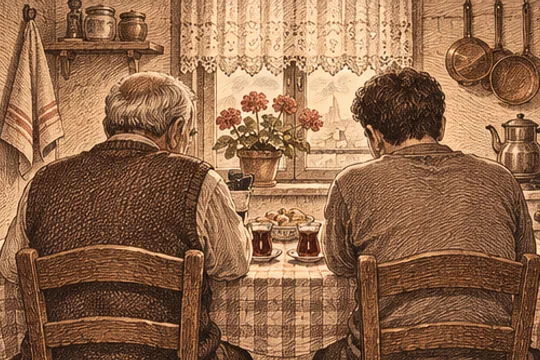
How many of us recognise what a blessing, what riches, there are in a glass of tea set on the table, a slice of cheese, a mouthful of bread, a few olives?
My late father, Erdoğan Sağlam, used to say, “Son, the easiest thing in the world is eating. And even that you can’t do without swallowing.”
Breathing in and out is easy, isn’t it? Ask someone with COPD whose lungs are failing, and see what answer you get. You may have millions, more wealth than you could ever use up, and yet drawing breath may be harder for you than dying.
You can never know how rich you are while your father is still alive.
I know, because my father is no longer alive.
If only he were here to smile at us.
If only he were here to frown at us.
If only he were here to get cross with us.
My father was a mountain of a man. A man in the truest sense.
Today I feel as helpless as Pahom. I am drowning in a sea of “if onlys”.
If your mother and father are still alive, treasure them before it is too late.
Happy Father’s Day.
Dr. Mehmet Hakan Sağlam
Translated from the Turkish original. Türkçe