
From the artillery barracks to Gezi Park
9 August 2014 · Personal website
I look with great excitement at the works built in the Ottoman era that have survived to this day. It is impossible not to admire the attention to the finest details in every building. In many of them, beyond the building’s main purpose, even the birds were provided for. For these beautiful creatures of God, they built little bird palaces, each a work of art. They went so far as to establish a charitable foundation to keep birds from starving when they could not find food in winter.
If the great architect Sinan, who built the Süleymaniye Mosque in Istanbul and the Selimiye Mosque in Edirne, had had ribbed steel reinforcing bars and ready-mix concrete, he would have built Marmaray under the Bosphorus even then. What wonders they achieved with the limited materials of the day! Something made with treated solid wood today lasts at most thirty or forty years, yet thousand-year-old buildings made of natural wood in Seljuk and Ottoman times are still standing. Buildings of steel and concrete toppled like dominoes in the Marmara earthquake of 17 August 1999, while historic buildings made with Khorasan mortar and timber did not suffer a single crack.
On their arduous journey from Central Asia to the shores of the Adriatic, the Turks acted as gatherers wherever they set foot. They embraced and blended the customs, food, culture, music, peoples and principles of government of those whose lands they made their home. The result was the system we call the Ottoman state order. Few people know that many of the terms and practices we still use came down to us from Rome and from Anatolia’s ancient civilizations. The timar system at the heart of the Ottoman military, for example, was virtually identical to Rome’s pronoia system.
In the Roman Empire, by which I mean the Eastern Roman Empire that we consigned to history, regular salaries could not be paid, so a portion of state land was granted to soldiers for a fixed period. Even the Seljuks, before us, adapted the system to their needs and called it iqta.
Few know that Orhan Gazi’s wife Nilüfer Hatun was Roman and took her name from the Holofira, now known as the Nilüfer River, in Bursa. Çiğ köfte was an Assyrian dish described on ancient Assyrian tablets. The Polatlı district of Ankara was the centre of the Phrygian kingdom, and few know how closely dishes made there today resemble those described on Phrygian tablets. In short, the cultural inheritance of the hundreds of civilizations that lived on these lands is engraved in our very makeup.
How aware are we of this unique inheritance? I have my doubts. We feel pulled in opposite directions on nearly everything. We are neither Western nor Eastern. We do not even know if we are European. Some people even readily maintain that we are not the continuation of the Ottoman Empire.
We face the same dilemma in architecture. We have surrendered to a style without character, neither Eastern nor Western. Have you ever felt the urge to take a camera and photograph buildings put up after the republic was founded? If you took the works of the late Ottoman architect Kemalettin out of Ankara, what would be left? I can tell you straight away: nothing. All the buildings going up today look like shoeboxes set upright or laid flat. The glass façades now used on almost every building have done away with architectural beauty altogether.
Many of our universities have schools of architecture and civil engineering, yet our teachers show not a trace of vision or cultural breadth. These universities produce thousands of graduates a year. Yet we have scarcely more than three or five architects who have made a name internationally.
The republic’s reactionary cadres took Ottoman architecture as their enemy, as they did in virtually every other field. They destroyed Ottoman works and built characterless buildings devoid of grace, beauty or proportion, as though foreigners had occupied the country and were building their own culture from scratch.
Under Law No. 1057 of 1927, all the imperial monograms and inscriptions on old monuments and buildings were scraped off or smashed. Do you know what those monograms and inscriptions meant? “I lived here. I put up this building. I made this land my home. I brought civilization here and left my signature.” Even in many of the countries that broke away from the Ottoman Empire, our old artefacts are displayed behind glass. The republic’s pagan-minded cadres displayed the full force of a barbarism the West itself did not resort to.
How else can one explain the conversion of Hagia Sophia into a museum, the use of the Sultan Ahmed Mosque as a barracks, and the fitting of thick rings into its magnificent tiles to tether horses? Today, many secular nationalist and left-leaning intellectuals write strained arguments about Atatürk’s understanding of Islam and his being a true Muslim. Most people already acknowledge that there were many admirable sides to Mustafa Kemal. But we cannot overlook the hostility to the Ottomans of a man who was himself an Ottoman citizen and drew a salary from the state as an Ottoman soldier.
The Ottoman state was a state of people with the vision to think big. The republic was for those who said, “Let it be small, so long as it is mine.” Mosques demolished, fountains damaged, artefacts plundered, and so much more. No architect in their right mind can defend this outlook. “Could Ordu Avenue or Millet Avenue have been opened without demolishing the old buildings?” Just listen to that defence. Can someone who says that possibly be an architect?
Turkey is a country of contradictions. We take an Orientalist attitude to everything. We are neither Eastern nor Western, neither Muslim nor Christian, neither socialist nor capitalist, neither secular nor democratic. Do you know what we really are? We are a people who set out on horseback from Central Asia and embraced and blended almost every civilization we encountered as far as the Adriatic. More accurately, we are our own kind.
Could a statesman like Mustafa Kemal possibly need the protection of a law? The coup leader Kenan Evren and his cronies protected him, and what came of that? They have now been sentenced to life in prison. Two wrongs do not make a right.
Right and wrong are as clear and indisputable as plus and minus. It is not for us historians to defend one man’s mistakes for centuries. Yet our republican historians and certain privileged gentlemen on whom the Turkish Historical Society bestowed the title of “historian” for nothing have written history to order from their desks, reducing the vast history of the Ottoman Empire to tabloid fare.
In 1935 three people came from Ankara to the Süleymaniye complex in Istanbul. Hasan Ferit Çambel, Atatürk’s adopted daughter Afet İnan and Şevket Aziz Kansu, all members of the Society for the Study of Turkish History, began excavating Sinan’s grave. They found the skeleton a metre or two down. Kansu, the anthropologist, brushed the dust and dirt off the skull and measured it with calipers and other instruments. He declared it brachycephalic and said Sinan was a Turk. They left with the skull. In the end, this great man’s skull disappeared. Someone tell me what any of that has to do with history or historical research.
What are we to say about fanciful historians who do not know that widening the Corinth passage featured in the film “300 Spartans” and building the Suez Canal were Ottoman dreams, yet tell the nonexistent story of Baltacı and Catherine’s sexual exploits as if it had happened right beside them? Or the wretches who portray Mehmed the Conqueror as homosexual in the book Boğazkesen?
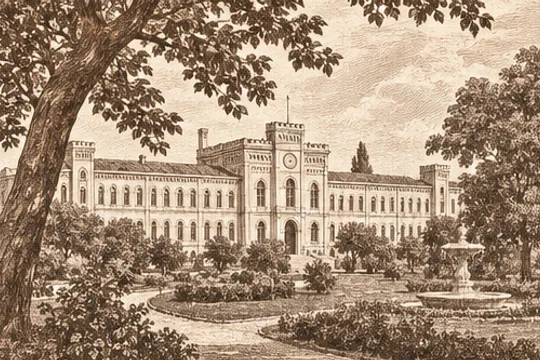
Now to the subject of this article. Sultan Selim III commissioned the architect Kirkor Balyan to build the Artillery Barracks between 1803 and 1806 in a broad meadow where Gezi Park stands today.
The building reflected the architectural features of a broad culture stretching westward from India. Its splendid, elegant towers, monumental gates and large courtyard made it an architectural masterpiece. Damaged in the Kabakçı Mustafa Rebellion after it was built, it was repaired under Mahmud II and suffered several fires. Later, during the reign of Sultan Abdülmecid, the efforts of Damat Gürcü Halil Rifat Pasha, the marshal of Tophane, saw it rebuilt in the architectural style of the nineteenth century. Its two monumental entrances, with traces of Russian and Indian architecture, faced Harbiye and Talimhane avenues.
Between 1860 and 1870 the barracks played an important part in modernizing the Ottoman army. Sultan Abdülaziz’s visit and meal with the soldiers on his return from Egypt in 1864 went down as a notable event in the building’s history. The barracks lost their importance after the 31 March Incident and were sold to a company by the Committee of Union and Progress government in 1913. The military drill ground in the middle was turned into a football pitch and used for many years for football matches and other displays. After the First World War, the French forces occupying Istanbul assigned the barracks to Senegalese troops. After the proclamation of the republic, the courtyard continued to be used for football matches and took the name Taksim Stadium. In 1923 Turkey’s national football team played its first official match there, against Romania.
In 1940, at the suggestion of city planner Henri Prost, it was decided to demolish the barracks and build housing and spaces for social activities in their place. Very little of the planned development was carried out after the demolition. The site was then designated for a park. It was to be called the İnönü Promenade, with a statue of İsmet İnönü in a suitable spot. Fearing a backlash from Atatürk’s admirers, however, the authorities changed the name to Gezi Park.
Incredible, is it not? A magnificent monument built in 1803 was demolished under İsmet İnönü, and a park was put there for the gentleman himself.
In many Western countries roads are rerouted to preserve a single stone. Here, a whole building is demolished to make way for a park.
Can you see how the traces of Turkish and Muslim life were erased from Constantinople, the sacred city of the Turks and the subject of a hadith of our Prophet?
Hagia Sophia was stripped of its status as a mosque. Other mosques were turned into prisons, barracks, stables, farriers’ shops and warehouses for tobacco and liquor. Most were sold or destroyed. Some became local CHP offices, and proceeds from the sale of others were used to furnish the party’s provincial and district offices.
Surely you think such barbarism is beyond the pale. What would happen if someone suggested knocking down Anıtkabir and putting a park in its place? How would you feel if someone proposed demolishing the first parliament building in Ankara, a place of great significance in Turkish history, and putting a park there? Your heart would sink and you would feel disgust. Yet the republic’s cadres handed our history over to demolition crews and scrap dealers without so much as a twinge.
We should look closely at what motivated the protests begun by modern reactionaries and contemporary barbarians in Istanbul’s Gezi Park on 31 May 2013. What could be more natural than wanting to put the Ottoman Artillery Barracks back in place of a park now used as a gathering spot for people addicted to drugs and for homosexuals?
The economy took a serious hit over the eighteen days of Gezi protests in Istanbul and many other Turkish cities. Yet in early May 2013 Turkey had paid off its IMF debt, and interest rates had fallen to 4 percent, their lowest since the Ottomans first borrowed in 1854. Contracts for the third Istanbul airport and the Yavuz Sultan Selim Bridge were put out to tender that same month. Both were major projects. The rail crossing on the bridge would link Istanbul to the Trans-Asian Railway stretching from China to the Turkic republics, establishing a modern Silk Road along rails of steel.
The Cape of Good Hope, discovered by the Portuguese explorer Bartolomeu Dias in 1488, changed the course of world trade from the moment it was found. As the Silk Road lost its importance, the countries, cities, towns, peoples, civilizations and merchants along it grew poorer and were swept from the stage of history in the decades that followed. With the discovery of the Cape, shipping became a major industry. Large quantities of goods travelled quickly by sea from ports in the Far East to Europe, and European banking and insurance grew in turn.
Shipping brought about a major change in the West. The value of colonialism became clear, and seafaring countries, first Portugal, Spain and the Netherlands and later Britain and France, began establishing colonies and territories under their control in the Far East and India.
After 525 years, Erdoğan’s high-speed rail and Bosphorus crossing projects are set to change the fate of Turkey and of all Asia and the Caucasus. Industrial, agricultural and commercial goods from all the countries along the route, particularly China and India, will reach world markets directly, with lower freight costs and insurance premiums. Pay attention to those words: “lower freight costs, lower insurance premiums.” Can you imagine how many billions the world’s freight and insurance companies will lose on those two items alone? And who owns the companies? Virtually all the world’s maritime freight and insurance firms are Western-owned. Erdoğan has poked a stick into a beehive. A route used for 525 years will lose its importance and things will come full circle. The Silk Road is being restored, and we Turks have the good fortune of being the ones to do it.
Why does Istanbul’s third airport frighten some countries? First of all, its railway connection matters a great deal. Today, only a handful of airports worldwide serve as transfer hubs because of their low operating costs, with Frankfurt, London and Paris foremost among them. Turkish Airlines has expanded remarkably in the past twelve years and now flies to almost every country and destination. With very low operating costs and the benefit of the airline’s direct long-haul passenger services, the new airport will eclipse Paris, London and Frankfurt. Between 100 and 150 million air travellers will now choose Istanbul. They will stay, shop and sightsee here. The loss to the West will be enormous.
So what would they have to do to keep that money, preserve the old order and carry on exploiting others?
They would have to get rid of Erdoğan!
They would have to do away with him, dead or alive!
In that frame of mind, the West ordered its collaborators, agents and sleeper cells in Turkey, along with the handful of looters and traitors who followed them, to rise up. That is what the Gezi events were.
Turkey has come through the affair with a few scratches for now. But however you count it, it cost the country $50–60 billion. The dollar rose from 1.70 to 2.30 Turkish lira, and interest rates climbed from around 4 to around 12 percent.
Sadly, history repeated itself.
The Artillery Barracks had lived through the Kabakçı Mustafa Rebellion when first built. When rebuilding them came up for discussion, they gave rise to the Looters’ Rebellion.
Translated from the Turkish original. Türkçe