
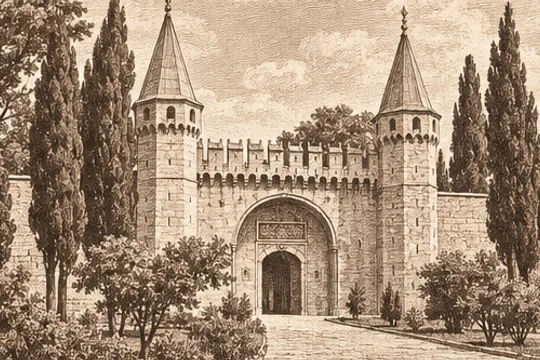
Topkapı Palace (1478), Dolmabahçe Palace (1856), the Presidential Palace (2014)
10 November 2014 · Tarafsız Haber
Things we experienced a mere ten or fifteen years ago show just how much technological progress has simplified our lives.
By simplicity I have in mind the monotony technology has injected into our lives, the listlessness, the drabness and the dissatisfaction, rather than the benefits it has brought.
We used to take up pen and paper and write to friends and family at the drop of a hat: for the religious holidays, the holy nights, weddings and circumcision celebrations. We sent kisses to the hands and eyes of each and every one of our extended family, taking care to mention every relative lest one uncle get cross or another feel hurt. We never forgot to slip in a black-and-white photograph, full of feeling, the kind that still speaks to you when you look at it today. We addressed the envelope with great care, made the trip to the post office without a second thought, and paid ten kuruş for a stamp. Each was as lovely as a little painting. We gave it an eager lick, as though it were a sweet, stuck it neatly to the envelope and handed it over the counter. The clerk inspected it gravely and put it on the scales if he had any doubt. If all was in order, he brought the round postmark down on it with all his might. Thump!
Then what happened? First came the automatic franking machines. Those inseparable lovers, stamp and envelope, were parted for good. Once a stamp had clung to its envelope in all its beauty, lending the plain white paper a grace and meaning all its own. Now there was only a machine mark in red ink, utterly devoid of character.
Meaningless colour pictures took the place of black-and-white photographs. Most are tucked away in digital memory and deleted three days later. The second blow came with the typewriter and the computer. The beautiful handwriting that laid bare a person’s inner world gave way to ugly, insubstantial rows of mechanical lettering. Just as we were about to say enough was enough, electronic messages entered our lives. There’s no feeling in them, no laughter, no weeping. You can’t let a tear fall where it will show, blurring the ink to say, “I’m crying for you.” You can’t singe a corner of the letter to show your beloved how much you miss them. And as for asking after someone’s health, forget it.
So much has changed in our lives. We go on living, but does anybody even stop to wonder what for? We marvelled at how comfortable lifts were and forgot our neighbours on the floors in between. We marvelled at television and forgot the magic of the open-air cinemas: the light summer breeze, cracking sunflower seeds as we watched, all crying together at the saddest scene and booing the villain. We forgot queuing at a payphone to call a sweetheart with a token good for three minutes. We forgot whittling a pencil, getting a shoe patched, keeping a handkerchief in our pocket, boiling mint for a stomach ache, doing homework by a paraffin lamp, roasting chestnuts on a tin woodstove, spreading Sana margarine on bread and dipping it in sugar. We forgot the old crank telephones, booking a call at the post office and waiting days to speak to someone. By the time the young woman at the exchange called out, “Your number’s ready!”, you’d forgotten whom you meant to ring, and everyone would gather around the telephone. The candyfloss vendors who roamed the streets and the simit sellers with their sesame-covered kahke rings have long since vanished. As for haytalya, known today as bici bici, who outside Kilis, Adana and Mersin has heard of it? Many people don’t even know what fresh chickpeas or sugar cane look like.
How many remember the trolleybuses with their twin horns on the Ortaköy–Eminönü route? Or the conductors on the municipal buses who took your fare, tore off a ticket according to how far you were going and counted out your change to the last kuruş? How many students are left who, too hard up for the fare, drew themselves a counterfeit ticket on cheap straw paper with coloured pencils? None, none, none. The ticket is digital now, and so is the contraption we put in the conductor’s place.
The family greengrocer has gone, and so has the family butcher. Into the supermarket you go: look, choose, buy. Yesterday in Güneşli I saw a neighbourhood grocer with a wonderfully apt name: Karagün Market — the Hard Times Grocery. Those old grocers really were friends in hard times. In every grocer’s ledger of goods bought on credit were a thousand and one stories, and just as many friendships and bonds of trust. Today, if you haven’t a lira in your pocket, can you walk into any supermarket and come away with so much as a loaf of bread?
And who remembers those evenings when the whole family went visiting together? We would go round to our relatives’ homes. There was no television, of course. We talked for hours. Once television came along the visits grew fewer. Even on the ones we felt obliged to make, the people fell silent and the televisions did the talking. And then? Things went from bad to worse: the internet age began. Nowadays, after dinner in a household of four, everyone retreats to a different corner and they message one another endlessly.
They’ve built a tunnel beneath the Bosphorus. A splendid thing, isn’t it? But what will become of the Bosphorus ferries? One day they, too, will disappear, like the paddle steamers to the Princes’ Islands that live on only in Sezen Aksu’s songs. And if we can lay our hands on a single book or newspaper that hasn’t been digitised, perhaps we’ll feel moved to look up what those Bosphorus ferries were like.
In his incomparable poem “To the Martyrs of Çanakkale”, Mehmet Akif Ersoy described the twentieth century like this:
“Ah, that twentieth century, that noble creature,
Whose every darling is as wretched as can be,
Stood for months vomiting in the Turkish soldier’s face,
Shamelessly spilling all the secrets in its belly.
Had the mask not torn, that face would still beguile us…
That whore they call civilisation is shameless, truly.”
Here we are in the twenty-first century. What has changed and what hasn’t, what we have forgotten and what we remember, what we loved and what we did not, what we got to experience and what we missed: it is all there for us to see. Look what technology has given us! Has the mask torn and shown the true face beneath? Or is what we see today only a tiny fraction of what is still to come? You can’t help saying, “My God!”, can you?
Please, set aside one day for yourself. Take your camera and walk through the city you live in, street by street, photographing it as you go. Don’t try to arrange it with anyone else. Everybody will find some excuse and throw your plans off. There are so many things you can see today that you’ll soon go looking for in vain. Photograph whatever you see, and date the pictures so you can pass them on to the next generation. I picture Kilis as it was when I was little. How much we have lost! There was the 500-year-old Arasta Bazaar, demolished on the pretext of building a road. My grandfather’s blacksmith’s shop, the one with the double doors in Nacar Market, fell to the same demolition. Of the stone houses that had stood for centuries, very few survive. Sadly, the Republic’s intellectuals treated historic monuments with great brutality. Lovely works left to us by the Seljuks and the Ottomans were torn down on the strength of that specious slogan, “Roads are civilisation.” What bears witness to a civilisation: the historic monuments built on our soil, or roads of black asphalt? Talk about getting things muddled.
I am writing this sitting on a column some fifteen hundred years old, lying on its side in the grounds of Istanbul University. Do you know what fifteen hundred years means? Alp Arslan had yet to open the gates of Manzikert and enter Anatolia. The Seljuk state had yet to fall and the Ottoman state had yet to be founded. Constantinople, capital of the Eastern Roman Empire, had yet to be taken by Mehmed the Conqueror. Christopher Columbus had yet to discover the American continent.
We are one of the few peoples fortunate enough to live on land this ancient. Yet haven’t we sacrificed the vast history of Anatolia and the Turks to ignorance and folly? Think of rulers with as little vision as İsmet İnönü, who tore down the Artillery Barracks at Taksim to make a park, or the Republic’s officials, who sold off mosques and their complexes for next to nothing to farriers and livestock dealers. Think of generals who staged coups, such as Kenan Evren, the head of state in the 12 September era, who had asphalt poured over the two-thousand-year-old road through the necropolis at the ancient city of Hierapolis, in Pamukkale, because he got mud on his shoes.
A new presidential palace befitting the dignity of this state has been built in Ankara. The people who run the Chamber of Architects immediately likened it to a squat toilet, heedless of what their own organisation’s emblem looks like. Had it been commissioned by someone of their own persuasion, they would have sung its praises to the skies. We are witnessing the latest instance of hostility towards the AKP and Erdoğan. I ask every leader of the Chamber of Architects: how many Turkish architects have won awards abroad? Let me answer: only ten or fifteen. Turgut Cansever, Ertan Çakırlar, Sedat Hakkı Eldem, Çelik Gülersoy, Sedat Gürel, Nail Çakırhan, Behruz Çinici, Cengiz Bektaş, Han Tümertekin, Emre Arolat and a few others. Add another ten or so who have won various prizes in the United States and Britain. That’s the lot. Do you know what these award-winning architects share in their approach to design? Almost all took inspiration from Anatolian Seljuk and Ottoman architecture. Do the people running a body like the Chamber of Architects have any such award-winning projects to their names? If you took the works of the Ottoman architect Kemalettin out of Ankara, how many buildings worth looking at would be left? I invite our secular, modern, democratic and enlightened architects, whose designs amount to shoeboxes standing upright, on their sides or lying flat, to show a little imagination.
Last week, in one of my articles, I discussed mercantilism, which laid the foundations of Western economies. The system known as mercantilism was based on wealth in precious metals. On this view, the more gold and silver people and states possessed, the more powerful and prestigious they were. Mercantilism also set the increasingly powerful merchant class, the owners of capital, against feudal landowners. Europe’s landed aristocrats had less gold and silver than the new class. In their eyes land was the source of wealth, and people or states were considered richer the more land they held. In the end, however, the mercantilists prevailed over the physiocrats.
Mercantilism opened new horizons for European states. Before long this new commercial outlook turned towards production. From the late sixteenth and early seventeenth centuries, the accumulation of money and capital, helped by new colonies and powerful merchant fleets, set the Industrial Revolution in motion, first and foremost in England and in several other countries. Large increases in output paved the way for that revolution. From the fifteenth century on, Europe’s economic, intellectual and social structures changed completely. The effects were felt throughout the world.
We should also pay attention to the influence of mercantilism on European architecture. Consider some of the buildings that make London and Paris what they are today. Buckingham Palace (1761), the Palace of Versailles (1661), the Louvre Palace (1546), the Palace of Westminster (1512) and hundreds more all date from that era. Do you know why European monarchs commissioned such grand and magnificent buildings? As mercantilist countries acquired money and wealth, they began to express it in their architecture as a source of political power and prestige. Across Europe huge government buildings, palaces, guesthouses and parliament buildings went up to display the power and splendour of the state. European kings meant to impress their peoples and the rulers and peoples of other countries. And they did. Mercantilist states such as England, the Netherlands, Belgium, France, Spain and Portugal used powerful fleets to conquer new territories and speed up colonisation. They grew wealthy from the gold and silver they brought back and from trade in raw materials and enslaved people. Their architecture, too, reflected that wealth.
The magnificent new Presidential Palace was built for precisely that purpose. After Topkapı and Dolmabahçe, it will be the one monument from the Republican era we leave to future generations. A place like Çankaya Mansion, which is little more than a country house, or the prime minister’s offices tucked away in side streets could hardly impress foreign officials or convey your country’s cultural and architectural wealth. The desire to show other countries the splendour and power of the state was also what prompted the construction of Topkapı Palace in 1478 and Dolmabahçe Palace in 1856.
Our intellectuals who lack any vision and would have the president of this country live in a shanty if they could should take careful note.
Translated from the Turkish original. Türkçe