
From Topkapı to Beştepe
10 November 2014 · Personal website
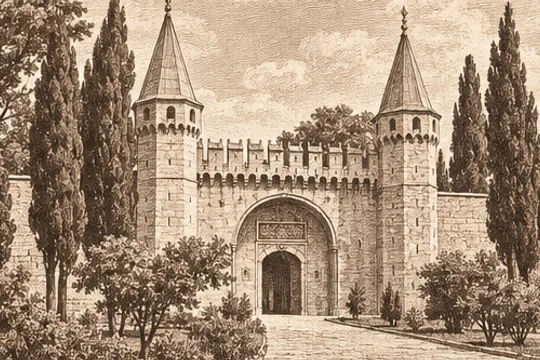
(Article 039 — 10 November 2014)
I am currently writing this text while sitting on a column, which is approximately five hundred years old, lying on the ground in the courtyard of Istanbul University. Do you know what five hundred years means? Alparslan hadn't yet opened the gates of Malazgirt and entered Anatolia. The Seljuk State hadn't yet fallen, and the Ottoman State hadn't yet been established. Constantinople, the capital of the Eastern Roman Empire, had not yet been seized by Fatih. Christopher Columbus had not yet discovered the American continent.
We are one of the few peoples fortunate enough to live on such ancient ground. Yet haven’t we sacrificed a vast part of Anatolian and Turkish history to ignorance and folly? Think of short-sighted rulers like İsmet İnönü, who pulled down the Taksim Artillery Barracks to make a park; of the Republican officials who sold mosques and their surrounding complexes to farriers and livestock dealers for a pittance; or of coup generals like Kenan Evren, the head of state after 12 September. He had a 2,000-year-old road through the necropolis of ancient Hierapolis at Pamukkale covered in asphalt because he got mud on his shoe.
In Ankara, a new Presidential Palace was built, befitting the reputation of this state. Immediately, officials from the Chamber of Architects emerged and, disregarding their own institution’s emblem, described this palace as resembling traditional Turkish toilet tiles. If this building had been commissioned by someone within their own mindset, they would be praising it, unable to find enough words to describe it. We are currently witnessing the latest example of animosity towards the AK Party and Erdoğan. I am addressing all the members of the Chamber of Architects. How many Turkish architects have received awards from abroad? I’ll answer: only around ten to fifteen. Specifically, Turgut Cansever, Ertan Çakırlar, Sedat Hakkı Eldem, Çelik Gülersoy, Sedat Gürel, Nail Çakırhan, Behruz Çinici, Cengiz Bektaş, Han Tümertekin, and a few others. Let’s add ten more people to this list – individuals who have won various awards in the US and UK. Do you know what common characteristics exist in these award-winning architects? Almost all of these architects draw inspiration from the architecture of the Anatolian Seljuk and Ottoman periods in their work. Do the heads of organizations like the Architects’ Association have projects like these, which have received awards? If you were to remove all the works of Mimar Kemalettin, a prominent Ottoman architect, and relocate them to Ankara, how many buildings would remain in Ankara? I would like to encourage our modern, democratic, enlightened, and creative architects – those who are unable to conceive of anything beyond the upright, side, and flat forms of a shoebox – to show a bit more creativity.
Last week, in an article I wrote, I addressed the topic of mercantilism, which forms the basis of Western economies. This economic system was founded on a wealth of precious metals. According to this view, the more gold and silver a state possessed, the stronger and more respected it would become. Mercantilism actually sparked a conflict between the increasingly powerful merchant (capital) class and the landowning feudal lords. This was because the European landowning aristocracy did not possess the same amount of gold and silver as this new class. They believed that wealth stemmed from land ownership – that a person or state was considered wealthy to the extent that they possessed more land. Ultimately, the mercantilists emerged as the winners in the dispute with the physiocrats.
Mercantilism opened new horizons for European states. This new commercial mindset eventually shifted towards production, and through the accumulation of capital and funds, particularly with the establishment of new colonies and powerful naval fleets, it initiated an industrial revolution, starting around the end of the 16th century and the beginning of the 17th century, notably in countries like England. The significant increases in production paved the way for the industrial revolution. As can be seen, starting from the 15th century, the economic, intellectual, and social structure of Europe underwent a complete transformation. However, this change wasn't limited to Europe; it impacted the entire world.
The influence of mercantilism on European architecture should also not be overlooked. Let’s take a look at some of the architectural works that shaped London into London and Paris into Paris today. Buildings like Buckingham Palace (1761), the Palace of Versailles (1661), the Louvre Palace (1546), and Westminster Palace (1512), along with countless others, were all built during that time. But, have you ever wondered why European rulers commissioned such magnificent and elaborate buildings? As mercantilist countries began to accumulate wealth and resources, they started to reflect this in their architecture, using it as a symbol of political and moral power. Across Europe, states began constructing massive government buildings, palaces, guest houses, and parliament buildings – all intended to showcase their power and grandeur. The aim of European monarchs was to impress both their own populations and those of other countries, and they succeeded in doing so. Countries like England, Holland, Belgium, France, Spain, and Portugal – mercantilist states – accelerated their efforts to conquer and colonize new territories, utilizing powerful naval fleets. Supplementing this expansion with the acquisition of gold and silver from their newly acquired lands, and further enriching themselves through the trade of raw materials and slaves, they reflected this newfound wealth in the architectural styles of their nations.
The new Presidential Palace is a magnificent structure built precisely for this purpose. It will be the sole symbol of the Republic era, intended to be passed down to future generations, following the grandeur of Topkapı and Dolmabahçe Palaces. Neither the splendor of Çankaya Mansion, nor the Başbakanlık (Prime Minister’s) building within the city, can impress foreign officials or reflect the country’s cultural and architectural richness. The reasons for constructing the Topkapı Palace, built in 1478, and the Dolmabahçe Palace, built in 1856, were also to demonstrate the state’s grandeur and power to other countries.
The new Presidential Palace, known as Beştepe, has already begun to impress those who visit it. Numerous state officials, both domestic and international, have been deeply affected by the palace’s appearance and grandeur. And wasn’t this what we hoped for – a “New Turkey” and a “Strong Turkey,” achievable through structures like this? The perspective of foreign guests arriving from the Middle East, Africa, or Asian countries after seeing this palace will fundamentally change; it will significantly increase their faith and trust in this country.
Without a clear vision, architects – who have produced projects throughout the 90-year history of the Republic – relying on their hands, there is no way this country’s president will be placed. From the moment Beştepe Palace construction began, these individuals – who have camped outside courts, seeking to stop the construction – and who are unable to even draw the logo of their own offices – what is there to discuss with them? After all, “logo” is a reflection of a institution and its members.
Translated from the Turkish original. Türkçe