
The dollar is rising because the Turkish people won’t say “Damn it!” again…
23 May 2018 · Personal website
(Article 229 — 23 May 2018)
Turkey will hold presidential and parliamentary elections on 24 June.
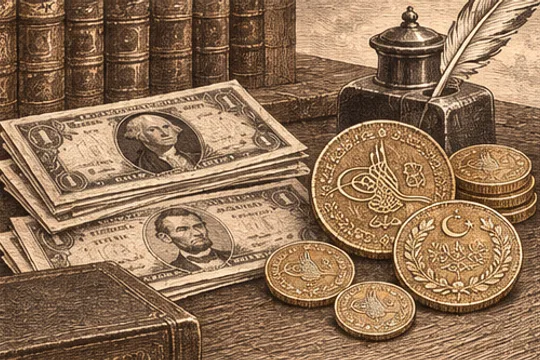
International credit rating agencies such as Standard & Poor’s and Fitch lowered Turkey’s credit rating to the level of “tribal states” such as Uganda and Nairobi. Foreign-owned HSBC and Global Menkul Kıymetler then drove the Istanbul stock exchange down with heavy sales of shares and bonds, and the US dollar rose from around 3.80 to 4.86 lira. This is the clearest sign that someone has launched an economic attack.
It is clear from all of this that it is long past time to create our own payment system, payment instruments and financing models so that we can build a strong, fully independent Turkey.
The United States uses SWIFT, the Society for Worldwide Interbank Financial Telecommunication, to track the movement of every dollar in the world in real time. It uses the involvement of its own banking system as a pretext to fine banks, financial institutions and companies around the world billions of dollars, and uses its influence at the United Nations to impose embargoes on countries it wants to punish. If we want to prevent this, it is time to take bold steps.
President Erdoğan’s proposal to link international trade to gold is a genuinely sensible way to end dependence on the US dollar and avoid financial operations of this kind by the United States. Gold is my field. My master’s research was on gold smuggling in Turkey and my doctoral thesis was on how the world’s gold exchanges work. I took an active part in establishing the Istanbul Gold Exchange in 1994. Everyone knows the Turkish people’s fondness for gold. At weddings, circumcision celebrations and on special occasions, people give one another gold both as a gift and as a way of showing solidarity. In 1994 I surveyed how much gold the Turkish public had saved over the centuries and identified a reserve of about 5,000 tonnes. It is quite likely that it has now reached 7,000 tonnes.
In 1998, at the request of India’s Ministry of Finance, I wrote a report on gold banking. As a result of that report, gold banking made considerable progress in India and a significant share of the gold Indians kept under their mattresses was brought into the banking system. But my recommendations went unheeded in Turkey, and we were left far behind.
To gain financial independence, Turkey needs to accumulate its own capital. The way to build that capital is through production and exports. The rich countries of the West had no trouble accumulating capital. From the early eighteenth century, England set up colonies in India and elsewhere in the Far East and Africa and carried home their gold, silver and diamonds, following every rule of mercantilism. Other seafaring societies of the age, such as France, the Netherlands and Spain, built colonies of their own and followed the same method.
As precious metals from Africa, spices and textiles from the Indian subcontinent and nearly every marketable good from Eastern societies were shipped to Western countries, this wealth began to concentrate in the hands of long-established families in shipping, insurance and banking. The fortunes of families such as the Rothschilds and Rockefellers, now global powers, came from this accumulation of wealth over centuries.
America was founded as a new state in 1776, but spent a long time dealing with its own domestic problems. Then came the Great Depression of 1929, which affected America and the whole world.
Unemployment in the United States reached 25 percent in 1933, and more than five thousand banks failed across the country. The decline in October 1929 was only the beginning. By mid-November stock prices had lost a third of their value. At the bottom in 1932, shares had lost 90 percent of their pre-crisis value. A share of US Steel that sold for $262 before the crash scarcely found a buyer at $22 in 1932.
The Depression’s effects on the US economy compounded. Millions of people lost their jobs. In 1930 there were 4.6 million unemployed, rising to 8 million in 1931 and 12 million in 1932. By early 1933 close to 13 million people had lost their jobs. Unemployed Americans stood in long breadlines, begged for food or sold apples on street corners.
More than a third of the country’s banks failed in the three years after 1929. People in despair stood in long lines outside banks to get their savings back. Many ordinary people lost years of savings when the banks went under.
At first President Hoover did very little about the economic collapse. He favoured minimal state intervention and argued that direct aid to individuals would weaken their character, undermine their work ethic and make them depend on government assistance. In 1931 Hoover reversed his initial approach and embraced intervention. In 1932 the Reconstruction Finance Corporation (RFC) decided to lend two billion dollars to banks, railways and other private companies. In July 1932 the federal government also set aside $300 million for relief and public works projects.
In November 1932 Franklin D. Roosevelt was elected president with 57.4 percent of the vote, against Hoover’s 39.7 percent. Roosevelt’s election changed the fate of the United States.
In 1929 the country had 4.6 million unemployed. By 1933 the number was approaching 13 million. In 1929, 659 banks failed, followed by 1,352 in 1930 and 2,294 in 1931. Most were small local or regional institutions with one or a few branches.
To tackle the country’s social and economic problems, President Roosevelt enacted thirteen major laws. Introduced in quick succession around the middle of 1933, they aimed to get the economy moving again. A new law governing the banking system barred banks from speculative trading on stock exchanges and introduced protections for depositors. The New Deal, as Roosevelt called it, also brought changes to industrial production, markets and labour relations. The chief aims were to revive industry by curbing overproduction, raising pay and shortening working hours. Higher wages in particular were expected to stimulate aggregate demand, lift sales and clear inventories. In addition to measures supporting and encouraging the private sector, substantial funds were set aside for public investment and services. The Public Works Administration (PWA), charged with overseeing this work, generated a total of $13.2 billion between 1933 and 1942 and helped create jobs. Through the PWA, 122,000 homes, 664,000 miles of roads, 77,000 bridges and 285 airports were built in that period. The government put its planned investments into effect one after another. By launching public projects in afforestation, flood control and soil conservation, President Roosevelt enabled 300,000 people to be hired in 1933 and established a belt of 200 million trees from North Dakota to Texas.
Keynes argued that to get the economy moving again, jobs had to be created for the unemployed and the state had to concentrate on infrastructure projects with social aims. Roosevelt followed the Keynesian economic policy devised by Keynes to the letter. Thanks to the policy pursued from 1933 to 1945, the United States escaped the ill effects of the Great Depression and became a world giant.
Almost every country affected by the crisis adapted Keynes’s proposed remedy to its own circumstances. Britain tried to revive construction to bring its economy out of stagnation. Homeowners were given grants and encouraged to demolish old buildings and build them again. Germany concentrated on motorways across the country and investment in the arms industry. Many other countries increased public investment in railways, roads and dams. Turkey pursued a similar policy at the time and, in keeping with its principle of statism, built numerous industrial plants, railways and roads with public funds.
The United States never again had a president as successful as Roosevelt. He brought a country that had hit bottom out of crisis. When he died on 12 April 1945, America was beginning to become a welfare state.
But one of Roosevelt’s most important achievements was persuading the world to accept the Bretton Woods system. He made the US DOLLAR a major world currency. With an economy emerging stronger from the Second World War, the US advocated a stable system like the gold standard, with fixed exchange rates. It also wanted an international institution to help rebuild shattered economies.
The talks that began on 1 July 1944 resulted in agreement to establish the International Monetary Fund (IMF) and the International Bank for Reconstruction and Development (IBRD).
Under Bretton Woods, member countries other than the United States defined their currencies in terms of US dollars. The US currency was pegged not to another country’s currency but to gold at the prevailing price of $35 an ounce.
With its strong and stable economy, this gave America an advantage over other countries. Under Bretton Woods, countries that turned their gold over to the United States received cash dollars calculated at $35 an ounce. They then used the paper dollars they received from the US Treasury to pay for imports.
But what would happen when the paper dollars ran out? And what would countries with no gold reserves do if they could not get dollars?
The system was simple and cleared the way for the United States to become a global power. Countries with no gold or no dollars left were given loans by American banks or the US-controlled IMF. This created a colonial system built on debt that could last decades or even centuries. It went on without interruption until 1971. Under the Bretton Woods agreement, countries that accumulated dollars could ask at any time to have their gold returned at $35 an ounce. But that never happened. One night in 1971 the US administration suddenly said, “The agreement is over. Those who want gold will get it at the higher current price instead of $35.” The truth was that in those years no country had the money to buy gold anyway.
The crucial point about Bretton Woods was this. For countries other than the United States to trade with each other and import goods, they had to send their gold reserves to the US central bank to get dollars. To finance US imports, the American mint only had to print money with paper and ink. At the 1945 price of $35 an ounce, a kilogram of gold was worth $1,120. To import $1,120,000 worth of goods from Japan, for example, France first had to hand over 1,000 kilograms (one tonne) of gold to the US central bank and obtain $1,120,000. What did America need to import the same amount from Japan? Nothing. All it needed was small pieces of green paper printed by the American mint for the cost of the paper and ink.
If the United States is now the world’s foremost industrial and financial giant, the one man responsible is a genius named Franklin Delano Roosevelt.
It is this wealth that made Turkey and many countries in the same position increasingly dependent on the West.
Turkey’s exports are no longer growing as rapidly as they did between 2002 and 2015. They quickly rose from $35 billion to $160 billion, but have barely moved for the last four or five years. Chief reasons include a failure to diversify products, insufficient capacity, shrinking markets, weak brands, a shortage of patents and know-how, economic difficulties in export markets, global economic, political and military crises, high interest rates, growing pressure on the exchange rate, and political and economic risks in individual countries.
There is an even more important point we must not overlook. You can have a driver’s licence and a beautiful car, but you still need petrol in the tank to get it going. The crucial thing that will keep Turkey’s economy moving is money, in other words financing. Unfortunately, money is a scarce resource in Turkey.
Because we have not solved the financing problem, many investors, banks in particular, borrow abroad at high interest rates. They convert their foreign-currency loans into Turkish lira, add the exchange-rate risk and lend the money to borrowers in Turkey. In the process, the cost of credit climbs from 3.5–4 percent to 22 percent. One of the main reasons is that the Central Bank requires banks to set aside 10.5 percent on lira deposits and 12 percent on foreign-currency deposits.
The Central Bank’s conduct is like someone pouring petrol on a wooden building, striking a match and then brazenly asking why it caught fire.
The Turkish lira reached 4.86 to the US dollar. The truth is that everyone who shapes Turkey’s economic policy, beginning with the Central Bank officials, has made a mess of it.
I have written about this over and over. “We will bring foreign exchange down,” “Anyone buying foreign currency will get burned,” and “This rise is artificial” are all empty talk.
First, Turkey has to tackle dollarization. Homes and businesses are rented in foreign currency, cars and homes are sold in foreign currency, government privatization and build–operate–transfer tenders are conducted in dollars or euros, and currency exchange shops are opening one after another on almost every street, like liquor stores. Is this not a serious problem?
Would it not be more effective for the Central Bank and economic officials to act more sensibly and take decisions to halt dollarization? Suppose the government decided that when a dispute arose over a lease in a foreign currency, the parties could not take it to court. Would anyone sign another lease or sales contract in dollars or euros?
Would that not be more effective than Central Bank officials acting like neighbourhood bullies and making absurd statements like, “We’ll hang anyone who buys dollars, we’ll cut them down, we’ll take the necessary steps”? Suppose someone now asked the officials, “Go on then, if you’ve got the nerve, let’s see you do something.” What would they do? Nothing, of course.
The US dollar keeps rising against the lira because people know nothing can be done.
So what should we do? First, stop the empty talk. Second, end Turkey’s love affair with foreign currencies. Finally, take steps to increase production and exports over the medium and long term.
This is what happens when you hand the Central Bank and other great institutions to people who have never bought or sold so much as a lemon in their lives…
Those who will listen will listen. Nothing happens to those who will not anyway…
I have saved the chief reason for the dollar’s rise for last. The AK Party has announced its parliamentary candidates. Do you not see that the lists inspire no confidence in the Turkish public? Almost everyone’s reaction was the same: “The mountain brought forth a mouse.”
This election is crucial for the transition to the presidential system. Yet practically everyone in a winnable spot on the list is already an MP. People around the country are talking among themselves and grumbling about most of the MPs: “What have these people done for the country in the past few years to deserve being on the list again?”
People are deserting the lira for the dollar because the candidate lists have not convinced them. They worry the AK Party may fail to win a parliamentary majority even if Erdoğan is elected president. They see no sign of anyone campaigning on the streets, and the lists offer the same old faces in place of renewal.
Remember 2002, when the AK Party came to power. The country had suffered a major economic crisis and collapse. Twenty-seven banks and tens of thousands of businesses had shut down, and millions had lost their jobs. The Turkish currency was unrecognizable under all its zeroes, and people who could see no future at home were looking for ways to leave the country.
In that chaotic and uncertain period, the AK Party’s ranks, which came out of the National Outlook tradition, looked like a lifeline. The party took power on its own with 34.63 percent of the vote. The figure rose to 41.67 percent in the 2004 general parliamentary elections, 46.58 percent in 2007 and 49.90 percent in 2011. The upward trend continued unbroken until the general election of 7 June 2015, when the party’s share suddenly fell to 40.86 percent.
Now let us go back to 2002.
As a party from the National Outlook tradition, the AK Party already had the core 15 to 17 percent vote of the Welfare Party and the Felicity Party in its back pocket. The coalition governments involving ANAP, DYP, DSP, Welfare, Felicity and the MHP, which had kept the country limping along from 1994 to 2001, had to throw in the towel when they could no longer cope with the 1999 Marmara earthquake and deep economic problems that grew worse afterward.
In the 2002 general election the AK Party won 363 seats with 34.28 percent of the vote, while the CHP won 178 seats with 19.39 percent. Turkey’s oldest, most established parties fell below the electoral threshold and some disappeared altogether. The DYP received 9.54 percent, the MHP 8.36, the Young Party 7.25, ANAP 5.13, Felicity 2.49, DSP 1.22 and BBP 1.02. None met the threshold.
To me, the most striking figure is the Felicity Party’s 2.49 percent. The Islamic conservative vote became the AK Party’s core, while millions of people from different political traditions who were fed up with coalition governments lent it their votes. Recep Tayyip Erdoğan’s party did well in democratization as well as economic and social affairs. Over time the temporary or borrowed votes became lasting ones, and with new voters coming in, the party reached 49.90 percent. Even the 2013 Gezi events and the judicial and police coup of 17 and 25 December 2013 did nothing to reduce its vote. On the contrary, they increased it.
But something visibly changed after 2011. The AK Party began turning inward. Those with National Outlook roots were prized and placed in influential posts at virtually every level, while everyone else was shut out.
Two months before the 7 June 2015 elections, I visited a businessman close to the AK Party. “You are turning increasingly inward and shutting out everyone who does not come from National Outlook,” I told him. “I cast my first vote in 1983 for Turgut Özal’s Motherland Party. I voted for other parties in later years. But since 2002 I have voted for the AK Party so my country could break its sterile political cycle, grow richer, gain standing and develop. My voting for the AK Party does not mean I have moved closer to National Outlook, and it should not. For you there are two kinds of AK Party supporter: the ‘real’ ones from National Outlook and the ‘fake’ ones who do not belong to that tradition. In your words, we are people grafted onto the party later. To put it crudely, you see us as turncoats, or at best as people who for one reason or another sold out their old party and came to the AK Party. Our genes will never match yours. You cannot accept us. You will learn painfully at the general election what a mistake that is and what it costs you.”
The AK Party suffered a defeat and lost its parliamentary majority.
Then what happened? The AK Party could not form a government on its own. The president exercised his constitutional authority and called another election for 1 November 2015, and the AK Party regained its parliamentary majority.
What did the AK Party do between 7 June and 1 November 2015 to win the election? Did it change its MPs or make new proposals to the public? No. It did nothing. It could not have done anything anyway.
Here is what really happened. Voters went to the polls reluctantly, uneasy about their choice, and marked their ballots for the AK Party, saying, “Damn it! Anything to spare the country another crisis and instability.”
The way worries keep growing, it seems people are not willing to say “Damn it!” again in the 24 June elections.
They are, in fact, pricing in the risk of a crisis on 24 June. More and more people think, “If Erdoğan and the AK Party win, I’ll sell my dollars for 20 to 30 percent less. If they don’t, the dollar will go up many times over anyway.” This is a very bad situation.
But know this: these lists are worthless. Some of our columnists are trying to dress them up, saying they were put together with great care. I will say something different. These lists were drawn up for the sake of filling them out and keeping everything in the hands of the same people.
Erdoğan has a very hard job. The election is only a month away, yet there is not a single parliamentary candidate holding rallies or going from street to street to persuade the public. They have all let themselves off the hook and dumped the work of persuading people on Erdoğan. Let him work so others can become MPs. How very nice for them.
Almost everyone is now asking, “If you were going to stick with the existing MPs, why interview more than seven thousand people?”
And ordinary voters are asking, “Bülent Arınç’s son-in-law was arrested in the Gülen investigation, and Arınç himself would not hear a word against Fethullah Gülen. Why have Bülent Arınç’s son and the son of Mehmet Ağar, whose name so often came up in the period of unsolved killings, been made parliamentary candidates?”
I hope I’m wrong, but the result will be a defeat.
A friend tells you the hard truth…
Dr Mehmet Hakan Sağlam
Translated from the Turkish original. Türkçe