
It isn’t raining. Why should anyone die?
12 April 2015 · Personal website
(Article 074 – 12 April 2015)
Wednesday, 26 December 1973, about half past twelve. Nearly forty-two years ago I walked out of the yard of Kemaliye Primary School in Kilis and watched with curiosity as a crowd approached along Cumhuriyet Avenue. I was only in first grade. The municipal band was playing something mournful, which I later learned was a funeral march, and people were carrying a coffin draped in the Turkish flag. Outside the shoe shop adjoining the tomb just up from the school, I asked a middle-aged man reading a newspaper, “Sir, who’s died?” He looked up from the paper. “Haven’t you heard, son? İsmet İnönü has died.” The ceremonial guard went past us. For years afterwards I never saw such a grand funeral, in Kilis at least.
Thursday, 10 November 1983, at about eleven in the morning. You may ask how I know the date and time so precisely. That was the day the Turkish Republic of Northern Cyprus declared independence. I was a boarder at Kabataş Boys’ High School, in my final year. Our teacher was giving a lesson on Atatürk’s Principles and the History of the Revolution. Somehow the subject came round to İsmet İnönü’s death. When the teacher said in the course of the lesson that İnönü had died in Ankara and been buried at Anıtkabir, I was taken straight back all those years. I immediately said, “One minute, ma’am, you’ve got it wrong. İsmet İnönü died in Kilis, not Ankara.” The whole class started laughing. She paused and said, “Hakan, my dear, what would İsmet İnönü have been doing in Kilis? Goodness knows, he may never even have set eyes on it.” I insisted: “He died in Kilis, ma’am. His coffin went right past me with the band. I saw it with my own eyes. Why would I lie to you?” But I could not persuade her that İnönü had died in Kilis. I learned later that he really had died in Ankara.
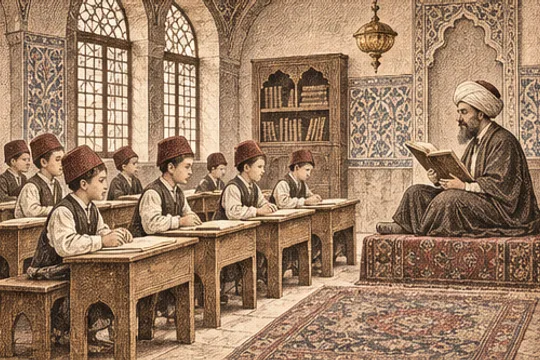
It turned out that the funeral I had watched was for a soldier killed in service and buried on the same day as İsmet İnönü. So it took me ten years to understand that İnönü had died in Ankara, not Kilis. That must be exactly how preconceptions work. Some things that happen to us as children get lodged in a corner of the mind. Something similar happened in my middle-school years. It was 1978. I attended Kilis Atatürk Middle School. We walked to and from school. There were no school buses like there are today. The Kilis Asri Cemetery was right on our route. In winter, walking home from school at midday, we passed funerals near Zekeriya Korkmaz Boulevard almost every day. Then one sunny summer day I learned that Saliha, who had taught me to read the Qur’an, had passed away. I remember telling the person who broke the news, “It isn’t raining. Why would anyone die?” I always saw funerals on the way home when it was raining, so I thought people died in rainy weather.
You may have all sorts of thoughts about me after reading these memories, but that is what childhood is like. I recently visited refugee camps in Kilis. In the camp nurseries there were hundreds of children who had lost their mothers and fathers in the war. I suppose there are only a handful of moments in a lifetime when one is overwhelmed by feeling. Some of the things I saw there made me cry for hours. First of all, I felt proud to be Turkish. My faith in my country grew many times over. I felt the greatness and strength of the New Turkey, which spent six billion dollars on two and a half million people over four years. I saw the fine line between plenty and want, hunger and having enough to eat, life and death. I saw how people who had lived comfortably until yesterday lost everything in an instant and took to the roads, how children who had felt the warmth of their parents just a second before were left all alone in the world by barrel bombs. Perhaps the children growing up in the nurseries and other schools of the Öncüpınar and Elbeyli camps will form preconceptions like the ones I had. After four years under the protection of the Turkish state, they may go back to their own country and hear someone say, “I’m hungry”. They might reply, “What is hunger?” Worse, when they leave the camps they now call home, they may cry, “Why are you taking us away from our home?”
People can be forced to uproot themselves and leave for many reasons. Among the chief causes are discrimination, oppression and persecution on ethnic grounds, economic conditions and war. Events before and after the Balkan War made migration from the Balkans to Anatolia unavoidable.
The first wave of migration from the Balkans towards Anatolia came with the Serbian uprising of 1804. The insurgents’ massacres of Turks in the districts around Smederevo drove people into Rumelia and Bosnia and Herzegovina. Under the Akkerman Convention of 1826, 150,000 Turks were forced to leave Serbia. In 1867 around 150,000 Bosniaks fleeing Serbian persecution moved to Anatolia alongside Turks. Another 300,000 Turks had to leave Serbia between 1908 and 1923, and 350,000 between 1923 and 1933. Some of the migrants died of illness and hunger on the road.
Greek atrocities in the Balkans began with the Greek uprising of 1821. In his 1864 book History of the Greek Revolution, the historian George Finlay wrote: “In April 1821 a Muslim population of nearly 20,000 lived scattered across Greece and worked in agriculture. In less than two months, most had been massacred. Men, women and children were killed without mercy and without subsequent remorse.”
The uprising’s nationalist slogan, uttered by the Greek archbishop Germanos, was “Peace to Christians, respect for consuls, death to Turks.” In describing the extent of the atrocities, Finlay relates that the Turks of Tripolitsa were subjected to genocide for three days and three nights. The insurgent leader Kolokotronis said, “When I entered the town, my horse’s hooves never touched the ground from the gate of the upper citadel onwards.” He meant that his triumphal route was carpeted with Muslim bodies.
During the Balkan War, Greek atrocities reached unimaginable proportions. What a Greek pharmacist in Ioannina did is horrifying: “Forcing eight or ten Ottoman Turkish girls to dance in tears every night, breaking their spirits with threats and torture … what joyful pride in victory it gives the sons of Hellas! When Ioannina fell, I knocked on my customers’ doors and offered to protect them. They knew me as a friend of the Ottomans and came to my house with their jewellery, money and families. I threw seven of the men into the well. I slit the throats of three elderly women.”
After the Morea, massacres of Turkish civilians by Greeks in Crete caused 60,000 people to move from there to Anatolia and Istanbul in 1864. After the First World War, some Turks in Greece also had to flee to Anatolia. Under the population exchange following the War of Independence, carried out under the Treaty of Lausanne, 384,000 people came to Turkey between 1923 and 1933. Between 1934 and 1960, 23,788 people arrived from Greece, and between 1960 and 1970 another 20,000 were forced to leave.
Among the Balkan peoples, surely none surpassed the Bulgarians in the atrocities of 1877–78 and 1912. In the war of 1877–78 the Russians were their chief supporters and instigators. During that Russo-Ottoman War the Russians crossed the Danube into Bulgaria and carried out extensive massacres in occupied areas. Their armies disarmed the Turks and distributed weapons to the Bulgarians. What went down in history as the Harmanlı massacre was one of the largest and most horrific by death toll. In January 1878 Russian and Don Cossack units attacked and massacred a body of between 40,000 and 100,000 refugees at Harmanlı, mostly women and children. Those who escaped perished of cold and hunger along the banks of the Maritsa and in the mountains.
During the Balkan War the Bulgarians refined and used the methods of persecution they had learned from the Russians. The Bulgarian armies advancing as far as Çatalca, and the Bulgarian irregulars who aided them, also committed massacres in Thrace and Macedonia. The exact toll is unknown. According to a report in the Hungarian newspaper A Nap on 7 February 1913, 60,000 Albanians and 40,000 Turks were killed in Macedonia alone. If at least as many Turks and Muslims were killed in eastern and western Thrace, an estimated 200,000 Muslims and Turks were killed by the Bulgarians alone.
Many accounts describe what refugees endured on the road. When the war broke out in the autumn of 1912, it was nearly impossible to move along roads turned to mud by the Balkan cold and rain. People left hurriedly with a few possessions at most. Fear of death took precedence over property. Stéphane Lauzanne, a French journalist who closely followed the Balkan War, described the parties of refugees: “I met the first party just twenty kilometres along the road to Istanbul. After that there was no end to them. Among them were poor people, older people, women and children, fleeing towards us from the horizon, silent and agitated, afraid of an unseen force pursuing them… Every face bore the marks of fear, and all of them looked bewildered. The villages were almost empty.”
What the journalist saw next moved him still more. He painted this picture of Istanbul in November 1912: “The railway carried in the wounded while refugees filled the roads. A strange crowd gradually formed at the gates of Istanbul. All the refugees had gathered there. Before long the roads became impassable. A convoy of ox carts with coarse covers stretched as far as the eye could see. In each, women and children lay on a heap of straw among the chests. These poor people had all fled the fighting, left their villages and barely made it to Istanbul with their lives. They slept in the open in streets, squares and around mosques… These were the people whom military defeat had forced to leave their homes.”
People who reached cities such as Istanbul, Thessaloniki and Kavala could not be housed in healthy conditions because of overcrowding. Many died of cold, disease or malnutrition. Some figures put the number of Muslims massacred during the Balkan War at 632,408, or 27 per cent of the entire population of conquered Ottoman Rumelia. Cemal Pasha, minister of the navy and a leading member of the Committee of Union and Progress, says in his memoirs that about 500,000 people, mostly women and children, were massacred by Serbs, Greeks and Bulgarians as a result of the Balkan War.
The archives show that 500,000 people migrated from Bulgaria to Turkey between 1885 and 1923, followed by 101,000 in 1923–33, 272,971 in 1934–60 and 116,521 in 1968–79. The most recent migration from Bulgaria to Turkey came in 1989, when the Bulgarian government forced Turks to leave. Migrants were taken by train to the Turkish border en masse. In about three months Turkey had to receive the largest forced migration Europe had seen since the Second World War. During this period, 226,863 people from 64,295 families entered Turkey as independent immigrants. Despite all these migrations, more than one million Turks still live in Bulgaria today.
When the lands of Romania were under Ottoman rule, tens of thousands of Turks from Bessarabia and Crimea settled there. During the Russo-Ottoman War of 1806–12, Russian armies crossed the Danube and advanced as far as Shumen, forcing the Turks of the region to leave. After 1812, 200,000 Turks from around Shumen and Dobruja migrated to Anatolia and settled in various regions, above all Eskişehir. Migration resumed after the Russo-Ottoman War of 1877–78, when Bessarabia fell to Russia and Dobruja was left to Romania. Around 80,000 Turks left their homes in Dobruja in those years and settled in Anatolia. After 1923 new migrations from Dobruja began. Between 1923 and 1933, 33,852 people left. The number who migrated from Romania between 1934 and 1960 reached 87,476.
Official records show that during the Republican era 305,158 people belonging to 77,431 families migrated from Yugoslavia to Turkey. Under pressure from the Yugoslav authorities, Turks, Bosniaks and Albanians, especially those in Skopje, Prizren and the Sandžak region, were forced to sell their homes and possessions for next to nothing and come to Turkey in the waves of 1946–68 and 1971.
Muslim Turks have been going through exactly what Syrians are suffering today for nearly two centuries. The Serbian uprising, the Morea revolt and the Balkan Wars were in fact an operation to expel and remove Ottoman Turks who had settled deep within Europe. It was quite successful.
Thank God those who left behind lands once held by the Ottomans, above all Greece, Bulgaria, Serbia, Yugoslavia and Romania, and took to the roads barefoot had a state such as Turkey to turn to.
I can’t bear calling the people who escaped the civil war and took refuge here “Syrians”. They were Ottoman citizens a hundred years ago. They are as Turkish as I am and as much citizens of the Republic of Turkey as I am.
How did you feel last week when the electricity went out across the country for just eight hours? Remember that many communities in Syria have had no electricity for four years. There is no running water. Hospitals lack even basic medicines and anaesthetics, so people undergo operations, even amputations of hands and arms, while fully conscious. When I was eleven, I asked, “It isn’t raining. Why would anyone die?” You might now ask something like, “Why would anyone eat grass?” Yet out of hunger and want, people in Syria really do try to stay alive by eating grass.
Being a migrant or a refugee is hard. May God spare everyone that fate.
Translated from the Turkish original. Türkçe