
The new CHP and Turkey’s free cows
2 November 2014 · Tarafsız Haber
On 1 November 2014 the CHP leadership went on a retreat in Belek, Antalya, to discuss proposals that might bring the Republican People’s Party to power in 2015.
To be honest, the party needed the freedom to have this kind of discussion.
Party leaders came up with some very interesting proposals and valuable observations!
CHP deputy chairman Sencer Ayata gave a presentation and made it very clear that votes were “in the lion’s mouth,” hard to come by. In his view, with a little effort the CHP could win the 2015 election and come to power. Ayata said, “There are no small parties left in Turkey and fewer voters switch between parties. The CHP could gain up to five percent of the vote from the MHP and ten percent from the AK Party.”
Kamer Genç, CHP member of parliament for Tunceli, said, “It is a disgrace to us and to the country that the AKP, a party mired in bribery and corruption that has destroyed the values of the republic and Atatürk, is still in power. I believe the CHP will come to power in 2015. No one can command the people’s votes, as long as we tell them about the filth. I believe honest Turkish citizens will deliver a slap to the AKP and Erdoğan.”
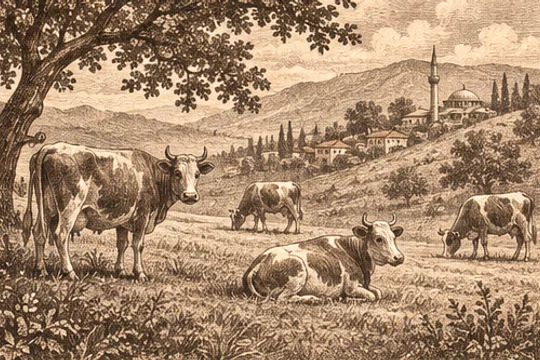
To my mind, though, the retreat’s best slogan came from Ensar Öğüt, the CHP member for Ardahan. Presenting his proposals for livestock farming, he made this very interesting observation: “Let’s raise cows that roam freely in the pastures. Let’s feed people their healthy meat so we can raise healthy generations. People who eat meat from animals high in omega-3 become intelligent. Intelligent people read and vote CHP.” Party chairman Kemal Kılıçdaroğlu joked, “I promise we’ll eat meat with omega-3 from now on.”
Just look at what a party dreaming of winning the 2015 election talked about for two days at its retreat. If European social democrats had happened to be invited to the meeting in Antalya and had heard these MPs speak, what would they have said? With less than a year to go before the election, Turkey’s largest opposition party was discussing matters that scarcely amounted to a fig seed. There was neither a single social project nor a single concrete proposal. Could the CHP win some votes from the MHP and the AKP with a good campaign? Quite possibly. But how? That is the whole question.
The conduct of CHP members on the road to Adnan Menderes’s execution, and above all the way religious sensitivities were trampled underfoot in the İnönü era, remain fresh in this nation’s memory. Even after sixty or seventy years, the Turkish people have not forgotten. Who could forget mosques being turned into stables, nightclubs, taverns and CHP provincial and district offices, or burned and demolished, or the call to prayer being changed to Turkish? Even today some people have the nerve to defend what was done in those days. There are thousands of examples of how Seljuk and Ottoman monuments, each a masterpiece, were destroyed. It is worth recalling a few.
The Katip Mustafa Çelebi Mosque, built by him in the 1590s on Çukur Çeşme Street in the Beyoğlu neighbourhood that bears his name, now operates as a tavern called İstiklâl Meyhanesi. This 350-year-old mosque was sold in 1941 for 4,010 lira during İsmet İnönü’s presidency. It had been struck from the official register in the 1930s. In the 1940s it was sold to the Zarifî family, who owned the old sewing workshop behind the mosque, and was demolished and replaced by a three-storey reinforced-concrete building. It was also used as a nightclub in 1985. In 2005 the Zarifî family made it the İstiklal tavern. Who were the Zarifîs? An old Istanbul family that lent money to the Ottoman Empire during the Russo-Turkish War of 1877–78 and helped found the Six Indirect Taxes Administration.
The Sheikh Kaygusuz İbrahim Baba Qadiri lodge on İncili Çavuş Street in Sultanahmet’s Alemdar neighbourhood is now used as a restaurant serving alcohol. The building dates from 1863. In the Qadiri lodge, Kaygusuz İbrahim Baba of Bolu was succeeded as head, in turn, by Sheikhs Süleyman Sabri, Mehmed Surûrî, al-Hajj Mustafa Şevki and Hasan Rıza. The building belonged to the Foundations Directorate, which rented it out as a restaurant serving alcohol.
In 1966, when opposition leader İnönü claimed that mosques had not been closed under him, the prominent journalist Mehmed Şevket Eygi called on readers of Yeni İstiklal to send photographs, accounts and information about mosques torn down, sold, leased or turned into warehouses and museums under the CHP. Some of the submissions appeared in the newspaper. In 2003 Eygi made the material into a book, The Destruction of Mosques in Our Recent History. The subtitle calls it “the sad story of thousands of places of worship that were closed, sold, demolished, leased, turned into warehouses, CHP branches, music halls and taverns, sports clubs or museums.” The book recounts in detail what the author calls the most painful destruction of cultural heritage in Turkish history.
On 15 November 1935 a law was passed “on the classification of mosques and prayer halls and the allowances (salaries and payments) for attendants at mosques and prayer halls left outside the classification.” Law No. 2845 said, “Mosques and prayer halls left outside the classification shall be closed so that they may be put to other uses under the applicable procedures and rules.” Hundreds of mosques were subsequently closed, sold, demolished or even used as party offices. In many parts of Anatolia, heartbroken citizens tried to buy mosques and prayer halls being used for purposes other than those for which they were built and turn them back into places of worship. The Kâbe Mescit prayer hall in Tokat was leased out in the 1940s and turned into a salt storehouse. A letter sent to Yeni İstiklal on 4 January 1967 said that thirty-three mosques and prayer halls in Tokat had been demolished and some of their sites sold.
The Cedit Mustafa Pasha Mosque in Divriği was turned into a prison. Inmates relieved themselves in jars set in front of the prayer niche.
The Mihrişah Valide prayer hall on Barutçular Street in Anadolu Hisarı was assigned to the CHP as a party branch.
In 1945 the Grand Mosque in the Cumhuriyet neighbourhood of Türkoğlu, Maraş, was closed. Animals entered through the door left open and turned it into a stable.
The same letters indicate that the Seljuk Yivli Minaret Mosque in Antalya and the Akşemseddin Mosque in Osmancık became stables, and that the İsfehan Bey Mosque, Bingöl’s only mosque was turned into a grain store and an animal stable.
An article in Cumhuriyet on 20 April 1936 read: “How heartless! A historic mosque in Seferihisar has been turned into a stable!” According to the report, the historic mosque dating from Bayezid II in the village of Hereke, in Seferihisar, İzmir, was damaged and made into a stable. The ruins included a madrasa and library as well as the mosque, and part of the material was used in construction.
The Sultan Ahmed Mosque, built by Sedefkâr Mehmed Efendi, a pupil of Sinan and chief architect to Sultan Ahmed I, has won the admiration of art historians. The colours of its tiles and mosaics earned it the name Blue Mosque. Under İsmet İnönü, between 1939 and 1945, it was used as a staging point and temporary quarters for troops assembled from Anatolia and bound for the Thracian frontier.
For six years fires were kept going inside that magnificent building, meals cooked and laundry vats boiled. Much of the splendid tilework burned, fell off or blackened.
Faced with this destruction of our history, some people who make it their duty to defend everything done in İnönü’s time had no choice but to admit what happened. “Yes, we did that to mosques, but ask us why,” they said in all unseriousness. Some writers who had spent years in the CHP and been close to İsmet İnönü defended the practice as follows: “Yes, the CHP and İsmet İnönü did use some mosques in Turkey as warehouses between 1939 and 1946. They locked their doors, posted soldiers around them and closed them to worship. During the Second World War, which was still under way between 1939 and 1946 [as written in the source], İnönü thought that mosques would not be targeted in a possible attack on Turkey. To protect historical and religious objects in our museums from damage, he had some of them placed in mosques. Yes, between 1939 and 1946 he used some mosques as warehouses, but they held objects of religious and historical value, such as the Sacred Relics, Muhammad’s standard, sword and Blessed Mantle, and Uthman’s bloodstained Quran. A true Muslim should therefore congratulate İnönü for what he did, rather than condemn him.”
There is a familiar saying in Kilis: “Bald and cocky to boot.” Could there be a more absurd defence?
What do you suppose was put in place of the Merzifonlu Kara Mustafa Pasha Mosque beside Sirkeci Station, which has since been rebuilt? You would never guess: a music hall.
The Molla Arap Mosque in Bursa was handed over to the military. They closed it to worship and used its lower section and surroundings as stables for horses. The İsfehan Bey Mosque, the only mosque in Bingöl, was made into a wheat store and an animal stable.
The Dolmabahçe Mosque in Istanbul was turned into a Naval Museum, as if there were nowhere else to put one.
It remained a museum until the military made it the Yassıada Liaison Office after the 1960 coup.
Meanwhile, on 23 July 1940 Yenigün published the prices at which various mosques in Hatay were being offered for sale. The Halebi Osmaniye Mosque was valued at 400 lira, the Kurmalı prayer hall at 120, the Kantara Mosque at 50 and the Sadık Efendi prayer hall at 100.
When American troops occupied Baghdad in 2001 [as written in the source], they lay down and rested on the floor of a mosque in their boots. Like those Americans, this country’s soldiers lived and slept inside the magnificent Sultan Ahmed Mosque for a full six years between 1939 and 1945, when one-party rule held sway, and did all sorts of things there.
While the CHP plans to gain power by raising free-roaming cows full of omega-3, feeding their meat to healthy generations and producing intelligent people who read, President Erdoğan is sending messages to East and West in quick succession. He constantly stresses the importance of Turkey and the region. Speaking in Istanbul on Sunday, he said: “Istanbul is the heart of the entire region. The sorrow of the old man in Cairo whose tears run down his beard reaches Istanbul. The cry of the child killed while playing by the sea in Palestine is heard in Istanbul. We need one thing: one nation, one state, one flag, one homeland. We are working to rebuild such a Turkey. You cannot say, ‘What do Bosnia and Herzegovina, Palestine, Egypt or Syria have to do with me?’ What happens there must always concern us. That is the duty of the new Turkey. It is the duty that comes with being a great power.”
While the CHP seeks to support Assad, the AKP government looks after millions who fled Aleppo, Hama, Homs, Damascus, Deir ez-Zor, Raqqa and Idlib in fear for their lives. It feeds them and acts as mother and father to children who have lost their parents.
Turkey sees one striking event after another, enough to keep sociologists and social psychologists around the world busy for years. The Gezi events alone, or the Kobani protests that left forty-two dead, are significant sociological cases. Even the protests over a mosque to be built near Validebağ in Üsküdar over the past week are worth studying. Those who are upset that the call to prayer interrupts their sleep but remember to say “thank God, we are Muslims,” those who never put their foreheads to the ground in prayer, and the DHKP-C, PKK, KCK, HDP and CHP crowd we might call a “coalition of unbelievers” can suddenly make common cause.
What has happened in Turkey in the past year and a half is a power struggle between those longing for the old Turkey and those devoted to the new one. In a weak, feeble, helpless Turkey, power seekers had free rein to build their own fiefdoms without moving the country a single step forward. They are now at loose ends, together with the terrorist groups that acted as their subcontractors, domestic and foreign financiers who backed them, the mainstream media figures who supplied their PR, and countless traitors. As Turkey frees itself of this dead weight, it realizes its strength, gains confidence and returns to its roots. The close attention President Erdoğan and Davutoğlu pay to the Middle East, the Balkans, Africa and the Caucasus illustrates this. For countries unsettled by Turkey’s regional power, rising standing and global influence, the only hope lies in those longing for the old Turkey.
When Turks and Kurds stand as one, a greater Turkey will be established in this region. HDP members of parliament who go to bed and wake up with Kobani on their minds profited enormously from the fear the PKK created in the region for thirty years. “We are Kurds. No one can touch us; the PKK is behind us. We’ll hang, shoot and cut people down,” they would cry as they got their way, dominated people and carved out their own fiefdom. The Peace and Brotherhood Project suddenly left HDP MPs and the mayors, councillors and local organizations at every level that act as extensions of the PKK isolated. No branch or unit wants to lose its position or standing. That is the real cause of the friction between Öcalan and Qandil. Öcalan supports the peace project, while Qandil and its affiliates do the exact opposite. The loss of standing and authority is one thing, but their financial losses must also be considered. The merchants of blood who have long profited from virtually every kind of commerce, including trafficking in arms, drugs, cigarettes, diesel and people, have no intention of giving it up. Kobani is of no importance to the PKK, and the people killed there count for nothing. The real aim is to use Kobani as a pretext to turn rising tensions into conflict and get the Turkish state to resume its war with the Kurds. Then let the money roll in and the drugs flow out.
A federal Turkish empire in the Middle East is hardly a remote possibility.
Yesterday Professor Mehmet Çelik and I visited a newly opened Syrian restaurant on Istanbul’s Millet Avenue and the Syrian sweet shop Şam-ı Şerif. Chefs from Aleppo are renowned for their skill with both savoury dishes and sweets. Both establishments are run entirely by Syrians. It is wonderful that Syrians have come to Istanbul, opened businesses and brought their flavours here. What is sad is that we could communicate with them only in English. Aleppo is only sixty kilometres from Kilis, my hometown.
Ninety years ago someone from Aleppo and someone from Kilis could readily get by in Turkish. Today they do not speak Turkish and we do not speak Arabic. Just look at what has become of two peoples who lived together for four hundred years.
Turkey should stand by former Ottoman citizens and grant a Republic of Turkey passport unconditionally to any Ottoman citizen, wherever they may be. Article 30 of the Treaty of Lausanne concerns nationality. It states: “Turkish nationals habitually resident in territories detached from Turkey under the provisions of this Treaty will become ipso facto, in the conditions laid down by the local law, nationals of the State to which such territory is transferred.” With this article, millions of our Ottoman citizens became Bulgarian, Greek, Syrian, Iraqi, Saudi or Egyptian overnight. Two wrongs do not make a right. It is long past time to put this wrong right. We should give every surviving Ottoman citizen in Bosnia, Kosovo, Albania, Greece, Hungary, Romania, Yemen, Sudan, Jordan, Palestine, Mecca, Medina, Damascus, Aleppo, Baghdad, Mosul, Basra, Tbilisi, Crimea, Ganja, Sofia, Rhodes, Mytilene, Samos, Athens, Thessaloniki, Monastir and other Ottoman cities the Turkish passport with its crescent and star, which is theirs by birthright.
That will bind us to the world more closely, rather than cut us off. It will make us stronger and wealthier, rather than impoverish us. In the near future those passports will make it possible to establish a new Turkish empire and make Turkey one of the most powerful countries in the United Nations.
About a month ago a curious story caught my eye. Metin Arslan, who had recently stepped down as CHP chairman in Savaştepe district, had painted the party’s emblem on his sheep so they would not be confused with other sheep. This was his explanation: “The CHP is Turkey’s party. Citizens from every walk of life should stand up for it. I painted my sheep this way to make them different. The CHP is a different party too. Every person, every living creature and the entire Republic of Turkey needs the CHP. The CHP must come to power now.”
Isn’t that remarkable?
Here we are talking about a new Turkey and a new Turkish empire in these four pages, while the CHP dreams of coming to power with sheep and cows.
This must be what they call vision and a worldview!!!
Translated from the Turkish original. Türkçe