
The new Turkey and the CHP’s free cows
3 November 2014 · Personal website
(Article 036 — 3 November 2014)
On 1 November 2014 the CHP leadership went on a retreat in Belek, Antalya, to discuss proposals that might bring the Republican People’s Party to power in 2015. To be honest, the party needed the freedom to have this kind of discussion. Its leaders came up with some very interesting proposals and valuable observations on how to win power!
CHP deputy chairman Sencer Ayata gave a presentation and said that votes were “in the lion’s mouth,” hard to come by. In his view, with a little effort the CHP could win the 2015 election and come to power. Ayata said, “There are no small parties left in Turkey and fewer voters switch between parties. The CHP could gain up to five percent of the vote from the MHP and ten percent from the AK Party.”
Kamer Genç, CHP member of parliament for Tunceli, said, “It is a disgrace to us and to the country that the AK Party, a party mired in bribery and corruption that has destroyed the values of the republic and Atatürk, is still in power. I believe the CHP will come to power in 2015. No one can command the people’s votes, as long as we tell them about the filth. I believe honest Turkish citizens will deliver a slap to the AK Party and Erdoğan.”
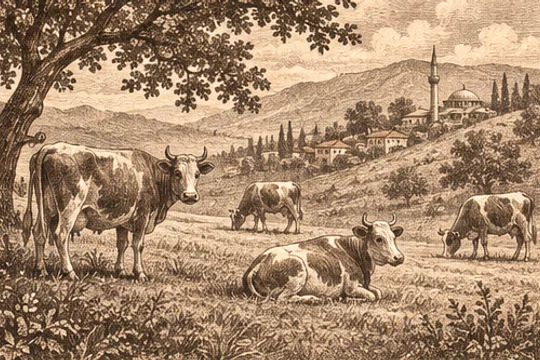
To my mind, though, the retreat’s best slogan came from Ensar Öğüt, the CHP member for Ardahan. Presenting his proposals for livestock farming, he made this very interesting and valuable observation: “Let’s raise cows that roam freely in the pastures. Let’s feed people their healthy meat so we can raise healthy generations. People who eat meat from animals high in omega-3 become intelligent. Intelligent people read and vote CHP.” Party chairman Kemal Kılıçdaroğlu joked, “I promise we’ll eat meat with omega-3 from now on.”
Just look at what a party dreaming of winning the 2015 election talked about for two days at its retreat. If European social-democratic leaders had happened to be invited to the CHP meeting in Antalya and had heard these MPs speak, what would they have thought? With less than a year to go before the election, Turkey’s largest opposition party was discussing matters that scarcely amounted to a fig seed. There was neither a single social project nor a single concrete proposal. Could the CHP win some votes from the MHP and the AK Party with a good campaign? Quite possibly. But how? That is the whole question.
The conduct of CHP members on the road to Adnan Menderes’s execution, and above all the way religious sensitivities were trampled underfoot in the İnönü era, remain fresh in this nation’s memory. Even after sixty or seventy years, the Turkish people have not forgotten. No one forgets mosques being turned into stables, nightclubs, taverns and CHP provincial and district offices, or burned and demolished, or the call to prayer being changed to Turkish. There are thousands of examples of how Seljuk and Ottoman monuments, each a masterpiece, were destroyed. It is worth recalling a few.
The Katip Mustafa Çelebi Mosque, built on his orders in the 1590s on Çukur Çeşme Street in the Beyoğlu neighbourhood that bears his name, now operates as a tavern called İstiklâl Meyhanesi. This 350-year-old mosque was sold in 1941 for 4,010 lira during İsmet İnönü’s presidency. The Zarifî family had it demolished and put up a three-storey reinforced-concrete building, which was used as a nightclub in 1985. In 2005 it became the İstiklâl tavern. Who were the Zarifîs? An old Istanbul family that lent money to the Ottoman Empire during the Russo-Turkish War of 1877–78 and helped found the Six Indirect Taxes Administration.
The Sheikh Kaygusuz İbrahim Baba Qadiri lodge on İncili Çavuş Street in Sultanahmet’s Alemdar neighbourhood shares the same fate. The lodge building dates from 1863, and the General Directorate of Foundations rented it out as a restaurant serving alcohol.
In 1966, when İnönü was opposition leader and claimed that mosques had not been closed under him, the prominent journalist Mehmed Şevket Eygi appealed in Yeni İstiklal for readers to send photographs, accounts and information about mosques that were torn down, sold, leased or turned into warehouses and museums under the CHP. In 2003 Eygi published the documents he received in a book called The Destruction of Mosques in Our Recent History. The book is an important account of the destruction of architectural works in our recent past.
A law providing for the closure of certain mosques was passed on 15 November 1935. Law No. 2845 said, “Mosques and prayer halls left outside the classification shall be closed so that they may be put to other uses under the applicable procedures and rules.” Hundreds of mosques were subsequently closed, sold, demolished or even used as party offices. The Kâbe Mescit prayer hall in Tokat was leased out in the 1940s and turned into a salt storehouse. A letter sent to Yeni İstiklal on 4 January 1967 said that thirty-three mosques and prayer halls in Tokat had been demolished and their sites sold.
The Cedit Mustafa Pasha Mosque in Divriği was turned into a prison. Inmates relieved themselves in jars set in front of the prayer niche.
The Mihrişah Valide prayer hall on Barutçular Street in Anadolu Hisarı was assigned to the CHP as a party branch.
In 1945 the Grand Mosque in the Cumhuriyet neighbourhood of Türkoğlu, Maraş, was closed. Animals entered through the door left open and turned it into a stable.
The same letters indicate that the Seljuk Yivli Minaret Mosque in Antalya and the Akşemseddin Mosque in Osmancık became stables, and that the İsfehan Bey Mosque in Bingöl was turned into a grain store and an animal stable.
An article in Cumhuriyet on 20 April 1936 read: “How heartless! A historic mosque in Seferihisar has been turned into a stable!” According to the report, the historic mosque dating from Bayezid II in the village of Hereke, in Seferihisar, İzmir, was damaged and made into a stable. The ruins included a madrasa and library as well as the mosque, and part of the material was used in construction.
The Sultan Ahmed Mosque, built by Sedefkâr Mehmed Efendi, a pupil of Sinan and chief architect to Sultan Ahmed I, has won the admiration of art historians. The colours of its tiles and mosaics earned it the name Blue Mosque. Under İsmet İnönü, between 1939 and 1945, it was used as a staging point and temporary quarters for troops assembled from Anatolia and bound for the Thracian frontier. For six years fires were kept going inside that magnificent building, meals cooked and laundry vats boiled. Much of the splendid tilework burned, fell off or blackened.
Faced with this destruction of our history, some people who make it their duty to defend everything done in İnönü’s time had no choice but to admit what happened. “Yes, we did that to mosques, but ask us why,” they said, and offered this defence: “Yes, the CHP and İsmet İnönü did use some mosques in Turkey as warehouses between 1939 and 1946. They locked their doors, posted soldiers around them and closed them to worship. During the First World War, which was still under way between 1939 and 1946 [as written in the source], İnönü thought that mosques would not be targeted in a possible attack on Turkey. To protect historical and religious objects in our museums from damage, he had some of them placed in mosques. Yes, between 1939 and 1946 he used some mosques as warehouses, but they held objects of religious and historical value, such as the Sacred Relics, Muhammad’s standard, sword and Blessed Mantle, and Uthman’s bloodstained Quran. A true Muslim should therefore congratulate İnönü for what he did, rather than condemn him.”
There is a familiar saying in Kilis: “Bald and cocky to boot.” Could there be a more absurd defence?
What do you suppose was put in place of the Merzifonlu Kara Mustafa Pasha Mosque beside Sirkeci Station, which has since been rebuilt? You would never guess: a music hall.
The Dolmabahçe Mosque in Istanbul was turned into a Naval Museum, as if there were nowhere else to put one. After the 1960 coup, the military used it as the Yassıada Liaison Office.
On 23 July 1940 Yenigün published the prices at which various mosques in Hatay were being offered for sale. The Halebi Osmaniye Mosque was valued at 400 lira, the Kurmalı prayer hall at 120, the Kantara Mosque at 50 and the Sadık Efendi prayer hall at 100.
When American troops occupied Baghdad in 2001 [as written in the source], they lay down and rested on the floor of a mosque in their boots. Like those Americans, this country’s soldiers lived and slept inside the Sultan Ahmed Mosque between 1939 and 1945.
While the CHP plans to gain power by raising free-roaming cows full of omega-3, feeding their meat to healthy generations and producing intelligent people who read, President Erdoğan is sending messages to East and West in quick succession. He constantly stresses the importance of Turkey and the region. Speaking in Istanbul on Sunday, he laid out a vision that crossed continents: “Istanbul is the heart of the entire region. The sorrow of the old man in Cairo whose tears run down his beard reaches Istanbul. The cry of the child killed while playing by the sea in Palestine is heard in Istanbul. We need one thing: one nation, one state, one flag, one homeland. We are working to rebuild such a Turkey. You cannot say, ‘What do Bosnia and Herzegovina, Palestine, Egypt or Syria have to do with me?’ What happens there must always concern us. That is the duty of the new Turkey. It is the duty that comes with being a great power.”
While the CHP seeks to support Assad, the AK Party government looks after millions who fled Aleppo, Hama, Homs, Damascus, Deir ez-Zor, Raqqa and Idlib in fear for their lives. It feeds them and acts as mother and father to children who have lost their parents.
Turkey sees one striking event after another, enough to keep sociologists and social scientists around the world busy for years. The Gezi events alone, or the Kobani protests that left forty-two dead, are significant sociological cases. Even the protests over a mosque to be built near Validebağ in Üsküdar over the past week are worth studying. Those who are upset that the call to prayer interrupts their sleep but remember to say “thank God, we are Muslims,” those who never put their foreheads to the ground in prayer, and the DHKP-C, PKK, KCK, HDP and CHP crowd we might call a “coalition of unbelievers” can suddenly make common cause in this country.
What has happened in Turkey in the past year and a half is a power struggle between those longing for the old Turkey and those devoted to the new one. In a weak, feeble, helpless Turkey, power seekers had free rein to build their own fiefdoms without moving the country a single step forward. They are now at loose ends, together with the terrorist groups that acted as their subcontractors, domestic and foreign financiers who backed them, the parallel and mainstream media figures who supplied their PR, and countless traitors. As Turkey frees itself of this dead weight, it realizes its strength, gains confidence and returns to its roots. The close attention President Erdoğan and Prime Minister Davutoğlu pay to the Middle East, the Balkans, Africa and the Caucasus illustrates this. For countries unsettled by Turkey’s regional power, rising standing and global influence, the only hope lies in those longing for the old Turkey.
When Turks and Kurds stand as one, a greater Turkey will be established in this region. Those who now go to bed and wake up with Kobani on their minds and once profited from the fear the PKK created in the region for thirty years spent years dominating people and carving out a fiefdom. “The PKK is behind us. No one can touch us. We’ll hang, shoot and cut people down,” they would cry. The Peace and Brotherhood Project suddenly exposed HDP MPs first of all, along with the mayors, councillors and local organizations at every level that act as extensions of the PKK. No branch or affiliate wants to lose its position or standing. That is the real cause of the friction between Öcalan and Qandil. Öcalan supports the peace project, while Qandil and its affiliates do the exact opposite. The loss of standing and authority is one thing, but their financial losses must also be considered. The merchants of blood who have long profited from virtually every kind of commerce, including trafficking in arms, drugs, cigarettes, diesel and people, have no intention of giving it up. Kobani is of no importance to the PKK, and the people killed there count for nothing. The real aim is to use Kobani as a pretext to turn rising tensions into conflict and set Turks and Kurds against each other again.
A federal Turkish empire in the Middle East is hardly a remote possibility. Yesterday Professor Mehmet Çelik and I visited the newly opened Syrian restaurant Salloura on Istanbul’s Millet Avenue and the Syrian sweet shop Seniora next door. Chefs from Aleppo are renowned for their skill with both savoury dishes and sweets. Both establishments employ Syrian chefs. It is wonderful that Syrians have come to Istanbul, opened businesses and brought their flavours here. What is sad is that we could communicate with them only in English. Aleppo is only sixty kilometres from Kilis, my hometown. Ninety years ago someone from Aleppo and someone from Kilis could readily get by in Turkish. Today they do not speak Turkish and we do not speak Arabic. Just look at what has become of two peoples who lived together for four hundred years. I recommend visiting both the restaurant and the sweet shop and treating yourself to a wonderful meal.
Turkey should stand by former Ottoman citizens and grant a Republic of Turkey passport unconditionally to any Ottoman citizen, wherever they may be. Article 30 of the Treaty of Lausanne concerns nationality. It states: “Turkish nationals habitually resident in territories detached from Turkey under the provisions of this Treaty will become ipso facto, in the conditions laid down by the local law, nationals of the State to which such territory is transferred.” With this article, millions of our Ottoman citizens became Bulgarian, Greek, Syrian, Iraqi, Saudi or Egyptian overnight. Two wrongs do not make a right. It is long past time to put this wrong right. We should give every surviving Ottoman citizen in Bosnia, Kosovo, Albania, Greece, Hungary, Romania, Yemen, Sudan, Jordan, Palestine, Mecca, Medina, Damascus, Aleppo, Baghdad, Mosul, Basra, Tbilisi, Crimea, Ganja, Sofia, Rhodes, Mytilene, Samos, Athens, Thessaloniki, Monastir and other Ottoman cities the Turkish passport with its crescent and star, which is theirs by birthright.
That will bind us to the world more strongly, rather than cut us off. It will make us stronger and wealthier, rather than impoverish us. In the near future those passports will make it possible to establish a new Turkish empire and make Turkey one of the most powerful countries in the United Nations.
About a month ago a curious story caught my eye. Metin Arslan, who had recently stepped down as CHP chairman in Savaştepe district, had painted the party’s emblem on his sheep so they would not be confused with other sheep. This was his explanation: “The CHP is Turkey’s party. Citizens from every walk of life should stand up for it. I painted my sheep this way to make them different. The CHP is a different party too. Every person, every living creature and the entire Republic of Turkey needs the CHP. The CHP must come to power now.”
Isn’t that remarkable? Here we are talking about a new Turkey and a new Turkish empire in these four pages, while the CHP dreams of coming to power with sheep and cows.
This must be what they call vision and a worldview!!!
Translated from the Turkish original. Türkçe